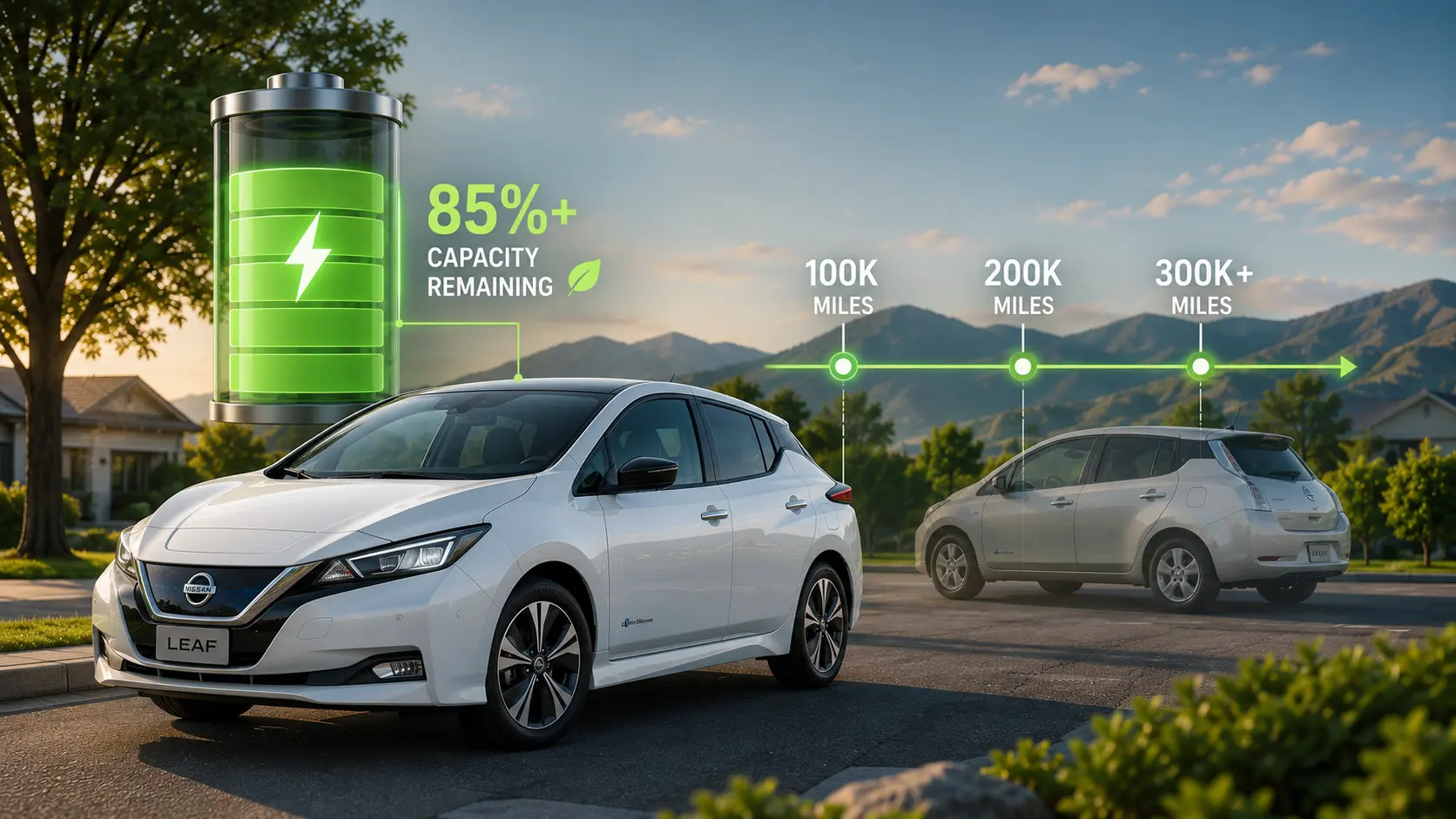
Quick Answer: Yes, for most modern EVs the battery is expected to outlast the car itself. Recurrent’s analysis of over 30,000 EVs found that less than 4% have ever needed a battery replacement, including cars over 10 years old. And for EVs built from 2022 onwards, that number drops to just 0.3%. The battery dying before the car is becoming a genuine rarity, not the norm.
If you spend any time in EV owner forums or Reddit threads, you will find the same fear showing up again and again.
This plays out in real threads regularly. In January 2026, a 2013 Tesla Model S owner posted their battery replacement quote on Reddit. The 60 kWh replacement came in at $13,830. The 90 kWh upgrade pushed past $23,000. The car itself was worth $10,000 to $15,000 on the used market. The quote cost more than the car. The comments erupted. Carscoops, who covered the thread, put it simply: “Battery replacement isn’t just expensive, it can easily eclipse the value of the car itself.”
It is one of the most repeated fears in the EV world. And in 2026, the data says it is one of the least justified.
This post brings together the best available evidence on how long EV batteries actually last, how often they actually get replaced, and where replacement costs are heading. The answers are more reassuring than most people expect.
The Fear vs The Reality: What Real Data Shows
Let’s start with the most important number.
Recurrent’s research found that outside of recalls like the ones for manufacturing defects in the Chevrolet Bolt and Hyundai Kona EV, less than 4% of EV batteries have ever been replaced. That number includes first-generation EVs that are more than ten years old.
Break that down by generation and the picture gets even clearer:
- First-generation EVs, the oldest ones on the road, have seen a replacement rate of 8.5%
- Second-generation EVs, including the original Chevrolet Bolt and Tesla Model 3, have seen a 2% replacement rate
- The newest EVs built from 2022 have a battery replacement rate of just 0.3%
In simple terms: if you buy a modern EV today, there is roughly a 99.7% chance you will never need to replace the battery at all. Recurrent’s own conclusion was blunt: modern EV batteries “should outlast the cars themselves.”
How Long Do EV Batteries Actually Last
The honest answer is that nobody knows exactly, because most modern EVs simply have not been on the road long enough to reach end of battery life yet. But the data we do have points strongly in one direction.
Most modern electric car batteries are expected to last about 15 to 20 years in typical use, with gradual range loss over time rather than sudden failure.
A major study published in Nature Energy analyzed over 300 million records from UK roadworthiness tests across 17 years. The study showed that EVs have an average lifespan of 18.4 years, compared to 18.7 years for petrol cars and 16.8 years for diesel.
Think about that for a moment. EVs are almost exactly matching petrol cars for total lifespan, and already outlasting diesel. And this data includes early-generation EVs with far less advanced batteries than what is being sold today.
Geotab’s 2026 analysis of 22,700 EVs confirms that modern EV batteries are robust and built to last beyond a typical vehicle’s service life.
But What About Battery Degradation
There is a difference between a battery dying suddenly and a battery slowly losing range over years. The second one is what most EV owners will actually experience, and it is much less dramatic than people fear.
Geotab’s 2026 study found an average degradation rate of 2.3% per year across 22,700 real vehicles. This works out to 81.6% capacity remaining at the eight-year mark.
That is still well above the 70% threshold most manufacturers cover under warranty. And it means the range loss is gradual and manageable, not a cliff edge.
One thing worth understanding: Geotab’s degradation figure increased from 1.8% per year in their 2023 study to 2.3% in 2026, not because batteries got worse, but because the newer dataset includes more vehicles and the newer fleet fast-charges harder. The batteries themselves did not get worse. Charging habits changed.
That matters because it means your charging habits have a real impact. Owners who rely heavily on fast charging will see faster degradation. Owners who mostly charge at home will stay closer to the 1.5% per year range. You have more control over this number than most people realise.
Want to understand how charging habits affect long-term battery health in detail? Our full guide on how charging habits affect your EV battery over time covers this with specific numbers.
The One Scenario Where Replacement Makes Sense
For the vast majority of EV owners, battery replacement will never come up. But it is worth being clear about when it does.
The most common real-world scenario is older first-generation EVs, particularly pre-2016 models with less advanced thermal management, that have seen heavy use in hot climates. These cars sometimes reach a point where the battery’s remaining capacity no longer makes practical sense for the owner to keep.
The second scenario is accident damage. Even a minor collision can damage a battery pack, and in some cases insurers will total the car rather than cover a full replacement. This is less about battery aging and more about how EV battery packs are physically integrated into the vehicle structure.
For a 2022 or newer EV driven in normal conditions with sensible charging habits, neither of these scenarios is likely to apply.
If you do need to understand what replacement would cost for your specific model, here are the guides for the most common models people ask about:
- Tesla Model S battery replacement cost
- Tesla Model Y battery replacement cost
- Tesla Model X battery replacement cost
- Chevy Bolt EV battery replacement cost
- Nissan Leaf battery replacement cost
The Replacement Cost Story Is Changing Fast
Even if you are in the small group that does need a replacement, the cost picture is changing dramatically and fast.
Current out-of-warranty replacement costs range from roughly $5,000 to $20,000 depending on the pack size and model. That is a wide range and the top end is genuinely expensive. But here is what most people do not know: battery pack costs have fallen 72% since 2012, from $400 per kWh to $111 per kWh by end of 2024.
Goldman Sachs projects that by 2030 pack prices could reach $50 per kWh or lower. At that price, a 100 kWh replacement pack would cost $4,500 to $5,000, and a more standard 75 kWh pack around $3,375. That is on par with a major engine replacement in a gas car.
By 2030, pack replacements could cost between $3,000 – $5,000, which is about the same as or less than the cost of an engine replacement.
So the financial nightmare scenario that people fear is becoming less true every single year. The longer you own your EV, the cheaper any hypothetical replacement becomes.
What Happens to the Battery After the Car
There is one more part of this story that rarely gets told: even when an EV battery is no longer ideal for driving, it is far from useless.
Batteries that have dropped below 70% to 75% capacity still hold substantial energy and work well for stationary storage applications like home solar systems or grid backup. This second life use case is growing fast.
The global second-life EV battery market was valued at $990 million in 2025 and is projected to grow to over $20 billion by 2033. Major manufacturers including BMW, GM, and Toyota are actively developing programmes to repurpose retired EV batteries rather than scrapping them.
This means when your EV battery eventually does reach the end of its driving life, it still has real value, either as a second-life energy storage unit or as a source of recoverable raw materials for new battery production.
If you are curious about this angle, our guide on how used EV batteries are being repurposed for solar storage covers the second-life market in detail.
The Bottom Line
The fear of an EV battery dying before the car is one of the most persistent myths in the EV world. Real data in 2026 tells a different story.
Battery replacement rates for modern EVs are below 1%. Expected lifespans are 15 to 20 years. And for the rare cases where replacement is needed, costs are falling fast toward the same level as major gas engine repairs.
The financial time bomb that people fear in online forums is increasingly a relic of first-generation EV ownership, not a fair description of what most owners buying today can expect.
If you are looking after your battery with sensible charging habits and moderate fast-charging use, the data says you are very unlikely to ever need a replacement. And if you do need one, it will cost significantly less than it would have even three years ago.
Frequently Asked Questions
Q. Will my EV battery outlast the car?
A. For modern EVs built after 2022, the data strongly suggests yes. Recurrent’s analysis of over 30,000 EVs found a battery replacement rate of just 0.3% for cars built from 2022 onwards. The battery dying before the car is increasingly rare, not common.
Q. How long do EV batteries actually last in real life?
A. Real-world data points to 15 to 20 years for most modern EV batteries in typical use. A Nature Energy study analyzing over 29 million vehicle records found EVs have an average road lifespan of 18.4 years, nearly identical to petrol cars at 18.7 years.
Q. What percentage of EVs ever need a battery replacement?
A. Outside of manufacturer recalls, less than 4% of all EVs have ever needed a battery replacement, including first-generation models over 10 years old. For newer EVs from 2022 onwards, that figure is 0.3%.
Q. How much will EV battery replacement cost in the future?
A. Costs are falling fast. Goldman Sachs projects replacement pack costs could reach $50 per kWh or lower by 2030. At that rate, a 75 kWh replacement pack would cost around $3,375, which is comparable to a major gas engine repair.
Q. What happens to an EV battery when it wears out?
A. Most retired EV batteries still hold 70% to 80% of their original capacity and are valuable for second-life applications like home solar storage. The global second-life battery market is projected to reach over $20 billion by 2033. Very few end up in landfill.
Q. Does the 8-year battery warranty mean my battery will fail after 8 years?
A. No. The warranty guarantees minimum performance for at least 8 years. It does not mean the battery will fail at that point. Real-world data shows most batteries continuing well beyond the warranty period with gradual, manageable range loss.

Jamie Carter is an EV enthusiast and independent researcher who has been following electric vehicle technology since 2019. After buying her first EV and spending years digging through manufacturer data, owner forums, and industry reports to answer her own questions, she started sharing what she learned. At EV Battery Central, Jamie writes research-backed guides on battery health, charging habits, and EV ownership & more.