
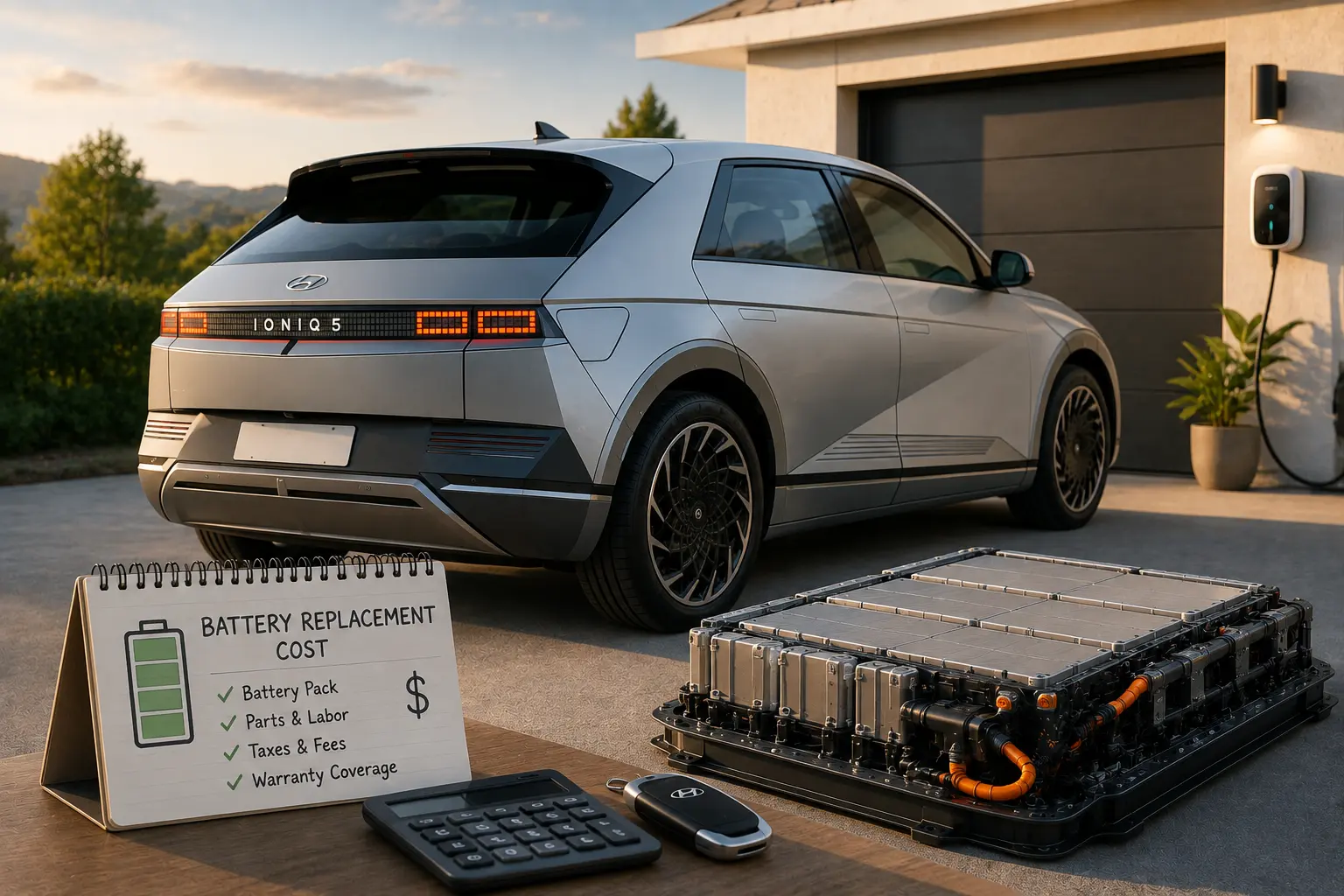
If you own a Hyundai IONIQ 5, the battery replacement question will cross your mind eventually. Maybe you saw a horror story in a forum. Maybe you are buying a used one and want to know the worst-case scenario. Maybe your warranty is running out and you want to know where you stand.
The honest answer: most IONIQ 5 owners will never pay for a battery replacement out of pocket. Hyundai’s 10-year battery warranty is one of the strongest in the industry and most early failures are still handled under coverage. But if you are outside warranty or dealing with a complex situation, the numbers can be significant.
This guide gives you the real cost ranges, the warranty details most owners miss, the important recall you need to know about, and an honest answer to the question IONIQ 5 owners eventually ask: is replacing the battery actually worth it?
IONIQ 5 Battery Sizes: Which One Do You Have?
Before looking at costs, you need to know which battery pack your IONIQ 5 has because the price difference is meaningful.
| Model Year | Battery Size | Original EPA Range |
| 2022–2024 Standard Range | 58 kWh | 220–266 miles |
| 2022–2024 Long Range | 77.4 kWh | 266–310 miles |
| 2025 Long Range | ~84 kWh | 318 miles |
| IONIQ 5 N | 84 kWh | 221 miles (performance-tuned) |
How to check yours: Look at your window sticker, owner’s manual, or the Hyundai app under vehicle information. You can also check the trim badge. Standard Range variants use the 58 kWh pack. Long Range variants, including AWD configurations, use the 77.4 kWh or 84 kWh packs.
Hyundai IONIQ 5 Battery Replacement Cost by Pack Size (2025–2026)
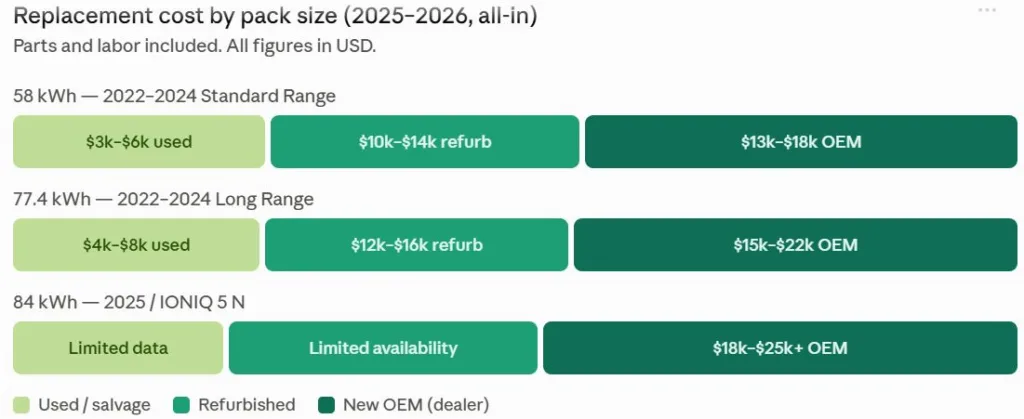
Here are the real-world price ranges owners and specialists are seeing in 2025–2026, based on dealer quotes, independent EV shop data, and published industry sources. These are all-in figures including parts and labor.
| Pack Size | New/OEM (Dealer) |
Re-manufactured (Specialist) |
Module Level Repair |
| 58 kWh (Standard Range) |
$13–18k | $10–14k | $3–8k |
| 77.4 kWh (Long Range) |
$15-22k | $12-16k | $4–10k |
| 84 kWh (2025/N) |
$18-25k+ | Limited availability |
Limited availability |
Sources: FindMyElectric, Electric Car Battery Replacement Cost Explained, June 2026; Recurrent Auto, Hyundai IONIQ 5 Battery Health Data 2025–2026
A note on the high quotes you may have seen online: Social media horror stories about $25,000 to $30,000 IONIQ 5 battery bills are almost always tied to accident damage, insurance negotiations, or dealer markups on collision-related work, not a normal owner walking in with a degraded pack. The figures in the table above reflect standard out-of-warranty replacement, not insurance or accident cases.
Labor costs: Removing and replacing the IONIQ 5’s high-voltage pack typically adds $750 to $2,000 to the bill. The job requires EV-certified technicians and specialist equipment. This is not a DIY repair.
What Drives the Price Difference?
Three factors move the needle most on the final cost.
1. New OEM vs remanufactured vs module-level repair
A brand-new OEM pack from a Hyundai dealer costs the most but offers the most predictable outcome. Remanufactured packs from specialist EV shops can save $3,000 to $6,000, and many come with 2 to 3 year warranties from the installer.
The IONIQ 5 is also designed with serviceable battery modules, which means not every battery issue requires a full pack replacement. A failed module, a faulty contactor, or a battery management component may be repairable at significantly lower cost. Always ask for a full diagnostic report showing exactly what failed before agreeing to any quote. The repair versus replacement question matters enormously on this car.
2. Who does the work
Independent EV specialists consistently undercut dealer pricing by thousands. Get at least three quotes: your Hyundai dealer, an independent EV specialist familiar with the E-GMP platform, and if possible a Kia or Genesis-certified shop since all three brands share the same architecture and battery system. Always ask what warranty the installer puts on the replacement pack itself.
3. The 58 kWh vs 77.4 kWh difference
Standard Range and Long Range packs are priced differently. If you have a Standard Range IONIQ 5, your worst-case replacement cost is meaningfully lower than a Long Range owner’s. Know your pack size before getting any quote.
The IONIQ 5 Battery Warranty: What It Actually Covers
This is where most IONIQ 5 owners discover details they did not know when they bought the car.
Coverage period: 10 years or 100,000 miles, whichever comes first. This is one of the strongest EV battery warranties available in the US market.
In California and California-emissions states: Coverage extends to 10 years or 150,000 miles.
What is covered:
- Defects in materials or workmanship
- Excessive capacity loss if the battery drops below approximately 70% of original capacity within the warranty period
What the warranty does NOT cover:
- Normal gradual capacity loss that stays above the threshold
- Damage from accidents, flooding, or misuse
- Modifications to the battery system
- Commercial or fleet use beyond standard terms
Important detail: The warranty clock starts from the original in-service date when the car was first sold or leased, not the model year. If you bought your IONIQ 5 used, verify the original sale date directly using your VIN, not just the model year, to know exactly where you stand.
For second owners: Hyundai’s battery warranty generally transfers to subsequent owners. However, the exact transfer terms can vary by model year and state. Always verify your specific coverage by calling Hyundai with your VIN before assuming you are fully covered.
The IONIQ 5’s Biggest Battery Advantage: 800V Architecture and Active Thermal Management
Unlike the Nissan Leaf’s passive air-cooled system which contributed to faster degradation in older models, the IONIQ 5 uses an active liquid-cooled thermal management system on its E-GMP platform.
This is one of the most important things to understand about the IONIQ 5 battery long-term. Active liquid cooling keeps the battery within its optimal temperature range during both charging and driving. In hot climates, on road trips with back-to-back fast charging, and in cold weather conditions, the cooling system protects the cells in ways that passive air cooling simply cannot.
The E-GMP platform also supports 800-volt ultra-fast charging, which means the IONIQ 5 can charge from 10% to 80% in under 18 minutes at a compatible 350 kW charger. The same 800V architecture also reduces heat generated during fast charging compared to 400V systems, which is better for long-term battery health.
Real-world data from Recurrent tracking over 1 billion miles of driving from their owner community shows the IONIQ 5 battery holding up well across high-mileage use, with some examples exceeding 300,000 miles before needing a warranty battery swap.
The ICCU Recall: What Every IONIQ 5 Owner Needs to Know
This is the most important recall affecting the IONIQ 5 battery system and many owners are not aware of it.
NHTSA issued a recall covering 2022 to 2024 IONIQ 5 models (and 2023 to 2025 IONIQ 6 models) for a defect in the Integrated Charging Control Unit, known as the ICCU. Under certain electrical loads, an internal transistor inside the ICCU can fail. When it fails, it can damage the 12-volt battery system, which in turn can cause the car to lose power assist and potentially stall.
Why this matters for battery owners specifically:
The ICCU failure does not damage the main high-voltage traction battery, but it can disable charging and trigger what looks like a battery problem. Owners who experienced sudden loss of charging capability on early IONIQ 5 and IONIQ 6 models may have actually had an ICCU issue rather than a main battery fault.
What to do: Check nhtsa.gov/recalls with your VIN to see if your vehicle has any open recalls including the ICCU campaign. If your car is affected and the repair has not been completed, take it to a Hyundai dealer for the free remedy before paying for any battery diagnostics.
Signs Your IONIQ 5 Battery May Need Attention
Watch for these warning signs regardless of mileage:
- Range consistently and significantly lower than when the car was new, not just cold weather reduction, but persistent shorter trips on a full charge
- Charging speed noticeably slower than the car’s rated capability at a compatible fast charger with a warm battery
- Any battery-related warning light or error code on the dashboard
- Charging stopping unexpectedly before reaching the set limit, repeatedly
- Range estimates that swing wildly between similar trips
- The car entering reduced power mode without an obvious explanation
Any of these warrant a battery health check first. Ask the service center for a full diagnostic report showing exactly what failed before agreeing to any repair. If you are seeing these symptoms and are still within warranty, do not pay for anything. File a warranty claim first.
Is Replacing the IONIQ 5 Battery Worth It?
This depends entirely on the car’s current market value compared to the replacement cost.
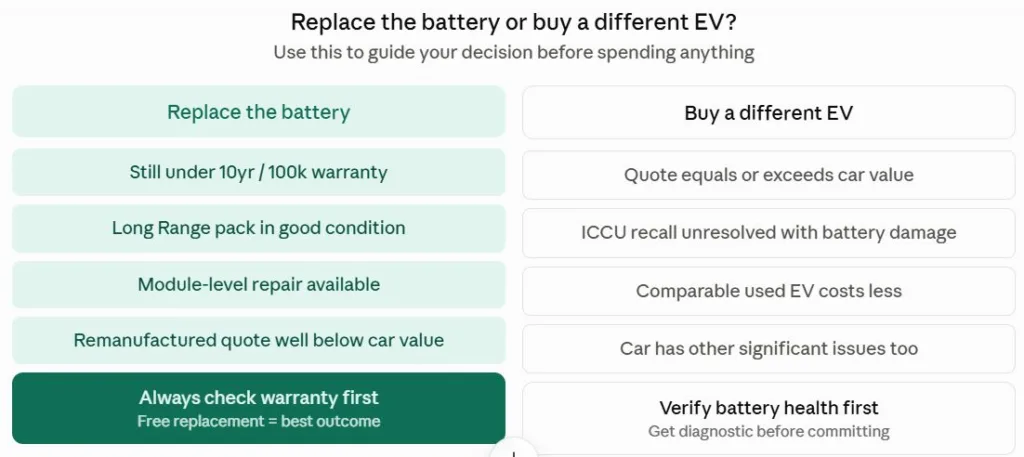
When replacement makes sense:
- You are within the 10-year/100,000-mile warranty and replacement is free or covered
- You have a 2024 or 2025 Long Range IONIQ 5 in otherwise excellent condition and the replacement cost is meaningfully less than buying a comparable used EV
- The fault is module-level and repairable at a fraction of full pack cost
When it probably does not make sense:
- The all-in replacement quote equals or exceeds the car’s current market value
- You have a 2022 Standard Range IONIQ 5 with high mileage where a comparable replacement vehicle with a healthy battery is available for similar money
- A comparable used EV with verified, strong battery health is available for less than the repair total
Real-world context from Recharged and FindMyElectric data: A 2022 IONIQ 5 Long Range that has depreciated to $16,000 to $20,000 in the private market facing a $14,500 OEM dealer replacement quote is at the edge of financial viability. In that situation, a remanufactured pack at $12,000 from a reputable specialist, with a 2 to 3 year warranty on the replacement, becomes a much more viable calculation. The same car at $25,000 in value makes a full OEM replacement straightforwardly worth it.
The rule of thumb: Always compare the replacement quote against the cost of stepping into a different used EV with a verified, healthy battery before signing a repair order. Our EV battery replacement cost calculator can help you run these numbers for your specific situation.
Ways to Reduce IONIQ 5 Battery Replacement Cost
If you are outside warranty and need to replace or repair, here is how to keep costs down:
- Get at least 3 quotes: your Hyundai dealer, an independent EV specialist familiar with the E-GMP platform, and a Kia-certified shop if one is available nearby. The same battery architecture means Kia-trained specialists can work on IONIQ 5 packs competently.
- Always ask for a diagnostic first, not just a quote. The IONIQ 5’s modular battery design means a full replacement is not always the only path. A diagnostic that identifies a specific failed module can save thousands.
- Consider a remanufactured pack from a reputable specialist. Many offer 2 to 3 year warranties on remanufactured packs which is often comparable to or better than dealer warranty on the replacement.
- Check your VIN for the ICCU recall. If that is unresolved, it must be handled free of charge by a Hyundai dealer. Do this before any paid battery work.
- Verify your warranty status by original in-service date. Many owners discover they have more coverage than they assumed. Call Hyundai with your VIN before assuming you are out of coverage.
For daily charging habits that slow degradation and protect your battery long term, read our guide on how charging habits affect EV battery life over time.
Quick Reference: IONIQ 5 Battery Costs at a Glance
| Situation | Estimated Cost |
| Under warranty replacement | Free (if below 70% capacity threshold) |
| 58 kWh replacement, remanufactured | $10,000–$14,000 installed |
| 58 kWh replacement, OEM dealer | $13,000–$18,000 installed |
| 77.4 kWh replacement, remanufactured | $12,000–$16,000 installed |
| 77.4 kWh replacement, OEM dealer | $15,000–$22,000 installed |
| Module-level repair (if applicable) | $3,000–$10,000 depending on scope |
| Labor only | $750–$2,000 |
| ICCU recall repair | Free at Hyundai dealer |
Final Thoughts
The Hyundai IONIQ 5 battery replacement question is really two separate questions. First, are you within the 10-year warranty? If yes, you should not be paying for anything. Check your VIN, verify the original in-service date, and file a warranty claim if your battery has dropped below 70% capacity.
Second, if you are outside warranty, does replacement make financial sense given the car’s current value? On newer, higher-value IONIQ 5 models the math often works. On older, higher-mileage examples approaching the bottom of their depreciation curve, a comparable used EV with a healthy battery may be the better move.
Either way, always get a proper diagnostic before agreeing to any quote. The IONIQ 5’s modular battery design means full pack replacement is not always the only option, and knowing exactly what failed is the most valuable information you can have before spending anything.
Frequently Asked Questions
Q. How much does it cost to replace a Hyundai IONIQ 5 battery?
A. In 2025–2026, the all-in out-of-warranty cost ranges from around $10,000 for a remanufactured 58 kWh pack at an independent specialist, up to $22,000 or more for a new OEM 77.4 kWh pack installed at a Hyundai dealer. Module-level repair, where applicable, can come in significantly lower at $3,000 to $10,000.
Q. Does Hyundai cover battery replacement under warranty?
A. Yes. The IONIQ 5 high-voltage battery is covered for 10 years or 100,000 miles in the US, and 10 years or 150,000 miles in California and California-emissions states. If your battery drops below approximately 70% of original capacity within that period, Hyundai is required to repair or replace it at no cost to you.
Q. What is the ICCU recall and does it affect the main battery?
A. The ICCU recall covers 2022 to 2024 IONIQ 5 models for a defect in the Integrated Charging Control Unit. The ICCU failure does not damage the main high-voltage traction battery but can disable charging and trigger warning lights that look like battery problems. Check nhtsa.gov/recalls with your VIN and get the remedy completed free at a Hyundai dealer before any paid battery diagnostics.
Q. How long does a Hyundai IONIQ 5 battery last?
A. Based on Recurrent’s real-world fleet data, IONIQ 5 batteries are holding up well in high-mileage use. The E-GMP platform’s active liquid cooling and 800V architecture are significant advantages for long-term durability. Some early examples have exceeded 300,000 miles before needing a warranty battery swap. Under normal use, a realistic lifespan is 15 to 20 years or more.
Q. Does the IONIQ 5 battery warranty transfer to a second owner?
A. Generally yes. Hyundai’s battery warranty typically transfers with the vehicle to subsequent owners. However, exact transfer terms can vary by model year and state. Always verify your specific coverage by calling Hyundai with your VIN before assuming full coverage as a second owner.
Q. Is it worth replacing a Hyundai IONIQ 5 battery?
A. It depends on the replacement cost versus the car’s current value. If you are under warranty, a replacement is free and absolutely worth pursuing. If out of warranty, compare the replacement quote against the cost of a comparable used EV with a healthy battery before committing. For higher-value 2024 and 2025 IONIQ 5 models, replacement often makes financial sense. For older, more depreciated examples, the math is tighter.

Jamie Carter is an EV enthusiast and independent researcher who has been following electric vehicle technology since 2019. After buying her first EV and spending years digging through manufacturer data, owner forums, and industry reports to answer her own questions, she started sharing what she learned. At EV Battery Central, Jamie writes research-backed guides on battery health, charging habits, and EV ownership & more.