Quick Answer: In most cases, targeted repair or module replacement is significantly cheaper than a full battery replacement. A full replacement typically costs $7,000 to $25,000 depending on the model. A module-level repair can often come in at $1,500 to $6,000 for the same issue. The right answer depends on what is actually wrong, your car’s age, and whether you are inside or outside warranty.
If your EV battery is giving you trouble, the first question most owners ask is how much is a new battery going to cost me?
That is actually the wrong first question.
Before jumping to full replacement, it is worth understanding what repair options exist, how much cheaper they can be, and when replacement genuinely makes more sense than repair. The difference can be thousands of dollars.
EV Battery Replacement vs Repair: What Is Actually Being Compared
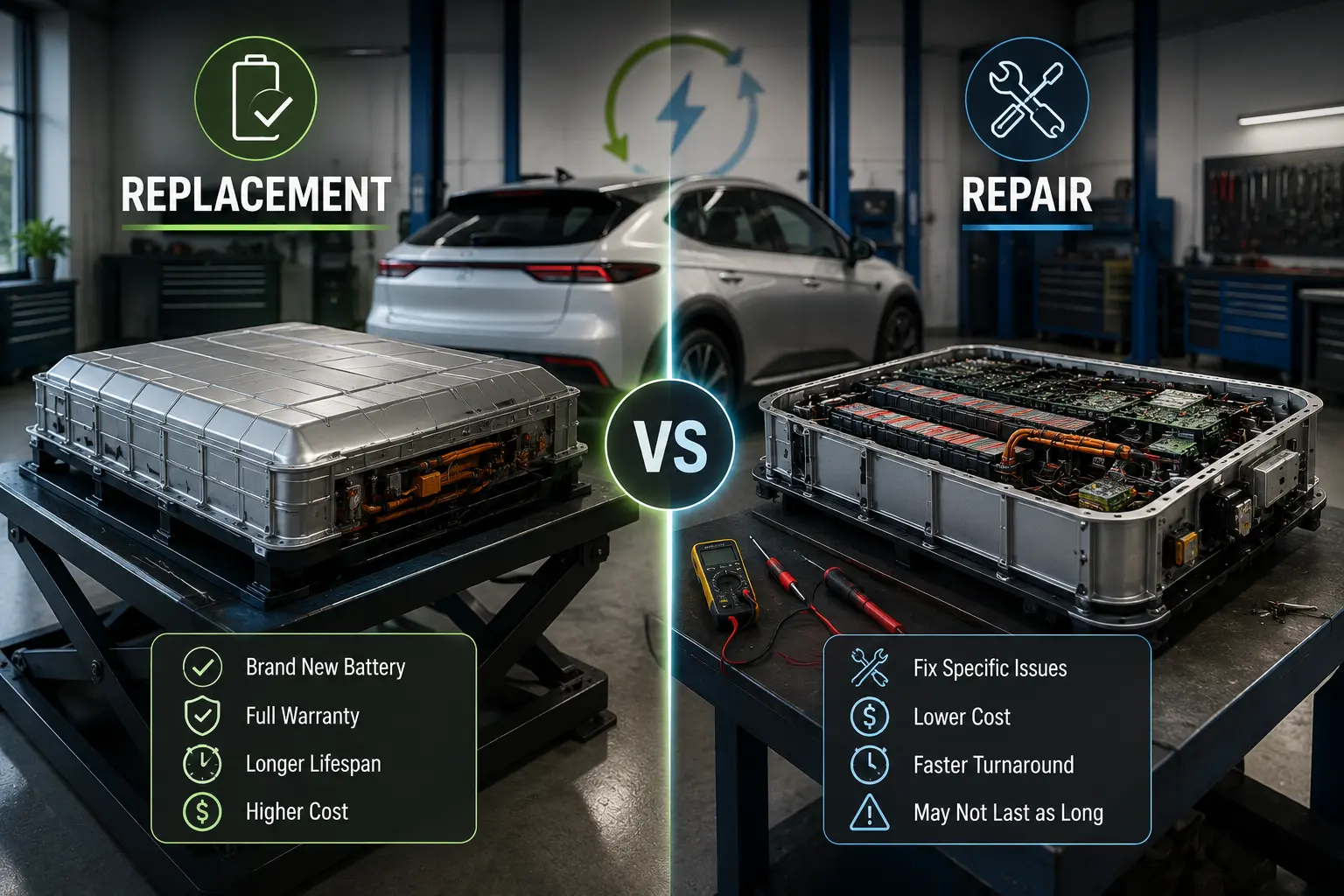
A full battery replacement means swapping out the entire high-voltage pack for a new, re-manufactured, or used unit. This is the most expensive option and the one that gets quoted in the horror stories.
A battery repair means fixing or replacing a specific part of the battery system without replacing the whole pack. This can mean replacing individual battery modules, fixing the battery management system, replacing a thermal management component, or addressing a connector or sensor fault.
The key thing most EV owners do not know is that many battery faults do not require a full pack replacement at all. The issue may be one failing module out of many, a software fault, or a component outside the cells themselves entirely.
Getting a proper diagnostic before agreeing to any quote is the single most important step in this whole process.
What Does Full EV Battery Replacement Cost in 2026
As of 2026, most full EV battery replacements cost somewhere between $7,000 and $25,000 out of warranty, according to FindMyElectric’s 2026 battery replacement cost guide. The exact number depends heavily on the vehicle model, pack size, and whether you use an OEM dealer, certified independent shop, or remanufactured pack supplier.
BloombergNEF reported that average lithium-ion battery pack prices fell to $108 per kWh in 2025, with battery electric vehicle packs averaging below $100 per kWh for the second year in a row. That cost reduction is starting to flow through to replacement pricing, but labour, diagnostics, and installation still add significantly to the total.
Here is a realistic range by popular model based on current data:
- Tesla Model 3: $13,000 to $16,000 at a Tesla service centre
- Nissan Leaf (24 kWh): $4,000 to $6,500 through specialist independent shops using genuine used packs, according to Recurrent’s replacement cost data from specialist shop Leo and Sons
- Chevy Bolt: $13,000 to $16,000 for a full OEM pack
- Hyundai Kona Electric: $6,000 to $7,000
These are out-of-warranty costs. If you are within your 8-year or 100,000-mile warranty and your battery has dropped below 70% capacity, your manufacturer is required to replace it at no cost to you.
How Much Does EV Battery Repair or Module Replacement Actually Cost
This is where the real savings are for many owners.
Not every EV battery is designed to allow module-level repair. But for those that do, the cost difference is significant.
Recurrent’s research on EV battery repair costs found that specialist EV repair shops like Greentec Auto offer refurbished packs at $167 to $242 per kWh depending on state of health. On a 40 kWh pack that translates to roughly $6,700 to $9,700, compared to $13,000 or more for a new OEM replacement.
For module-level repairs on vehicles where the pack design allows it, costs can come in at the mid-four-figure to low-five-figure range depending on how many modules are affected. FindMyElectric’s guide specifically notes that the Ford F-150 Lightning battery was designed with module-level service in mind, meaning a failed section may not require replacing the entire pack.
Common battery-related faults that are often repairable rather than requiring full replacement include:
- Battery Management System failures (software or hardware)
- Individual cell group or module failure within a larger pack
- Thermal management component failures (coolant pumps, temperature sensors)
- Connector, sensor, or wiring faults within the battery system
- 12-volt auxiliary battery failure (this is simply a battery replacement costing $100 to $300)
When EV Battery Repair Is Cheaper Than Full Replacement: The Real Numbers
Recurrent’s analysis found that in 2020, battery replacement costs represented roughly 100% of the value of a $15,000 used EV. By 2025, that figure had dropped to around 75%. By 2030, they project it will fall to just 30% of the value of a $15,000 used vehicle.
That trend matters for the repair vs replace decision. The older your EV, the more likely a full replacement costs more than the car is worth. The newer your car, the more a full replacement may still make financial sense if the alternative is losing significant resale value.
A simple rule of thumb: if the repair cost is less than the difference in resale value between a healthy-battery car and your current car, repair usually wins. If the car itself is worth less than the repair cost, it becomes a much harder call.
When Full EV Battery Replacement Makes More Financial Sense Than Repair
There are situations where repair is not the right answer and replacement is genuinely the better choice.
- When multiple modules have failed: If a significant proportion of the battery modules are degraded rather than just one or two, repairing individual modules becomes more expensive than a full replacement.
- When the car is still relatively new and high-value: A 2022 EV worth $35,000 with a failed battery pack makes full replacement financially viable in a way that a 2014 EV worth $8,000 does not.
- When you are under warranty: This is not really a choice. If the battery has dropped below 70% capacity before the 8-year or 100,000-mile mark, your manufacturer replaces it. No cost to you.
- When repair options are limited for your model: Some EV battery packs are designed as sealed integrated units with no module-level serviceability. For these cars, repair is simply not an option and replacement is the only path.
How to Decide Between EV Battery Repair and Replacement: 5 Steps Before You Spend Anything
The process before making any decision should follow these steps:
- Get a full diagnostic from a certified EV technician, not just a quote for replacement. You need to know what is actually wrong before you can compare options.
- Ask specifically whether the fault is repairable at module level or requires a full pack replacement.
- Get at least two quotes: one from your manufacturer or dealer, and one from a certified independent EV specialist. Independent shops often charge significantly less for the same work.
- Check your warranty status first. If you are within the 8-year window and your battery is below 70% capacity, call your manufacturer before spending a penny on diagnostics.
- Compare the total repair or replacement cost against your car’s current market value and its value with a healthy battery. This tells you whether it makes financial sense at all.
One thing most guides miss: always ask the technician to show you the diagnostic report, not just the quote. A quote tells you what they want to replace. A diagnostic report tells you what has actually failed. Those two things are not always the same, and the difference can be thousands of dollars.
Our existing model-specific guides cover current replacement cost data if you want numbers for your specific car:
- Tesla Model S battery replacement cost
- Tesla Model Y battery replacement cost
- Chevy Bolt battery replacement cost
- Nissan Leaf battery replacement cost
The Bottom Line: Should You Repair or Replace Your EV Battery in 2026
Full battery replacement is the most expensive option and often not the only option. A proper diagnostic before agreeing to any quote is the most important step you can take.
Battery repair, module replacement, and remanufactured packs are all real alternatives that can save thousands of dollars compared to a full OEM replacement. The right answer depends entirely on what has actually failed, your car’s age and value, and whether you are still inside your warranty window.
Battery costs are also falling fast. By 2030, Recurrent projects replacement costs will represent just 30% of the value of a $15,000 used EV, compared to 100% in 2020. If you are making this decision today on an older car, waiting even a year or two could change the financial math meaningfully.
Frequently Asked Questions: EV Battery Repair vs Full Replacement
Q. Is EV battery repair always cheaper than replacement?
A. Usually yes, if repair is possible for your model. Module-level repairs and remanufactured pack options are significantly cheaper than full OEM replacement. But not all EV packs are designed to allow module repair, so it depends on your specific vehicle.
Q. How do I know if my EV battery needs repair or full replacement?
A. You need a diagnostic from a certified EV technician first. Do not accept a replacement quote without understanding exactly what has failed. Many faults that present as battery failure are actually repairable components within the battery system.
Q. Can a third-party shop repair my EV battery?
A. Yes. Certified independent EV specialists can often repair or replace battery packs at significantly lower cost than manufacturer dealerships. Look for shops with specific EV battery experience and ask whether they use OEM, remanufactured, or used packs.
Q. Will EV battery repair affect my warranty?
A. Repairs done outside of the manufacturer warranty by non-authorised shops can affect remaining warranty coverage in some cases. If you are still within your warranty period, always go to the manufacturer first.
Q. Are refurbished EV battery packs reliable?
A. Quality varies significantly. Reputable specialist suppliers like Greentec Auto test their packs and offer their own warranties. Cheaper unverified packs carry more risk. Always ask for the state of health reading on any refurbished pack before agreeing to purchase.

Jamie Carter is an EV enthusiast and independent researcher who has been following electric vehicle technology since 2019. After buying her first EV and spending years digging through manufacturer data, owner forums, and industry reports to answer her own questions, she started sharing what she learned. At EV Battery Central, Jamie writes research-backed guides on battery health, charging habits, and EV ownership & more.