Quick Answer: Sodium-ion batteries are no longer a future technology. The world’s first mass-production sodium-ion passenger EV, the Changan Nevo A06, launched in China in mid-2026 using CATL’s Naxtra battery. Sodium-ion is not replacing lithium-ion. It is doing different jobs better: cheaper city EVs, cold-weather driving, and fleet vehicles. If you own a lithium-ion EV today, nothing about this changes how you should use or maintain it. But if you are buying in the next few years, this is worth understanding.
For the last decade, every EV battery conversation started and ended with lithium-ion. NMC, NCA, LFP, different flavours, same underlying chemistry. Sodium-ion was the thing that was always coming but never quite arriving.
In 2026, it arrived.
CATL’s Naxtra sodium-ion battery entered mass production in 2026, and the first mass-production passenger EV using it, the Changan Nevo A06, was unveiled in February 2026. Real cars. Real roads. Real sodium-ion chemistry for the first time at scale.
This guide explains what actually changed, what it means for EV owners today, and how to think about sodium-ion versus lithium-ion without the hype getting in the way.
Why Sodium-Ion vs Lithium-Ion Finally Matters in 2026
The debate between these two chemistries has been running for years. What changed in 2025 and 2026 is that three things happened at roughly the same time.
Sodium-ion can now be mass-produced at the gigawatt-hour scale that EVs need. It passed China’s tough new GB 38031-2025 EV battery safety standard, with CATL’s Naxtra being the first sodium-ion battery to do so. And it reached an energy density of 175 Wh/kg, which is competitive with mid-range LFP cells.
That third point matters most. Energy density, meaning how much energy you can pack into a given weight, was the main reason sodium-ion kept losing the argument for years. Sodium ions are larger and heavier than lithium ions, so cells store less energy per kilogram. At 175 Wh/kg, that gap against mid-range LFP has narrowed to the point where it no longer rules sodium-ion out for shorter-range EVs.
CATL’s chief scientist Wu Kai said during the company’s 2026 Tech Day Event that LFP is nearing its theoretical energy density limit, making sodium-ion increasingly important for cost-sensitive and cold-weather applications.
The Basic Chemistry: What Is Actually Different
You do not need to be an engineer to understand the core difference. It comes down to one swap.
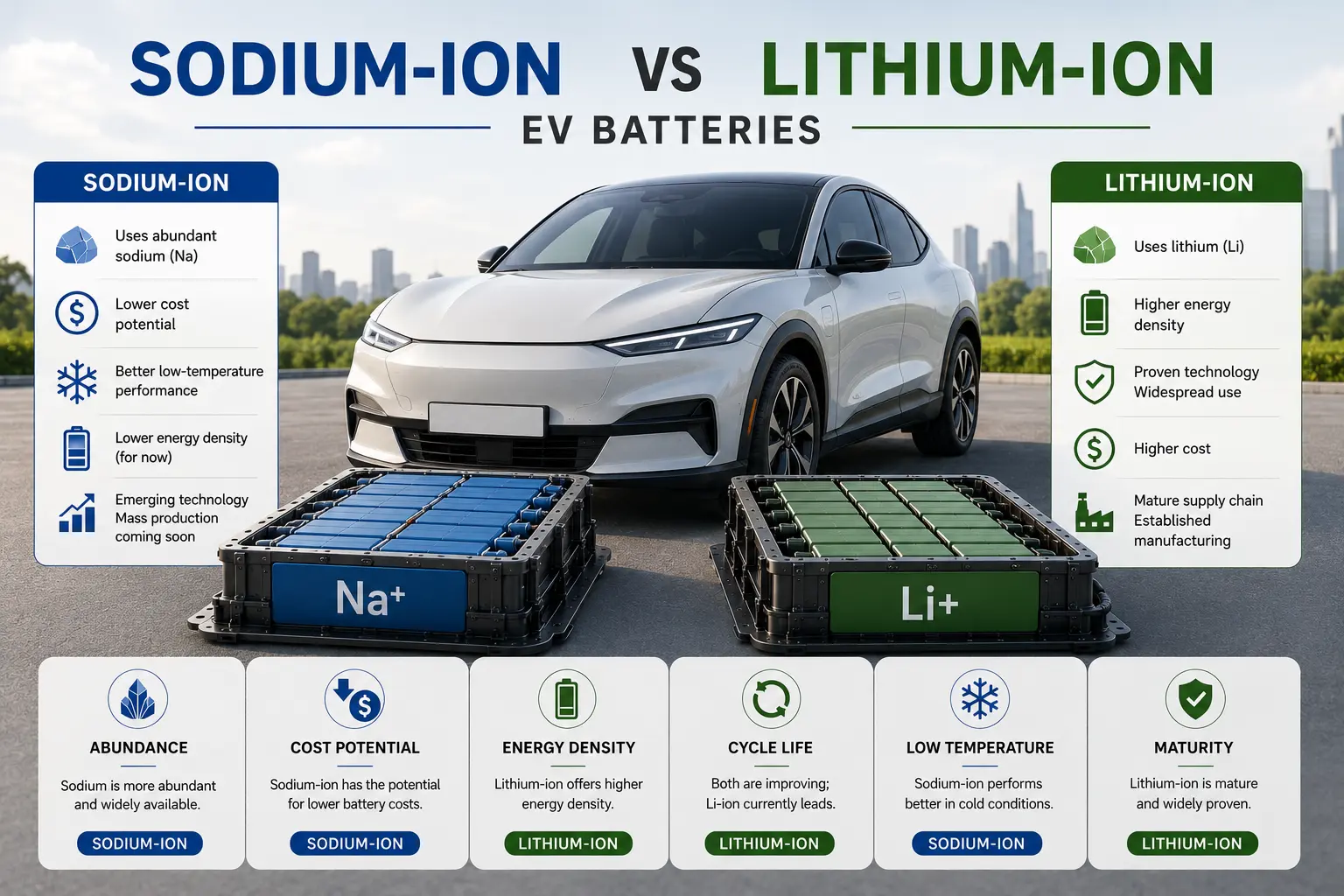
In a lithium-ion battery, lithium ions move between the cathode and anode to store and release energy. In a sodium-ion battery, sodium ions do the same job. That one swap changes almost everything else: the cathode materials, the anode materials, and the electrolyte all need to change too.
Sodium is roughly 1,000 times more abundant in the Earth’s crust than lithium and can be sourced from common compounds including ordinary salt. Sodium-ion cells also use aluminum current collectors on both electrodes, eliminating the need for copper, which reduces materials cost significantly.
The practical result: sodium-ion cells can be significantly cheaper to make. The downside is that sodium ions are larger and heavier than lithium ions, so the energy density ceiling is lower. You cannot get the same range from the same weight of battery using sodium chemistry.
How Sodium-Ion and Lithium-Ion Compare Side by Side
| Sodium-ion (CATL Naxtra) | LFP Lithium-ion | NMC Lithium-ion | |
| Energy density | 175 Wh/kg | 200–210 Wh/kg | 250–270 Wh/kg |
| Cold weather at -40°C | Retains ~90% capacity | Significantly reduced | Significantly reduced |
| Cycle life | 10,000+ cycles | 3,000–4,000 cycles | 1,000–2,000 cycles |
| Raw material cost | Very low (sodium abundant) | Low (no cobalt) | Moderate (nickel, cobalt) |
| Production maturity | Early scale-up | Fully mature | Fully mature |
| Best suited for | City EVs, fleets, cold climates | Most mainstream EVs | Long-range, performance EVs |
Sources: CATL Naxtra specification, Eleport sodium-ion vs lithium-ion comparison May 2026, Electrek CATL Tech Day April 2026
What Sodium-Ion Is Genuinely Better At
- Cold weather performance: This is where sodium-ion has the clearest advantage over any lithium-ion chemistry currently in production.CATL reports that the Naxtra sodium-ion battery retains more than 90% of its usable capacity at -40°C, provides stable power at temperatures as low as -50°C, and delivers nearly three times the discharge power of equivalent LFP cells at -30°C.
For EV owners in cold climates, that is a meaningful difference. Anyone who has tried to fast-charge an LFP battery in deep winter knows the drill: the car spends time warming the pack before charging can begin, speeds are lower, and sessions take longer. Sodium-ion largely avoids this issue because the chemistry itself is less sensitive to low temperatures. - Cycle life and durability: CATL’s Naxtra sodium-ion cells are rated for over 10,000 charge cycles before significant degradation. That is two to three times the cycle life of typical NMC batteries and well above most LFP ratings. For fleet vehicles and commercial applications where batteries cycle heavily, this longevity advantage is significant.
- Cost potential: This is the biggest long-term promise of sodium-ion. Because sodium is abundant, requires no lithium, cobalt, or nickel, and uses cheaper aluminum current collectors, the raw material cost of sodium-ion cells is significantly lower than lithium-ion equivalents.
At cell level, sodium-ion is currently estimated to cost around $40 per kWh, compared to around $70 per kWh for LFP cells. As production scales, analysts project sodium-ion could maintain a 25 to 35 percent cost advantage over LFP even if lithium prices continue to fall, because the current collector savings are structural rather than commodity-driven.
This cost advantage has not yet fully reached consumers because sodium-ion production is still ramping. As of 2026, sodium-ion cell manufacturing capacity is only slightly above 1% of global lithium-ion capacity, so scale is limited. But as CATL and BYD ramp production through 2026 and beyond, the cost gap should begin to show in vehicle pricing.
What Lithium-Ion Still Does Better
Sodium-ion wins in specific contexts. Lithium-ion still wins in others, and those cases cover most of the EV market right now.
- Long-range passenger EVs. At 175 Wh/kg, CATL’s Naxtra sodium-ion battery sits below competitive LFP packs at 200 to 210 Wh/kg and well below NMC cells at 250 to 270 Wh/kg. For a family EV targeting 400 to 500 miles of range, that energy density gap means a meaningfully heavier or larger battery pack to achieve the same range. For premium long-range EVs, lithium-ion remains the better chemistry.
- Production maturity and service networks. Lithium-ion has decades of manufacturing scale, global supply chains, certified service technicians, and established warranty programmes. Sodium-ion is just entering production. Warranty, service, and long-term support structures for sodium-ion vehicles are still being built.
- Global market availability. Right now, sodium-ion EVs are only available in China. European and US buyers will not have sodium-ion options for at least two to three years, and meaningful service networks in those markets will take longer.
Which EVs Currently Use Sodium-Ion Batteries
As of mid-2026, sodium-ion passenger EVs are only available in China. The first production models are:
The Changan Nevo A06 (also sold as the Qiyuan A06) launched in mid-2026 with a 45 kWh sodium-ion pack and a claimed range of over 400 km. CATL confirmed it will supply sodium-ion batteries across several Changan brands including AVATR, Deepal, Qiyuan, and UNI.
GAC Aion has also launched a model using sodium-ion chemistry, making it one of the earliest production sodium-ion passenger vehicles alongside the Changan.
BYD is building a dedicated 30 GWh per year sodium-ion facility in partnership with Huaihai, focused on smaller vehicles, scooters, and low-cost mobility.
Outside China, CATL confirmed at its April 2026 Tech Day that full-scale sodium-ion production for passenger EVs will roll out by the end of 2026, with European availability still years away.
What This Means for EV Owners in the US and UK Right Now
If you own a lithium-ion EV today, this development changes very little about how you should use or maintain it. Your LFP or NMC battery is not obsolete. It is well supported, well understood, and will serve you well for many years.
The practical relevance of sodium-ion for US and UK owners in 2026 falls into two categories.
If you are planning to buy an EV in the next one to two years: Sodium-ion vehicles will not be available in the US or UK during this window. Buy the lithium-ion EV that best fits your needs now. Sodium-ion is not worth waiting for in the short term.
If you are planning to buy three to five years from now: Sodium-ion options may be available in affordable city EV segments by then. The chemistry will be worth considering if you do shorter daily drives and want lower cost over long range. For longer-range needs, lithium-ion will remain the better choice for years regardless.
For context on how different battery chemistries affect your daily charging decisions, our guide on LFP vs NMC batteries and how they affect how you charge every day covers the practical differences between the two main lithium-ion types currently in most EVs.
The Bigger Picture: Two Chemistries, Two Jobs
The sodium-ion vs lithium-ion answer in 2026 is not that one chemistry replaces the other. It is that both finally have a real job to do. Lithium-ion will keep doing the heavy lifting in long-range, premium, and performance EVs for years. Sodium-ion will eat into affordable city EVs, fleet vehicles, two-wheelers, battery swap networks, cold-weather use cases, and grid storage.
CATL’s founder has said he believes sodium-ion could replace up to half of the lithium iron phosphate market in the future, particularly in cost-sensitive and short-range segments. Whether that projection proves accurate depends heavily on how fast production scales and whether sodium-ion can reach cost parity with LFP at the pack level.
What is clear is that the EV battery market is no longer a one-chemistry show. Buyers, fleet operators, and manufacturers now have a credible second option for specific use cases. That competition is broadly good news for EV affordability regardless of which chemistry ends up in any specific car.
The Bottom Line
Sodium-ion batteries in EVs are no longer a concept or a promise. They are in production and on the road in China in 2026. That is a genuine milestone.
For US and UK EV owners today, the practical impact is limited. The technology is not yet available outside China and lithium-ion remains the right choice for any EV purchase in the near term. But understanding what sodium-ion does well, particularly its cold-weather performance, cycle life, and cost potential, helps make sense of where EV battery technology is heading over the next five years.
The market is splitting. Different batteries for different jobs. That is a better outcome for EV buyers than one chemistry trying to do everything.
For a deeper look at what is coming next in EV battery technology more broadly, our guide on the future of EV batteries covers the wider technology landscape including solid-state batteries and what to realistically expect from each development.
Frequently Asked Questions
Q. What is a sodium-ion battery in an EV?
A. A sodium-ion battery works the same way as a lithium-ion battery, with ions moving between cathode and anode to store and release energy. The difference is that sodium ions do the work instead of lithium ions. The practical result is a cheaper, more cold-weather-capable battery with lower energy density than the best lithium-ion cells.
Q. Is sodium-ion better than lithium-ion for EVs?
A. For some uses yes, for others no. Sodium-ion is better for cold weather performance, cycle life, and cost in shorter-range applications. Lithium-ion is still better for long-range EVs, high-performance models, and any application where maximum energy per kilogram matters.
Q. Which EVs use sodium-ion batteries in 2026?
A. As of mid-2026, sodium-ion passenger EVs are only available in China. The first mass-production models are the Changan Nevo A06 and a GAC Aion model, both using CATL’s Naxtra sodium-ion cells. US and European availability is still at least two to three years away.
Q. Will sodium-ion batteries replace lithium-ion?
A. Not replace, but compete in specific segments. Most battery analysts and industry executives, including CATL’s founder, expect both chemistries to coexist, with sodium-ion taking affordable city EVs, fleets, and cold-climate use cases while lithium-ion remains dominant in long-range and premium vehicles.
Q. Does sodium-ion battery technology affect my existing EV?
A. No. Your existing lithium-ion battery is not affected by sodium-ion developments. The two chemistries are entirely separate. Sodium-ion will not be retrofitted into existing lithium-ion vehicles.
Q. Is sodium-ion safer than lithium-ion?
A. Sodium-ion cells are generally considered safer because they use more stable cathode materials and sodium ions have less electrochemical potential than lithium ions, making them less prone to thermal runaway in some designs. However, both chemistries can be made safe through proper battery management system design.

Jamie Carter is an EV enthusiast and independent researcher who has been following electric vehicle technology since 2019. After buying her first EV and spending years digging through manufacturer data, owner forums, and industry reports to answer her own questions, she started sharing what she learned. At EV Battery Central, Jamie writes research-backed guides on battery health, charging habits, and EV ownership & more.