Quick Answer: Most EV owners are happier with their cars than petrol car owners. But they consistently wish they had known more about home charging access, real-world range, the 12-volt battery, depreciation and what public charging is actually like on road trips. This guide covers all eight things real EV owners say would have helped them most before they signed.
A survey of over 1,000 EV and hybrid owners by autoinsurance.com found that 95% were satisfied with their car and J.D. Power’s 2026 US electric vehicle experience ownership study found that 96% of EV owners would choose electric again for their next car, even without the federal tax credit.
So the satisfaction is real. But in that same survey, owners said they wished they had known more about charging, battery life and the true cost of ownership before they bought.
This guide covers exactly that. Not to talk you out of an EV. But to make sure you go in with the right expectations rather than avoidable surprises.
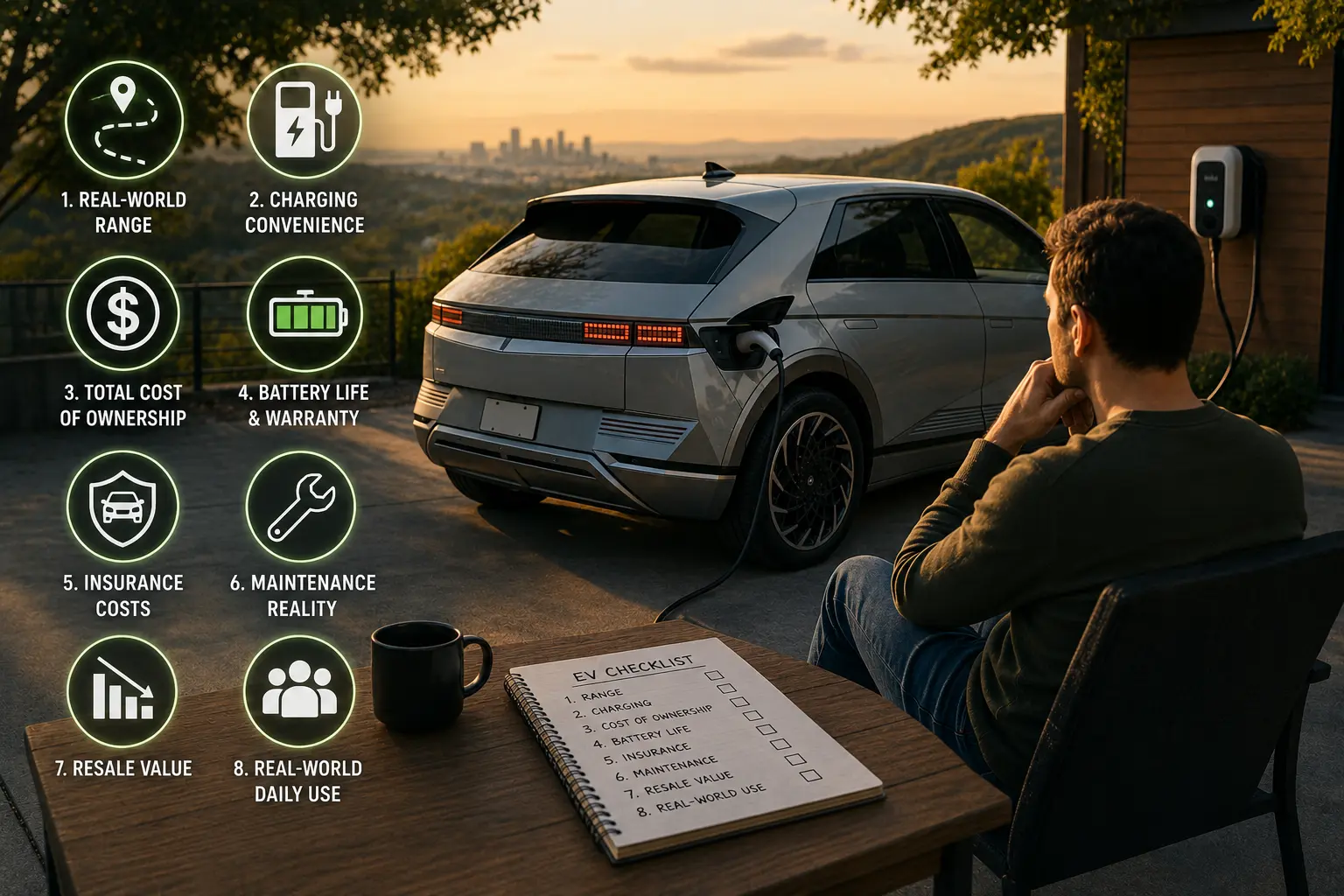
8 Things Real EV Owners Wish They Had Known Before Buying
1. Home Charging Is Not Optional. It Is the Whole Experience
This is the single most important thing to sort out before you buy. Owners who can charge at home overnight wake up every morning to a full battery. No petrol stations. No planning. No standing in the cold. It becomes completely invisible within a few weeks.
Owners without home charging rely on public charging for everything, including daily top-ups. The experience is fundamentally different and often much more frustrating.
A few survey of real EV owners found that 83% charged primarily at home and home charging remains the single biggest driver of EV owner satisfaction, above range, above performance, above everything else.
If you rent your home, live in an apartment block with no charging provision, or park on a public street with no access to an outlet, solve that problem before you buy the car. Not after.
If home charging is available to you, an EV becomes one of the most convenient vehicles you can own. If it is not, the convenience gap is real and worth factoring honestly into your decision.
2. Your Real-World Range Is Lower Than the Official Number
The range figure on the window sticker is based on controlled testing conditions. Your real-world range will be lower, and knowing by how much helps you plan properly from day one.
As a rough guide based on real driving data:
- In normal mixed conditions, expect around 10% to 15% less than the official figure
- At motorway speeds above 70 mph, expect 20% to 25% less
- In cold weather at freezing temperatures, Recurrent’s data from over 30,000 EVs shows an average of about 20% less range
- In very cold conditions below 20°F, that gap can reach 30%
This does not mean the car is broken or the manufacturer is lying. It just means the official figure is a best-case number and real driving rarely matches it.
The practical impact is smaller than it sounds for most people. If your daily commute is 40 miles and your EV has a 250-mile official range, even at 80% of that figure you have 200 miles available. More than enough.
Where it matters most is on long road trips, especially in cold weather. Plan charging stops based on 75% to 80% of your rated range rather than the full figure and you will rarely be caught short.
For a detailed look at how cold weather specifically affects your range and what to do about it, our guide on how cold weather affects your EV battery covers this in full.
3. The 12-Volt Battery Problem Nobody Warns You About Before Buying an EV
Most people buying an EV know the main battery pack is expensive. They have no idea the small 12-volt auxiliary battery even exists.
Your EV runs on two completely separate battery systems. The large high-voltage traction battery powers the motor and gives you your range. The small 12-volt auxiliary battery, about the size of a shoe box, powers your computers, locks, lights, and the startup sequence that wakes the entire high-voltage system.
If the 12-volt battery dies, your car will not start, will not unlock electronically, and will not respond in any normal way, even if the main battery is fully charged. Many owners have faced a completely non-responsive car, assumed the worst, and called for emergency recovery.
Tesla Model 3 owners are particularly prone to this. Their 12-volt batteries face constant demand from Sentry Mode and over-the-air updates. Many fail within two to three years of ownership.
The fix: be aware this battery exists, know that it typically needs replacement every three to five years, and if your car ever goes completely dead with a full main battery, test the 12-volt first before assuming anything more serious.
4. EV Battery Chemistry Matters More Than Most People Realise Before They Buy
Most buyers compare range, price, and features before buying an EV. Very few check which battery chemistry the car uses. That turns out to matter quite a bit for how you charge the car every day.
There are two main types: LFP (Lithium Iron Phosphate) and NMC (Nickel Manganese Cobalt).
LFP batteries, used in many Tesla Model 3 and Y variants, most BYD vehicles, and some other models, are designed to be charged to 100% regularly without significant extra wear. Manufacturers actually recommend regular full charges to keep the battery calibrated accurately.
NMC batteries, used in most other EVs including many Hyundai, Kia, and early Tesla models, perform better when kept between 20% and 80% for daily use. Regularly charging to 100% and leaving it there adds wear over time.
Owners who do not know which chemistry they have often develop the wrong charging habits for their specific car. An LFP owner keeping their car at 80% thinking they are being careful is actually following the wrong advice for their battery. An NMC owner charging to 100% daily thinking that is fine is accelerating degradation without realising it.
Check your owner’s manual or ask the dealer which battery chemistry your specific trim uses before you finalise your purchase.
For a full side-by-side breakdown, our guide on LFP vs NMC batteries and which lasts longer covers everything you need to know.
5. EV Depreciation Is Steeper Than Most Buyers Expect: What the Numbers Show
This is the most financially significant surprise for owners who do not plan to keep their EV long term.
Used EV prices dropped around 35% to 40% from new between 2022 and 2026 as the market rapidly expanded and new model options increased. That is a steeper depreciation curve than most petrol cars. If you buy a new EV planning to sell it after two or three years, that depreciation is one of your biggest real ownership costs.
The picture changes significantly if you keep the car longer. The fuel and maintenance savings that come with EV ownership compound meaningfully over six, eight, or ten years. A University of Michigan 2026 study found used battery-electric vehicles have the lowest total cost of ownership among all vehicle types when the full ownership period is considered.
The honest version: if you know you will sell in two to three years, factor in steeper depreciation than you might expect compared to a petrol car. If you are planning to keep it for eight years or more, the economics work clearly in the EV’s favour.
Battery health also affects what you get when you sell. Our guide on how EV battery health affects resale value shows exactly how much each percentage point of battery health is worth at resale.
6. Public Charging on Road Trips Requires Planning. Daily Driving Does Not
This is the thing that trips up new EV owners the most and the thing long-term owners stop worrying about fastest.
If you charge at home, your daily driving requires zero planning. You plug in overnight, wake up to a full battery, and never think about it. This becomes genuinely automatic within a few weeks.
Road trips are different. You need to know where charging stops are, roughly how long each stop will take, and which networks are available on your route. This is planning you do not do with a petrol car.
The good news is that the tools for this have improved enormously. Most modern EVs route you automatically to charging stops when you navigate to a destination beyond your range. Apps like PlugShare show real-time availability and reliability ratings from other drivers for public chargers.
The honest challenge is that public charging reliability still varies by network. J.D. Power’s 2025 US Electric Vehicle Experience Public Charging Study found non-charging visits at public chargers, meaning an owner arrived but could not charge, have hit their lowest level in four years. Progress is real. But failures still happen, particularly on networks outside the major providers.
Tesla owners have consistently rated the Supercharger network as significantly more reliable than most alternatives. Non-Tesla owners deal with more variability, particularly in rural areas.
The planning adjustment is real but temporary. Most owners in long-term surveys say it becomes completely automatic within three to six months and stops feeling like a burden.
7. Why EV Battery Degradation Worries You Before Buying but Rarely After
Before buying, most people worry about battery degradation and replacement costs. After owning for a year or two, almost nobody ranks it as their biggest concern.
A survey of over 1,000 real EV and hybrid owners found that the biggest challenges owners actually reported were long charging times, limited range on road trips, and charging infrastructure reliability. Battery degradation and replacement were mentioned, but rarely as a day-to-day frustration.
The real-world data backs this up. Recurrent’s analysis of over 30,000 EVs found the average car retains 97% of its original range after three years and 95% after five years. Less than 4% of all EVs have ever needed a main battery replacement.
The fear before buying is almost always bigger than the reality after owning. The battery, for most modern EVs in normal use, quietly does its job for years without needing attention.
What does require attention, as covered above, is the 12-volt auxiliary battery. That is the one worth keeping track of.
8. The Mental Shift Every New EV Owner Goes Through and How Long It Takes
This one is not about a specific feature or cost. It is about the mental adjustment that almost every new EV owner goes through and that almost nobody warns them about.
Driving an EV requires a different mental model than driving a petrol car. You stop thinking about filling up once a week and start thinking about plugging in overnight. You plan road trips around charging stops rather than petrol stations. You check the range estimate before an unfamiliar journey the way you might check a petrol gauge before a long drive.
In the first few weeks, this adjustment can feel significant. Range estimates fluctuate. Public charging feels uncertain. The routine is new.
Almost every long-term EV owner says the same thing: after two to three months, it becomes completely normal. The home charging routine becomes invisible. The range anxiety fades. The trip planning becomes second nature.
The owners who struggle most long-term are those who never make that mental shift and continue trying to use an EV exactly like a petrol car. The owners who settle in fastest are those who understand from day one that the fueling model is simply different, not better or worse on every dimension, just different.
The Things That Genuinely Surprise Owners in a Good Way
Since this is an honest guide, it is worth noting what real owners consistently say they did not expect to like as much as they do.
Never going to a petrol station is the most common positive surprise. Many owners describe it as the single biggest quality-of-life improvement of EV ownership. Starting every morning with a full battery and never thinking about fuel is a genuinely different experience.
Lower maintenance costs also regularly surprise owners. No oil changes, no timing belt, no spark plugs. Brake pads last longer because regenerative braking does most of the work. Many owners find their annual maintenance spend drops significantly compared to their previous petrol car.
The driving experience itself surprises many people. Instant torque from a standstill, smooth and quiet operation, and responsive acceleration consistently rate higher in satisfaction surveys than owners expected before they bought.
The Bottom Line
Buying an EV in 2026 is a genuinely good decision for the right buyer. The satisfaction numbers are higher than for petrol cars. The battery technology is more reliable than most people fear. The running costs over the full ownership period work clearly in the EV’s favour for anyone who keeps the car long enough.
The owners who struggle are almost always those who went in without sorting out home charging first, who planned to sell in two to three years without accounting for depreciation, or who expected the ownership experience to be identical to a petrol car and were frustrated when it was not.
Go in knowing what is actually different and what is genuinely better. That gap between expectation and reality is where almost all EV regret lives, and it is entirely avoidable.
Frequently Asked Questions About Buying an EV
Q. Is home charging essential for EV ownership?
A. It is not technically essential but it transforms the ownership experience. Owners with home charging consistently report significantly higher satisfaction than those relying primarily on public charging. If you cannot charge at home, factor that honestly into your decision before buying.
Q. Does the battery chemistry of my EV affect how I should charge it?
A. Yes, significantly. LFP batteries, common in many Tesla variants and BYD models, can regularly charge to 100% without extra wear. NMC batteries, used in most other EVs, benefit from staying between 20% and 80% for daily use. Check which chemistry your specific model uses before developing your charging habits.
Q. How much range will I really get compared to the official figure?
A. In normal mixed conditions, expect 10% to 15% less than the official figure. At motorway speeds, 20% to 25% less. In cold weather at freezing temperatures, around 20% less on average. Plan road trips based on 75% to 80% of your rated range to stay comfortable.
Q. What is the 12-volt battery and do I need to worry about it?
A. Your EV has a small 12-volt auxiliary battery separate from the main pack. It powers your computers, lights, and locks. If it dies, the car will not start even with a full main battery. It typically needs replacement every three to five years. Being aware it exists puts you ahead of most new EV owners.
Q. How bad is EV depreciation compared to petrol cars?
A. EVs have generally depreciated faster than comparable petrol cars in recent years. If you plan to sell in two to three years, budget for steeper depreciation. If you are keeping the car for eight or more years, the fuel and maintenance savings typically more than compensate.
Q. When does the charging adjustment stop feeling like extra effort?
A. Most long-term owners say two to three months. Once the home charging routine is established and you have done a few road trips using your car’s navigation for charging stops, it becomes automatic. The adjustment is real but temporary for almost everyone.

Jamie Carter is an EV enthusiast and independent researcher who has been following electric vehicle technology since 2019. After buying her first EV and spending years digging through manufacturer data, owner forums, and industry reports to answer her own questions, she started sharing what she learned. At EV Battery Central, Jamie writes research-backed guides on battery health, charging habits, and EV ownership & more.