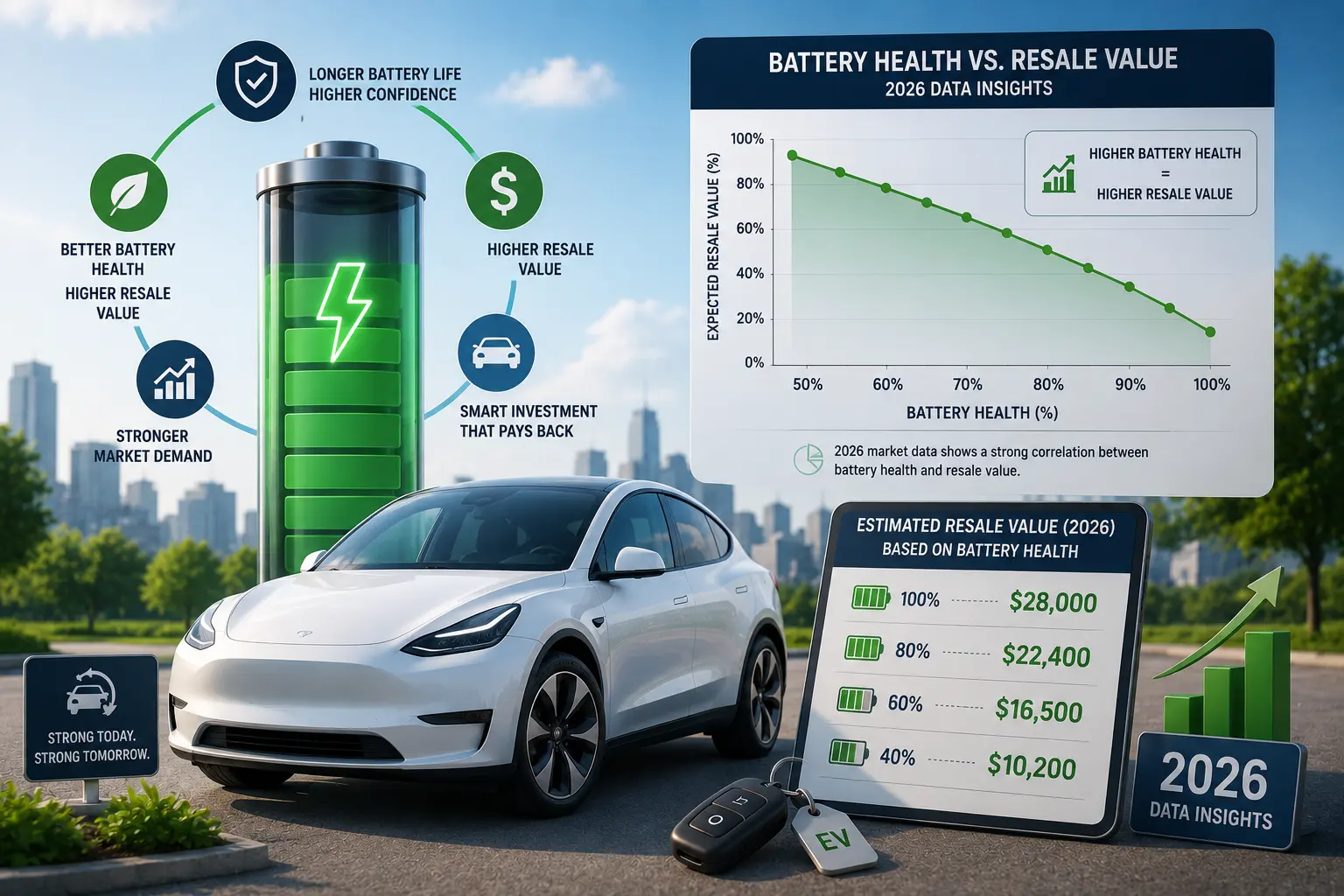
Quick Answer: Battery health is now the single biggest factor affecting used EV resale value in 2026. Real data from over 58,000 used EV listings shows that each 1% drop in battery health pulls resale value down by 1.2% to 1.6% for mainstream EVs, and up to 2% for premium models. A battery at 92% health versus 75% health can mean a $6,000 difference in what your car is worth.
When most EV owners think about resale value, they think about mileage, condition, and colour. Those things matter, but they are not what used EV buyers are actually worried about in 2026.
What they want to know is: how healthy is the battery?
Battery health has quietly become the most important number when buying or selling a used EV. More important than mileage. More important than trim level. More important than paint condition. And most EV owners have no idea how much it directly affects the money they will get when they sell.
This guide breaks that down with real 2026 numbers so you know exactly where you stand.
Why EV Battery Health Matters More Than Mileage in 2026
Here is something that surprises most EV owners.
A gas car with 80,000 miles on it still has an engine that is about 90% as functional as when it was new. The mileage tells you roughly how much wear the car has seen.
An EV battery does not work that way. Two EVs with the same mileage can have very different battery health depending on how they were charged, what climate they lived in, and whether they relied on fast charging daily.
That is why over 4.2 million used EVs are expected to change hands globally in 2026, and battery State of Health (SoH) has become the number buyers, lenders, and dealers all ask about first. According to a 2025-2026 study by Geotab tracking over 22,700 real EVs, the average battery still holds 81.6% of its original capacity after 8 years, which means most used EVs on the market today have healthier batteries than buyers assume.
SoH is simply a percentage of how much usable capacity remains compared to when the car was new. A battery at 90% SoH holds 90% of its original energy. A battery at 75% SoH holds 75%, which on a 300-mile car means your real range is now 225 miles.
What the Real 2026 Resale Data Shows
Analysis of over 58,000 used EV listings and thousands of battery health reports from 2025 to 2026 found clear patterns in how battery condition affects price.
Each 1% drop in battery health pulls resale value down by 1.2% to 1.6% for mainstream compact EVs, and by up to 2% for premium long-range models.
The relationship is not linear either. Prices fall faster once SoH drops below 85%. A car sitting at 84% health takes a steeper hit than the raw percentage difference suggests, because buyers at that level start factoring in how much faster the decline will continue.
In practical terms:
- A battery above 85% SoH is considered excellent in the 2026 used EV market and commands strong resale value
- Between 75% and 85% is still good but begins to attract negotiation pressure from buyers
- Below 75% triggers serious buyer hesitation and can make a car difficult to sell without a steep discount
The difference between a battery at 92% SoH and one at 75% SoH on the same vehicle can swing fair market value by up to $6,000.
How Much Is Your EV Battery Health Actually Costing You
Let’s put that in plain numbers. Say you have a mainstream EV that was worth $40,000 new. After 4 years it has a battery at 88% SoH. Based on current used EV market data, that car commands a strong price with minimal discount pressure.
Now take the same car with a battery at 78% SoH. That is a 10% drop in battery health. At 1.4% resale impact per 1% of battery loss, that 10% difference translates to roughly 14% less resale value. On a $25,000 used asking price that is around $3,500 less in your pocket before you even negotiate.
For premium long-range models the hit is steeper. A 10% battery health difference at 2% resale impact per percentage point means 20% less value, which on a $40,000 used Tesla can mean $8,000 less than an equivalent car with a healthier battery.
These are not small numbers. They are bigger than most cosmetic damage, service history gaps, or trim differences that buyers typically haggle over.
What Causes EV Battery Health to Drop Faster Than Normal
Not all battery wear is equal. Some habits cause significantly faster degradation than others, and those habits show up directly in resale value.
- Frequent DC fast charging: This is the biggest one. Daily fast charging habits accelerate battery wear roughly double compared to regular home charging. Buyers increasingly ask about charging history and it is becoming easier to detect from onboard data.
- Hot climate exposure: EVs in hot climates degrade about 0.4% to 0.45% faster per year. Over 5 years that adds up to 2% more total degradation compared to an equivalent car in a moderate climate, which is a meaningful resale difference.
- Frequently sitting at very high or very low charge: Batteries that regularly sat above 90% or below 10% for extended periods show faster degradation curves. This is increasingly detectable through battery diagnostic tools.
- Lack of thermal management: Some older EV models, most notably the pre-2018 Nissan Leaf, used passive air cooling instead of active liquid cooling. Those cars degrade significantly faster, especially in warm climates, and their resale values reflect that clearly.
How to Check Battery Health Before You Sell or Buy
You do not need to be a technician to get a battery health reading.
For owners getting ready to sell:
Most modern EVs display a battery health or State of Health reading in the infotainment system or companion app. Getting this number documented before listing your car adds credibility and often justifies a higher asking price. Buyers pay a premium for transparency.
For buyers checking a used EV:
Ask the seller for the SoH reading from the car’s own system. For older models that do not show this natively, a third-party OBD-II diagnostic tool can pull cell-level data and charging history. Tools like LeafSpy for Nissan Leaf and similar brand-specific apps give detailed readings that go well beyond what the dashboard shows.
If you notice any signs that something is off beyond normal gradual wear, our guide on battery issues EV owners report most covers the warning signs in detail.
How to Protect Your EV’s Resale Value Right Now
The good news is that the habits that protect battery health are the same ones that protect your resale value. They are not complicated.
- Keep daily charging between 20% and 80%– This is the single most effective habit for slowing degradation on NMC batteries. LFP batteries are more tolerant, but still benefit from avoiding sitting at 100% for extended periods.
- Use DC fast charging sparingly– Occasional fast charging for road trips is fine. Daily fast charging as your main method leaves a measurable mark on battery health over time, and increasingly on resale value too.
- Park in shade or a garage when you can– Heat is the enemy of long-term battery health. Consistent exposure to high ambient temperatures accelerates cell degradation in ways that show up years later at resale.
- Keep software updated– Many manufacturers push updates that improve battery management and charging efficiency. Staying current is free and sometimes meaningfully extends battery life.
- Document your battery health regularly– Take a screenshot of your battery health reading every 12 months. When you sell, showing a buyer three or four years of documented SoH readings demonstrating steady, normal decline is a genuine competitive advantage that justifies a higher price.
Does Battery Health Affect EV Resale More Than Gas Car Engine Health
In some ways yes, and the reason matters. With a gas car, buyers largely accept that an older engine has some wear. They expect it. The car still starts and runs, and they can estimate remaining life from service history and mileage.
With a used EV, battery health is less intuitive to most buyers. Range loss is not always obvious on a test drive on a mild day. But buyers in 2026 are more educated than they were two years ago. Platforms and dealers are increasingly requiring battery health reports, and buyers who do not get one are starting to lowball specifically to cover the uncertainty.
That uncertainty premium is what makes documenting your battery health so valuable as a seller, and what makes demanding a health report so important as a buyer.
The Bottom Line on EV Resale Value and Battery Health
EV Battery health is real money in 2026. Not just a technical detail for enthusiasts. Every percentage point of battery health you protect translates directly into dollars when you sell. Simple habits like charging to 80% daily, avoiding constant fast charging, and parking in shade are not just good for your battery. They are protecting thousands of dollars of resale value over the life of your car.
And if you are buying a used EV, never skip the battery health check. A car at 92% SoH and a car at 76% SoH can look identical on a warm-day test drive and have a $6,000 difference in what they are actually worth.
The used EV market in 2026 rewards buyers who know what to look for and sellers who document their battery care. Now you know what to look for.
Frequently Asked Questions About EV Resale Value and Battery Health
Q. How much does battery health affect EV resale value?
A. Real 2026 data from over 58,000 used EV listings shows each 1% drop in battery health reduces resale value by 1.2% to 1.6% for mainstream EVs and up to 2% for premium models. A difference of 15% in SoH between two similar cars can mean a $4,000 to $6,000 swing in value.
Q. What battery health percentage is good for a used EV in 2026?
A. Above 85% SoH is considered excellent and commands strong resale value. Between 75% and 85% is still acceptable but attracts negotiation pressure. Below 75% significantly hurts resale and can indicate the car may be approaching warranty replacement thresholds.
Q. Does mileage or battery health matter more for EV resale?
A. Battery health matters more. Two EVs with identical mileage can have very different battery health depending on charging habits, climate, and fast charging use. Buyers in 2026 increasingly ask for SoH data first, not just odometer readings.
Q. Can I improve my EV battery health before selling?
A. You cannot reverse past degradation, but you can stop making it worse. Switching to home charging, keeping the battery between 20% and 80%, and avoiding heat exposure in the months before selling will at least stabilise the current reading. Some owners also run a full battery calibration cycle before getting a health check done.
Q. How do I find out my EV’s battery health?
A. Check your infotainment system or manufacturer app. Many newer EVs show SoH directly. For older models, a third-party OBD-II scanner and model-specific app can give a detailed reading. You can also ask a dealer or EV specialist to run a diagnostic.

Jamie Carter is an EV enthusiast and independent researcher who has been following electric vehicle technology since 2019. After buying her first EV and spending years digging through manufacturer data, owner forums, and industry reports to answer her own questions, she started sharing what she learned. At EV Battery Central, Jamie writes research-backed guides on battery health, charging habits, and EV ownership & more.