
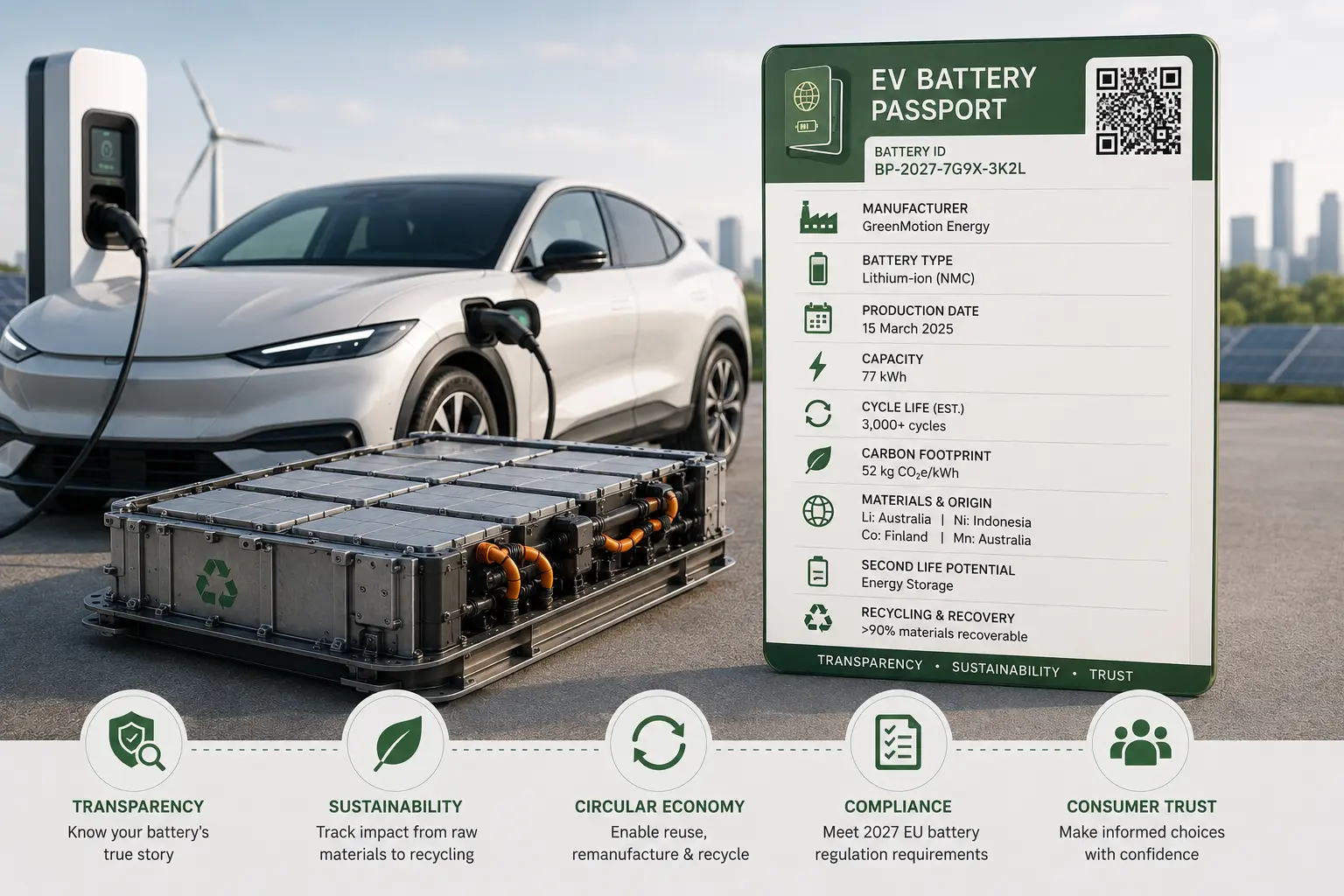
Quick Answer: An EV battery passport is a digital record linked to every EV battery via a QR code. From 18 February 2027, the EU mandates it for all EV batteries over 2 kWh sold in Europe. It contains battery health, carbon footprint, chemistry, cycle count, recycled content, and supply chain information. It is not just a regulation requirement. For used EV buyers, it will become the single most important document when purchasing a second-hand electric vehicle.
If you have been hearing the term “battery passport” and wondering what it actually means for you as an EV owner or buyer, you are not alone. It sounds technical and regulatory, but the practical impact on everyday EV ownership is significant and genuinely useful.
Think of it as a digital service history, but focused entirely on the battery. Not the engine, not the bodywork, just the most expensive and most important component in the car.
Here is everything you need to know.
What Is an EV Battery Passport?
An EV battery passport is a structured digital record that follows a battery throughout its entire life, from the moment the raw materials are mined, through manufacturing and use, to recycling or second-life reuse.
It is accessible via a QR code on the battery itself. Scan the code with any phone and you get access to verified data about that specific battery’s history, health, and environmental credentials.
The EU battery passport is mandated by EU Regulation 2023/1542 for batteries placed on the European market. It is a structured, machine-readable data record linked to the physical battery via a QR code. The passport stores lifecycle data including carbon footprint, recycled content percentages, battery chemistry, state of health, supply chain due diligence declarations, and end-of-life instructions.
The key word is structured. This is not a PDF document or a manufacturer’s brochure. It is a standardised digital record that different users including buyers, regulators, recyclers, and service centres can all access and read, each with different levels of detail depending on who they are.
When Does the Battery Passport Become Mandatory?
From 18 February 2027, all electric vehicle batteries, light means of transport batteries, and industrial batteries with a capacity greater than 2 kWh placed on the EU market must be accompanied by a digital battery passport.
That date is now six months away and closing fast. For EV manufacturers, importers, and dealers selling into Europe, this is no longer a future planning item. It is an immediate operational requirement.
The Digital Battery Passport becomes mandatory on February 2027 for EV, LMT, and industrial batteries above 2 kWh placed on the EU market. A single EV battery passport includes approximately 80 mandatory data attributes. A robust implementation typically takes up to 5 months to build.
The regulation applies to batteries placed on the market from that date onwards. Existing vehicles on the road do not retroactively require passports for their current batteries, but any new battery placed on the EU market after 18 Feb’27 must have one.
What Information Does an EV Battery Passport Contain?
The passport is not a simple label. It is a comprehensive record covering the battery’s entire journey. Here is what the regulation requires:
Battery identification:
- Manufacturer details, production date and location
- Battery model, batch number, and unique identifier
- Battery chemistry and cell format
Performance and health data:
- Current State of Health (SoH) expressed as a percentage
- Original capacity and current usable capacity
- Cycle count and remaining useful life estimate
- Charging history and operating temperature data
Environmental data:
- Carbon footprint of the battery from materials to production
- Recycled content percentages for lithium, cobalt, nickel, and graphite
- Raw material sourcing information and supply chain due diligence
End of life:
- Disassembly and recycling instructions
- Second-life eligibility assessment
From 2027 onwards, all EV and industrial batteries over 2 kWh will need to have a digital battery passport that travels with the battery for its entire life. All EV batteries will also have to have a scannable QR code which shows the battery passport with detailed data on the battery’s origin, specifications, carbon footprint and recycled content.
Not all of this data is visible to everyone. The regulation defines three different access levels: the general public gets basic information, regulatory authorities get full technical data, and recyclers and service centres get the specific data they need for their role.
Which Cars Are Already Using Battery Passports
The EU mandate kicks in February 2027 but some manufacturers have already started voluntarily.
Volvo and the London-based tech startup Circulor have designed a battery passport to open access the materials supply chain for stakeholders. The Volvo EX90 SUV features the first supply-chain tracker in a production EV. The AI-based system can track the Volvo’s battery life cycle, prove the origin of battery materials, and show its carbon footprint and recycled content. EX90 buyers can scan a QR code on the driver’s door frame to access passport data.
Volvo confirmed the passport will be expanded to every company model by 2027. Other manufacturers including BMW, Volkswagen, and Renault have active battery passport programmes in development or early deployment.
The Volvo approach is instructive because it shows what the technology looks like in practice. Buyers can scan a code on the door frame and see exactly where the battery materials came from, what the carbon footprint of that specific pack is, and what the current state of health reads. It takes about 30 seconds and gives you more information than any paper service record ever could.
What the Battery Passport Means for Used EV Buyers
This is where the battery passport has its most immediate practical impact on ordinary EV owners and buyers.
Right now, buying a used EV involves a lot of guesswork around battery health. Dealers and private sellers can claim any range they want. Mileage alone tells you very little about how the battery has been treated. A battery health report from a third-party tool gives you a snapshot but not the full history.
Battery health is the number one concern for used EV buyers. The Green Finance Institute found that fear of poor battery health is the single biggest barrier preventing the used EV market from taking off. Without a clear way to verify battery condition, buyers face uncertainty about range, resale value, and replacement costs.
The battery passport changes this fundamentally. From 2027, any new EV battery sold in Europe will carry a verifiable, manufacturer-confirmed record of its health, history, and cycle count. For used buyers, that means:
- You can verify the battery’s actual State of Health: Not an estimate. Not a dashboard reading that can be manipulated. A verified figure in the official passport.
- You can see the full charging history: How often was it fast-charged? What temperature range did it mostly operate in? Was it left at 100% charge regularly?
- You can see the carbon footprint: For buyers who care about the environmental credentials of their purchase, the passport gives verified data rather than manufacturer claims.
- You can assess second-life value: If a battery is approaching the end of its driving usefulness, the passport data tells recyclers and second-life operators exactly what they are working with, which affects what they will pay.
Karl Brauer, iSeeCars Executive Analyst, stated: Battery condition is the single most significant factor in EV depreciation. A car with a well-documented, healthy battery passport could hold its value 15 to 20 percent better than one without, as it removes the fear factor for the second-hand buyer.
That 15 to 20 percent value difference is significant. On a used EV selling for $25,000, that is a $3,750 to $5,000 gap in what a buyer is willing to pay, simply from the transparency that a passport provides.
For a full breakdown of how battery health currently affects resale values before the passport system is in place, our guide on how EV battery health affects resale value covers the current market data in detail.
Does the Battery Passport Affect US and UK EV Owners?
The mandatory passport requirement is EU-specific. The US currently has no equivalent federal regulation and the UK, post-Brexit, has not adopted the EU battery regulation directly.
However, the practical impact extends beyond Europe for two reasons.
Global manufacturers will standardize. Any car manufacturer selling into Europe, which includes Tesla, Hyundai, Kia, Ford, GM, Volkswagen, and almost every other major brand, will need battery passports for their European models. Most manufacturers will apply the same system globally rather than maintaining separate processes for different markets.
The US has no pending regulation for passports. But the Biden Administration’s demand for domestic EV and battery production has forced automakers and suppliers to document the source of materials, down to the rocks that first contained them.
Used EV imports will carry passport data. As European EVs age and enter the used market globally, their passports will travel with them. Used EV buyers in the UK and US purchasing European-origin vehicles will have access to passport data even without a domestic mandate.
For US and UK buyers, the practical advice is to start understanding what battery passport data looks like before 2027, so that when it becomes standard documentation on European vehicles you are buying or selling, you know how to read it and use it in negotiations.
What About My Existing EV? Do I Need to Do Anything?
If you own an EV already, you do not need to do anything right now. The battery passport mandate applies to batteries placed on the EU market from 18 February 2027. Your existing battery does not retroactively require a passport.
However, there are two practical points worth knowing:
- If you sell your EV after 2027: Your car will not have a passport since it predates the requirement. Buyers will be used to seeing passport data on newer vehicles by then, and the absence of a passport on older cars may become a friction point in resale negotiations. This is a natural market evolution rather than a compliance issue for you personally.
- If your battery is replaced after 2027: Any new battery placed on the EU market from that date must carry a passport. So if your existing EV has its battery replaced after the mandate kicks in, the replacement battery will come with a passport even if the original did not.
The Battery Passport and EV Battery Health: How They Connect
The most valuable single piece of data in any battery passport is the State of Health reading. This is expressed as a percentage of original capacity remaining, and it is the number that used EV buyers, insurance companies, and residual value analysts all care about most.
Right now, SoH readings come from the vehicle itself, third-party OBD tools, or manufacturer diagnostics. They are accurate but unverified by any independent standard. A seller can claim any SoH figure.
The battery passport changes this because the SoH data must be updated by certified entities throughout the battery’s life, creating a verified, time-stamped record of exactly how the battery’s health has evolved. This is significantly harder to misrepresent than a screenshot from a phone app.
For current owners wanting to understand where their battery’s health stands right now before the passport system exists, our guide on how to check your EV battery health covers the available methods by model.
The Bottom Line on EV Battery Passports
The battery passport is one of the most practical improvements to EV ownership that regulation has produced. It directly addresses the single biggest barrier to used EV adoption: the inability to verify battery condition with confidence.
For current EV owners, there is nothing to do right now. Your existing battery is not affected.
For anyone planning to buy a used EV after 2027, the passport will become as standard a part of the transaction as checking a car’s accident history is today. Knowing how to read it and what the State of Health figure means will be a genuine advantage.
And for anyone selling a used EV after 2027, documenting battery health proactively, even before the passport system fully covers your vehicle, will continue to be one of the most effective ways to justify a stronger asking price.
Frequently Asked Questions About the EV Battery Passport
Q. What is an EV battery passport in simple terms?
A. It is a digital record linked to a specific battery via a QR code. It contains verified information about the battery’s health, history, chemistry, carbon footprint, and supply chain. Think of it as the battery’s birth certificate, service history, and health report all in one scannable document.
Q. When does the EU battery passport become mandatory?
A. From 18 February 2027, under EU Regulation 2023/1542. All EV batteries, light transport batteries, and industrial batteries above 2 kWh placed on the EU market from that date must have a passport.
Q. Does my existing EV need a battery passport?
A. No. The requirement applies to batteries placed on the market from 18 February 2027. Your existing battery does not retroactively need a passport. If your battery is replaced after that date, the replacement will need one.
Q. Does the battery passport apply in the US and UK?
A. Not as a legal mandate. The EU Battery Regulation is a European requirement. The US and UK have no equivalent federal regulation currently. However, most global manufacturers will apply the system to all their vehicles, meaning passport data will become available on new EVs globally regardless of where they are sold.
Q. How do I access a battery passport?
A. Via a QR code on the physical battery. Once the passport system is in place from 2027, scanning the code with any smartphone will give public access to the basic data. More detailed data is available to authorised parties like service centres and regulators.
Q. Will the battery passport affect used EV resale values?
A. Yes, significantly. Analysis from iSeeCars suggests EVs with a well-documented, healthy battery passport could hold 15 to 20 percent more resale value than equivalent cars without one, because the passport removes the uncertainty that currently makes many buyers hesitant about used EVs.
Q. Can the battery passport data be faked or manipulated?
A. The system is designed to prevent this. Data must be entered by certified parties at different stages of the battery’s life, and the regulation requires interoperability and verification standards. It is not a simple document that anyone can edit.

Jamie Carter is an EV enthusiast and independent researcher who has been following electric vehicle technology since 2019. After buying her first EV and spending years digging through manufacturer data, owner forums, and industry reports to answer her own questions, she started sharing what she learned. At EV Battery Central, Jamie writes research-backed guides on battery health, charging habits, and EV ownership & more.