
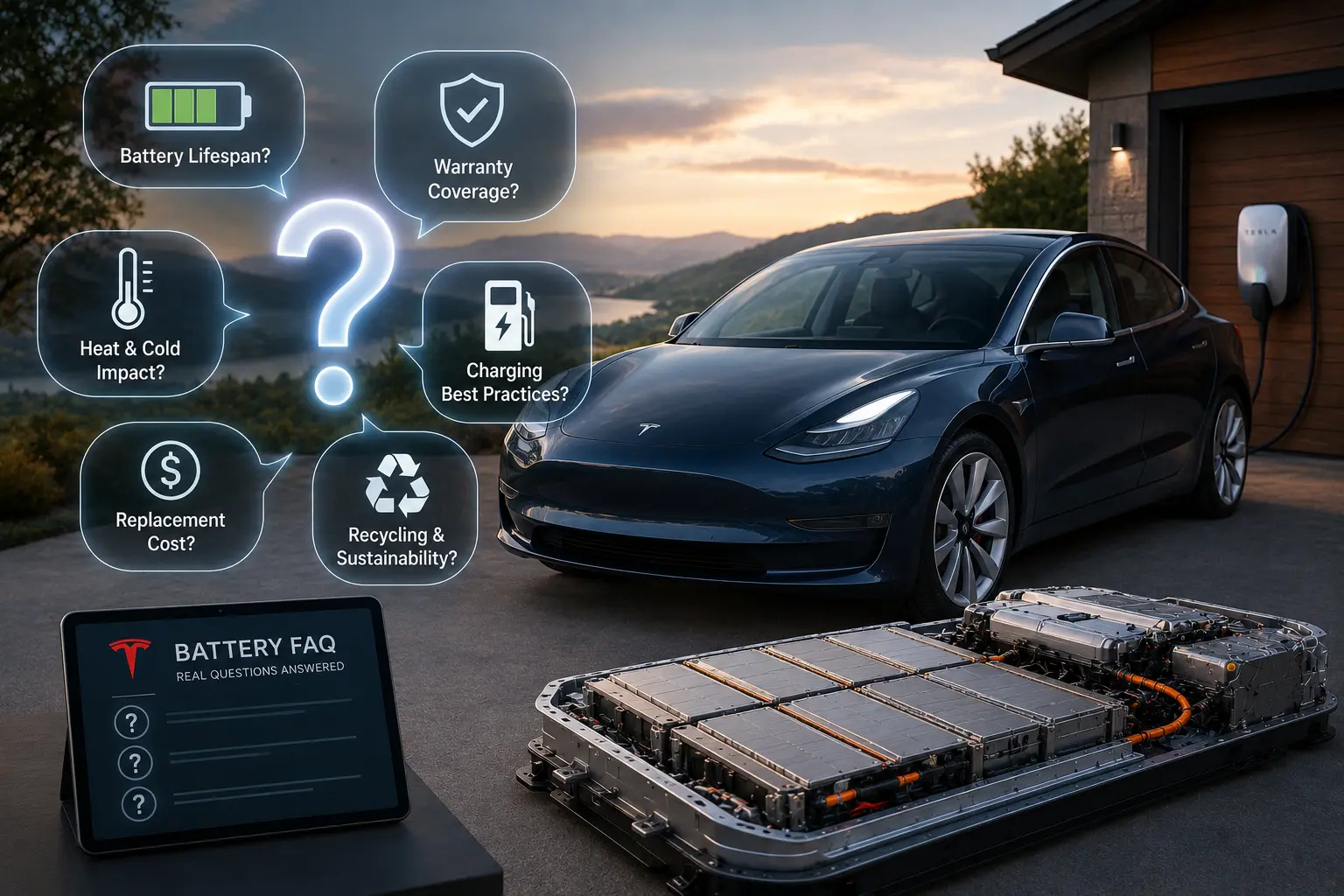
This page answers every real question Tesla owners and buyers ask about their battery, from replacement costs and charging times to lifespan, warranties, and warning signs. Use the category links below to jump straight to your question.
Tesla Battery Basics
- What type of battery does a Tesla use?
All Teslas use lithium-ion battery packs. The difference between models lies in the chemistry inside those cells. Most Model S and Model X vehicles use nickel-based chemistry, either NCA or NMC. Many Model 3 and Model Y standard range variants use Lithium Iron Phosphate, known as LFP. The Cybertruck uses Tesla’s in-house 4680 format cells. Knowing which chemistry your specific car uses matters because it affects how you should charge it every day.
- What is the difference between LFP and NMC batteries in Tesla?
LFP stands for Lithium Iron Phosphate. NMC stands for Nickel Manganese Cobalt. LFP batteries are more stable, tend to last longer in terms of total charge cycles, and can be regularly charged to 100% without significant extra wear. NMC batteries offer more energy in a smaller, lighter pack, which translates to higher range, but they benefit from staying below 80% for daily charging to reduce long-term wear. Many standard range Model 3 and Model Y variants shipped since 2021 use LFP. Most Long Range and Performance variants use NMC.
For a full breakdown of how LFP and NMC compare across all EVs, see our guide on LFP vs NMC batteries explained.
- How do I find out if my Tesla has an LFP or NMC battery?
Go to Controls, then Software, then Additional Vehicle Information on your Tesla touchscreen. If it shows “High Voltage Battery type: Lithium Iron Phosphate,” your car has an LFP battery. If the screen shows a daily charge recommendation of around 80% rather than 100%, your car most likely has a nickel-based NMC pack. This method is more reliable than guessing by model name alone, since Tesla has used different chemistries across different factories and production batches for the same model.
- What are Tesla 4680 cells and which Teslas have them?
The 4680 is a larger cylindrical battery cell format developed by Tesla. The name comes from the cell dimensions: 46mm wide and 80mm tall. As of 2026, the Cybertruck is the Tesla model most strongly associated with 4680 production. Early limited runs of the Model Y in Texas also used 4680 packs, but those were not the norm and most Model Ys continue to use 2170-based packs. The 4680 format is designed to be cheaper to produce and store more energy, but there is not yet enough long-term real-world data to say how these packs will age compared to Tesla’s more established cell formats.
- What does kWh mean for a Tesla battery and why does it matter?
kWh stands for kilowatt-hour. It measures how much energy your battery can store. A higher kWh number generally means more range per charge. A Tesla Model Y Long Range with around 82 kWh holds significantly more energy than a standard range variant with around 60 kWh, which is why the range figures differ so much between trims. When comparing Tesla models or replacement costs, kWh is the most useful number to understand because both range and replacement price scale directly with pack size.
Tesla Battery Lifespan
- How long does a Tesla battery actually last?
For most modern Teslas, a realistic estimate based on real-world fleet data is 300,000 to 500,000 miles of useful battery life. Tesla’s own 2023 Impact Report showed that Model 3 and Model Y batteries lost about 15% of capacity on average after 200,000 miles, meaning those cars still held 85% of original capacity at mileage where many petrol cars would be near the end of their expected life. Battery life depends on the specific model, climate, charging habits, and how the car was stored.
- How long does a Tesla Model 3 battery last?
A Tesla Model 3 battery should last around 300,000 to 500,000 miles under normal use, based on current real-world data. Tesla’s 2023 Impact Report confirmed that Model 3 batteries retained around 85% of original capacity at 200,000 miles on average. Battery chemistry matters here too. Long Range and Performance variants use nickel-based packs where daily charging to around 80% is generally recommended. Some standard range variants use LFP packs which can be charged to 100% routinely without the same concerns.
- How long does a Tesla Model Y battery last?
The Model Y is closely related to the Model 3 and shows similar early degradation patterns. A reasonable estimate is 300,000 to 500,000 miles under normal use. Since the Model Y is a newer model than the Model 3, there is slightly less long-term data available, but what exists points in the same direction. For current replacement cost information specific to the Model Y, our guide on Tesla Model Y battery replacement cost covers what to expect.
- How long does a Tesla Model S or Model X battery last?
The Model S and Model X have the longest real-world battery history in Tesla’s lineup. Many examples have crossed 200,000, 300,000, and even higher mileage. A healthy Model S or Model X battery can realistically last 300,000 to 500,000 miles or more. That said, both models were discontinued in January 2026, which means parts availability and future service support are worth thinking about for long-term ownership. Older 85 kWh and 90 kWh packs in particular deserve extra scrutiny when buying used, not because they always fail but because age and warranty status matter more now than they once did.
- How many miles can a Tesla Model X last overall?
A Tesla Model X is capable of lasting well over 200,000 miles and potentially 300,000 miles or more under normal use based on owner reports and fleet data. The battery is rarely the limiting factor at that mileage. Suspension components, falcon wing door mechanisms, and general maintenance history tend to be more relevant considerations on high-mileage Model X vehicles than the battery alone.
- How long do Tesla Model X batteries last specifically?
Based on available real-world data, a healthy Tesla Model X battery should retain usable capacity for 300,000 miles or more. The Model X shares much of its battery architecture with the Model S, so the historical degradation data for both models follows a similar pattern. For specific replacement cost information if a Model X battery does need attention, see our detailed guide on Tesla Model X battery replacement cost.
Tesla Battery Replacement Cost
- How much does it cost to replace a Tesla battery in 2026?
Tesla battery replacement cost in 2026 ranges from roughly $7,000 to over $20,000 depending on the model, pack size, whether the pack is new or remanufactured, and whether you use a Tesla service center or an independent specialist. Smaller packs on older standard range models can come in at the lower end. Larger packs on Model S, Model X, and Long Range variants sit at the higher end. Labour, diagnostics, and parts availability all affect the final number. Always get a written estimate before agreeing to any work.
- What is the Tesla Model X battery replacement cost?
A Tesla Model X battery replacement cost typically ranges from around $10,000 to over $20,000 out of warranty at a Tesla service center, depending on pack size and whether a new or remanufactured unit is used. The Model X uses larger packs than the Model 3 or Y, which directly drives the higher cost. Independent EV specialists sometimes offer lower prices using quality remanufactured packs. For a full breakdown including factors that affect price and how to reduce costs, our Tesla Model X battery replacement cost guide covers everything in detail.
- What is the Tesla Model S battery replacement cost?
Tesla Model S battery replacement cost varies significantly depending on the pack size and year. Older 60 kWh and 75 kWh packs generally cost less to replace than the larger 100 kWh packs. Out-of-warranty costs at a Tesla service center typically start around $10,000 and can exceed $20,000 for larger packs. A real-world case from early 2026 showed a 2013 Model S owner receiving a quote of $13,830 for a 60 kWh replacement pack. Our full Tesla Model S battery replacement cost guide covers current pricing and what to expect.
- What is the Tesla Model 3 battery replacement cost in 2026?
A Tesla Model 3 battery replacement cost at a Tesla service center typically falls between $13,000 and $16,000 for a full pack replacement out of warranty. Some independent EV specialists offer lower pricing using quality remanufactured packs. The exact cost depends on the pack size, whether a full replacement is actually needed, and whether any modules rather than the full pack can be repaired instead.
- What is the Tesla Model Y battery replacement cost in 2026?
A Tesla Model Y battery replacement cost out of warranty generally falls between $13,000 and $16,000 at a Tesla service center for a full pack replacement, similar to the Model 3 given their shared architecture. As with all Tesla models, the actual cost depends on pack size, model year, and whether the fault requires a full replacement or a more targeted repair. See our Tesla Model Y battery replacement cost guide for a full breakdown.
- What is the Tesla 12V battery replacement cost in 2026?
A Tesla 12V battery replacement cost is significantly lower than the main traction battery. Replacing the 12-volt auxiliary battery typically costs between $150 and $350 for the part, plus labour if done at a service center. Many Tesla owners replace the 12-volt battery themselves as it is accessible and the process is similar to replacing a conventional car battery. The 12-volt battery is a completely separate system from the main high-voltage pack and is one of the most commonly overlooked maintenance items on Teslas. Model 3 owners in particular report 12-volt failures within two to three years due to constant demand from Sentry Mode and software updates.
- Is Tesla battery repair cheaper than full replacement?
Often yes, if the fault is in a specific module or component rather than the whole pack. Before agreeing to any full replacement quote, always ask for a diagnostic report showing exactly what has failed. A faulty Battery Management System, a single failing module, or a thermal management component issue can sometimes be repaired or replaced at a fraction of full pack replacement cost. For a complete breakdown of when repair makes sense versus replacement, see our guide on EV battery repair vs replacement costs.
- How much does a Tesla battery upgrade cost?
Tesla does not officially offer battery upgrade programmes that simply increase pack size on existing vehicles. What is sometimes called a battery upgrade is either a full pack replacement with a newer generation pack of the same size, or in rare cases on older Model S vehicles, an upgrade to a larger capacity pack where compatible. Costs vary widely depending on the model and what is available. Contact Tesla service directly for what options exist for your specific VIN and model year, as availability has changed significantly since the Model S and Model X were discontinued.
Tesla Battery Charging Time
- How long does it take to charge a Tesla?
Charging time depends on which method you use and which Tesla model you have. A standard household Level 1 outlet adds around 3 to 5 miles of range per hour, which means a near-empty Tesla could take 40 to 80 hours to fully charge from empty. A Level 2 home charger adds around 25 to 35 miles per hour, so most Teslas charge fully overnight in 8 to 12 hours. A Tesla Supercharger can add up to 200 miles of range in around 15 to 25 minutes depending on the model and charger generation. Most Tesla owners charge at home overnight and only use Superchargers on road trips. For personalised estimates, try our Tesla charging time calculator.
- How long does it take to fully charge a Tesla at home?
On a Level 2 home charger, most Teslas charge fully in 8 to 12 hours depending on pack size and charger output. A Model 3 Standard Range typically takes around 8 hours. A Model Y Long Range can take up to 12 hours. A Model S or Model X with a large 100 kWh pack may need closer to 12 to 14 hours at standard Level 2 speeds. Most owners plug in before bed and wake up to a full or near-full charge, which is why home charging is so much more convenient than it might sound on paper.
- How long does it take to charge a Tesla Model 3?
On a Level 2 home charger, a Tesla Model 3 typically takes 7 to 10 hours to charge fully from near empty. At a Tesla Supercharger V3 station, the Model 3 Long Range can add around 170 miles of range in 15 minutes. Standard Range variants charge at lower maximum speeds. Actual charging time also depends on starting state of charge, battery temperature, and whether the battery has been preconditioned before arriving at a fast charger.
- How long does a Tesla charge last on a full battery?
On a full charge, most current Tesla models offer between 250 and 405 miles of range depending on the trim. A Model 3 Standard Range delivers around 272 miles. A Model Y Long Range sits around 310 miles. A Model S Long Range reaches around 405 miles. Real-world range will be lower than these figures in cold weather, at high motorway speeds, or with heavy cabin heating and cooling use. Most owners find they rarely need a full charge for daily driving and plug in regularly to keep the battery comfortably above 20%.
- How long does it take to charge a Tesla at a Supercharger station?
At a Tesla V3 Supercharger, capable of up to 250 kW, a compatible Model 3 or Model Y Long Range can add around 150 to 200 miles of range in 15 to 25 minutes. Older V2 Superchargers are slower, typically adding 90 to 130 miles in the same time window. Charging speed also slows naturally above 80% state of charge, which is why many Tesla owners stop at 80% at a Supercharger rather than waiting for a full charge. Total time from low battery to 80% is generally 20 to 30 minutes at a V3 station for most current models.
- How many kWh does it take to charge a Tesla?
This depends on your Tesla’s pack size and how depleted the battery is when you start charging. A Tesla Model 3 Standard Range has around 57 to 60 kWh of usable capacity. A Model Y Long Range holds around 75 to 82 kWh. A Model S Long Range holds around 100 kWh. If you charge from 20% to 80% rather than from empty to full, you are adding around 36 to 48 kWh depending on pack size. At an average residential electricity rate in the US of around 16 cents per kWh, a typical home top-up from 20% to 80% on a Model Y Long Range costs around $6 to $8.
- What is the best time to charge a Tesla?
For battery health, charging time does not matter significantly. For cost, off-peak hours, usually overnight between 11pm and 7am, often offer lower electricity rates. Most Tesla owners schedule charging through the Tesla app or car settings to complete just before their planned departure time. This keeps the battery at an optimal charge level rather than sitting at 100% for extended periods, which is better for long-term health especially on NMC batteries. Check your electricity provider’s time-of-use rates to find the cheapest window in your area.
- How many times can you charge a Tesla battery before it wears out?
Most Tesla NMC batteries are rated for around 1,000 to 1,500 full charge cycles before reaching 80% of original capacity. LFP batteries in some standard range models handle significantly more, often 3,000 cycles or above. In practical terms, if you charge from 20% to 80% daily, that counts as roughly 0.6 of a full cycle. At that rate, most Tesla owners complete around 150 to 200 full equivalent cycles per year. The battery is designed to outlast the practical life of the car for most normal use cases.
Tesla Battery Degradation and Care
- How fast does a Tesla battery degrade?
Based on real-world fleet data, Tesla Model 3 and Model Y batteries lose about 15% of capacity on average after 200,000 miles according to Tesla’s own 2023 Impact Report. That works out to roughly 1% to 2% per year for most owners driving normal annual distances. The rate varies based on climate, charging habits, and how often fast charging is used as the primary charging method. For context on what is normal degradation and what is not, our guide on EV battery degradation explained gives a clear year-by-year breakdown.
- Does Supercharging damage my Tesla battery long term?
Occasional Supercharging does not cause meaningful long-term damage. Using a Supercharger as your only or primary daily charging method over years is where the wear adds up. Real-world data consistently shows that vehicles relying heavily on DC fast charging degrade faster than those using primarily home charging. The occasional road trip Supercharger session is not a problem. Making it your default because it is convenient is where the habit matters over time. For the full picture on this, our post on whether fast charging is bad for your EV battery covers the data clearly.
- Should I charge my Tesla to 80% or 100%?
It depends on your battery type. If your Tesla has an LFP battery, Tesla actually recommends charging to 100% regularly to keep the battery calibrated accurately. If your Tesla has an NMC battery, Tesla recommends a daily charge limit of around 80% and saving 100% charges for when you need maximum range for a trip. Check your touchscreen under Charging to see what charge limit Tesla recommends for your specific vehicle. That recommendation reflects the chemistry in your car. For a deeper explanation of why this matters, see our guide on EV battery charging best practices.
- What is Tesla battery preconditioning and when should I use it?
Battery preconditioning warms or cools your Tesla battery to its ideal operating temperature before you drive or charge. Tesla does this automatically when you navigate to a Supercharger on your touchscreen map. You can also trigger it manually through the Tesla app before a cold weather drive or before arriving at a fast charger in very cold conditions. Preconditioning before a Supercharger session meaningfully speeds up charging and protects the cells from stress in cold temperatures. Our full guide on EV battery preconditioning explains exactly when and how to use it.
- What charge level should I store my Tesla at if not driving for weeks?
For storage of a few weeks to a few months, aim for 40% to 60% state of charge. This is the sweet spot that avoids both the voltage stress of a full charge and the risk of the battery drifting too low through natural self-discharge over time. For LFP batteries, some Tesla guidance allows a slightly higher storage level. If you can keep the car plugged in at a limited charge level during long storage periods, that is generally better than leaving it unplugged. For a full checklist on EV storage, our EV long-term storage guide covers everything in detail.
- Does Tesla LFP vs NMC change how I should charge my car every day?
Yes, meaningfully. If you have an LFP battery, Tesla recommends charging to 100% regularly and the car will typically show 100% as the recommended daily limit. If you have an NMC battery, Tesla recommends keeping daily charging at around 80% and saving full charges for longer trips. Using the wrong charging habit for your battery chemistry does not cause immediate damage but does affect long-term capacity retention over years of ownership. Always check your specific car’s charging screen rather than following general advice that may apply to a different battery type.
Tesla Battery Warranty
- What does Tesla’s battery warranty cover in 2026?
Tesla’s battery warranty covers defects and premature capacity loss. If your battery drops below the minimum capacity threshold, usually 70% of original capacity, before the warranty period expires, Tesla will repair or replace it. The warranty does not cover normal gradual degradation that stays above that threshold, damage from accidents, or modifications made outside of Tesla’s approved service. Always verify the exact warranty terms attached to your specific VIN since terms have changed across model years.
- How long is Tesla’s battery warranty by model?
As of 2026, Tesla’s battery and drive unit warranty varies by model and trim. Model S and Model X carry 8 years or 150,000 miles with 70% minimum capacity retention. Model 3 RWD carries 8 years or 100,000 miles. Model 3 Long Range and Performance carry 8 years or 120,000 miles. Model Y RWD carries 8 years or 100,000 miles. Model Y Long Range and Performance carry 8 years or 120,000 miles. The Cybertruck carries 8 years or 150,000 miles. All include 70% minimum capacity retention. Older vehicles may have different terms, so check the warranty attached to your specific VIN rather than relying on general charts.
- Does Tesla’s battery warranty transfer when I sell the car?
Yes. Tesla’s battery warranty is tied to the vehicle, not the original owner. If you sell your Tesla while it is still within the warranty period, the remaining coverage transfers to the new owner automatically. This makes remaining warranty status one of the most valuable data points when buying or selling a used Tesla. Always verify the exact remaining coverage through Tesla’s website using the VIN before completing any used purchase.
- What is the Tesla battery warranty for a 2019 Model X?
A 2019 Tesla Model X carries an 8-year or 150,000-mile battery and drive unit warranty with 70% minimum capacity retention. For a 2019 Model X, the 8-year clock started from the original date of delivery. Depending on when that was, many 2019 Model X vehicles are approaching or have recently passed the end of their standard warranty coverage. Always check the exact status using your VIN on Tesla’s website rather than estimating from model year alone.
- What happens if my Tesla battery fails right after the warranty expires?
Your options are a full OEM replacement through Tesla, a quality remanufactured pack from a certified independent EV specialist, targeted module-level repair if the fault allows it, or selling the car as-is at a reduced price. Battery costs are falling year on year. Goldman Sachs has projected that pack replacement costs could fall significantly by 2030. If you are facing this situation now, get at least two quotes before committing, one from Tesla and one from a reputable independent EV battery specialist.
Tesla Battery Warning Signs
- What are the warning signs my Tesla battery needs attention?
The most common warning signs include a sudden sharp range drop over days rather than the gradual decline over years that is normal, the dashboard showing a “Maximum Charge Level Reduced” message, charging speed noticeably slower than usual at a Supercharger even with a warm battery, range estimates swinging wildly between similar trips, and any orange triangle or battery-related warning light appearing. Gradual range loss of 1% to 2% per year is normal aging and not a warning sign. A sudden drop is. If you see persistent warnings, get a diagnostic from a Tesla service center before your next long trip. For a broader guide on battery warning signs across EV models, see our post on common EV battery problems owners face.
- What does “Maximum Charge Level Reduced” mean on a Tesla?
This message means your Battery Management System has detected that one or more cells in the pack are not performing within expected parameters and has reduced the maximum usable capacity to protect the remaining cells. It does not automatically mean you need a full battery replacement. It is a sign that the battery needs a proper diagnostic from a Tesla service center to determine whether the issue is a software calibration problem, a specific failing module, or something that requires more significant attention. Do not ignore this message for extended periods.
- Why will my Tesla not start even though the battery shows charged?
The most likely cause is a dead 12-volt auxiliary battery rather than a problem with the main high-voltage pack. Your Tesla has two completely separate battery systems. The main traction battery powers the motor. The small 12-volt battery powers the computers, locks, and the startup sequence that wakes the entire high-voltage system. If the 12-volt battery dies, the car will not start or respond to the key fob, even with a full main battery. This is one of the most commonly misdiagnosed problems in Tesla ownership. Test or replace the 12-volt battery before assuming main pack failure.
- Why is my Tesla charging slower than usual?
Several things can cause slower than expected charging. In cold weather, battery preconditioning before arriving at a Supercharger can help significantly since cold cells charge more slowly by design. If the car has been charging heavily in recent sessions, the BMS may be managing thermal load. A “Maximum Charge Level Reduced” message suggests a cell-level issue. On a home Level 2 charger, slower charging can indicate an onboard charger module issue if Supercharging still works normally. If the slowdown is consistent across all charging methods and not weather-related, a Tesla service diagnostic is the right next step.
- What is a “High Voltage System” alert on a Tesla?
A high voltage system alert on a Tesla dashboard indicates the BMS has detected a fault or abnormal condition within the high-voltage battery or associated systems. This is a more serious alert than a simple low charge warning. Do not continue driving for extended distances with an active high voltage system alert. Pull over safely when it is convenient to do so, contact Tesla roadside assistance, and have the car inspected before your next significant journey. In some cases this can be a sensor or software issue. In others it indicates a real fault requiring service attention.
Buying, Selling and Disposal
- How does Tesla battery health affect resale value?
Battery health is one of the most important factors in used Tesla pricing. Analysis of used EV sales data shows that each 1% drop in battery State of Health can reduce resale value by 1.2% to 2% depending on the model. A Tesla with 92% battery health commands meaningfully more than the same car with 78% health, even at identical mileage. If you are selling a Tesla, documenting your battery health with regular screenshots over time is one of the most effective ways to justify a stronger asking price. If you are buying a used Tesla, always ask for the battery health reading before agreeing to any price. For a deeper look at the numbers, see our guide on how EV battery health affects resale value.
- What should I check about a Tesla battery before buying used?
Ask for the State of Health reading from the Tesla app or service menu. Check the charging screen to understand which battery chemistry the car has, which tells you whether previous charging habits were appropriate. Look at the service history for any battery-related warnings or repairs. Run the car’s range estimate at a high state of charge and compare it to the original EPA figure for that trim and year. If the car is close to the end of its battery warranty period, factor that into price negotiations. A professional pre-purchase inspection that includes a battery diagnostic is worth the cost on any used Tesla above $20,000.
- What does Tesla Model S and Model X discontinuation mean for battery support?
Tesla announced the discontinuation of the Model S and Model X in January 2026. This does not mean Tesla stops supporting existing vehicles immediately, but it does mean that as time passes, parts availability may become more limited and battery replacement options may evolve. Current Model S and Model X owners should check their remaining warranty status now while service infrastructure is still fully established. Independent EV battery specialists are becoming an increasingly important option for these models as official support naturally evolves over time. This is worth factoring into any long-term ownership or purchase decision involving these models.
- How are Tesla batteries disposed of when they reach end of life?
Tesla has publicly committed to recycling all of its batteries rather than sending them to landfill. Retired Tesla battery packs often have a second life in stationary energy storage applications before reaching full recycling. At the recycling stage, valuable materials including lithium, nickel, cobalt, and manganese are recovered and used in new battery production. For a broader look at what happens to EV batteries at end of life, our guide on EV battery disposal and recycling covers the full process.