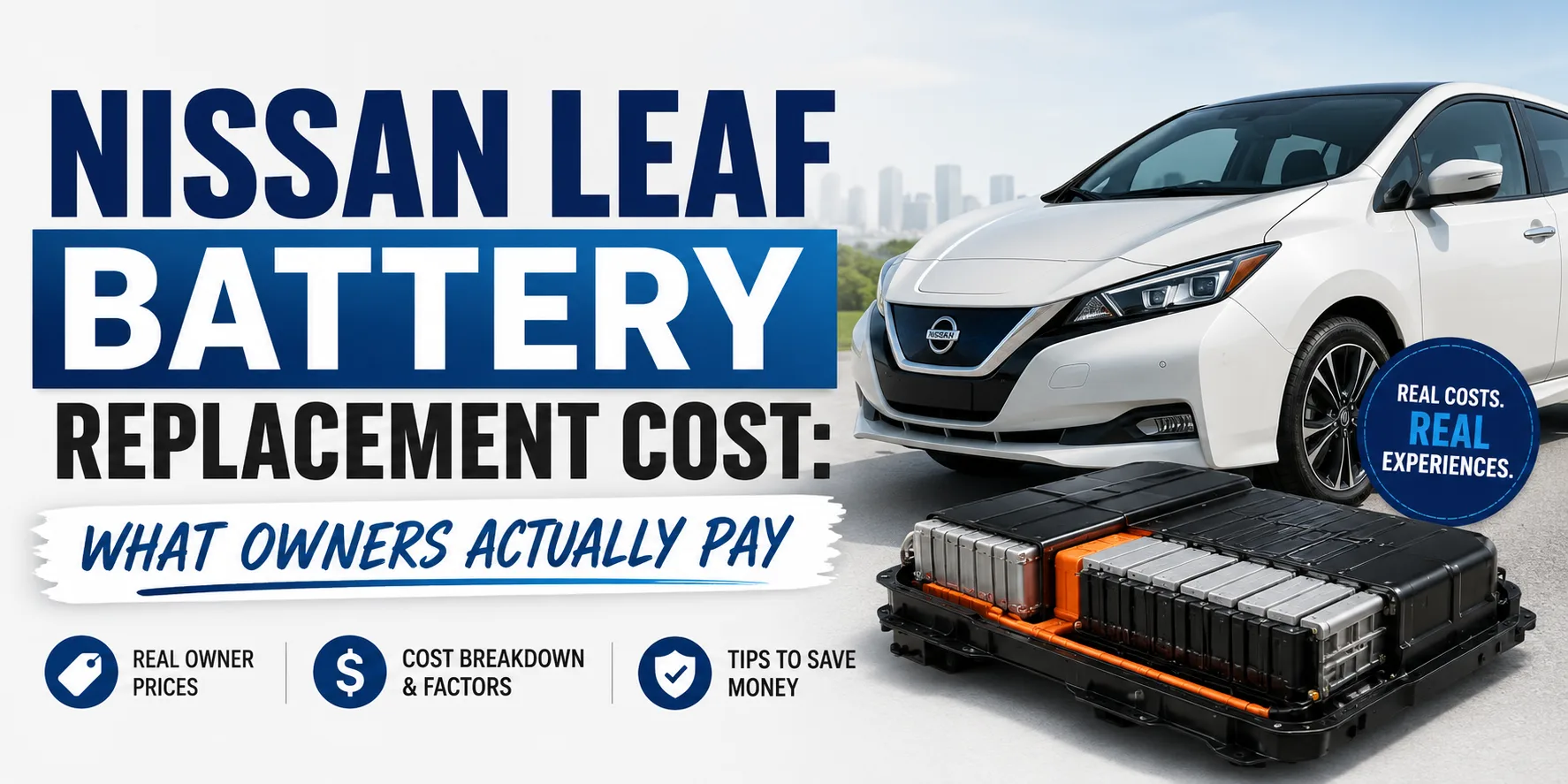
If you own a Nissan Leaf, you’ve probably wondered at some point: what happens if the battery needs replacing? It’s the most expensive component in the car and the answer isn’t straightforward. The cost ranges from a few thousand dollars to well over the car’s market value, depending on which battery size you have, where you get the work done, and whether your warranty still has you covered.
This guide gives you the real numbers, the warranty details that most owners overlook, and the honest answer to the question Leaf owners eventually all ask: is replacing the battery actually worth it?
Nissan Leaf Battery Sizes: Which One Do You Have?
Before looking at costs, you need to know which battery pack your Leaf has because the price difference between them is significant.
| Model Year | Battery Size | Original EPA Range |
|---|---|---|
| 2011–2015 | 24 kWh | 73–84 miles |
| 2016–2017 | 30 kWh | 107 miles |
| 2018–2022 | 40 kWh | 149–151 miles |
| 2019–2025 (Plus) | 62 kWh | 212 miles |
How to check yours: Look at your window sticker, owner’s manual, or check in your NissanConnect app under vehicle details. You can also search your exact model year and trim level the 40 kWh and 62 kWh packs come with the Leaf Plus badge.
Nissan Leaf Battery Replacement Cost by Pack Size (2025–2026)
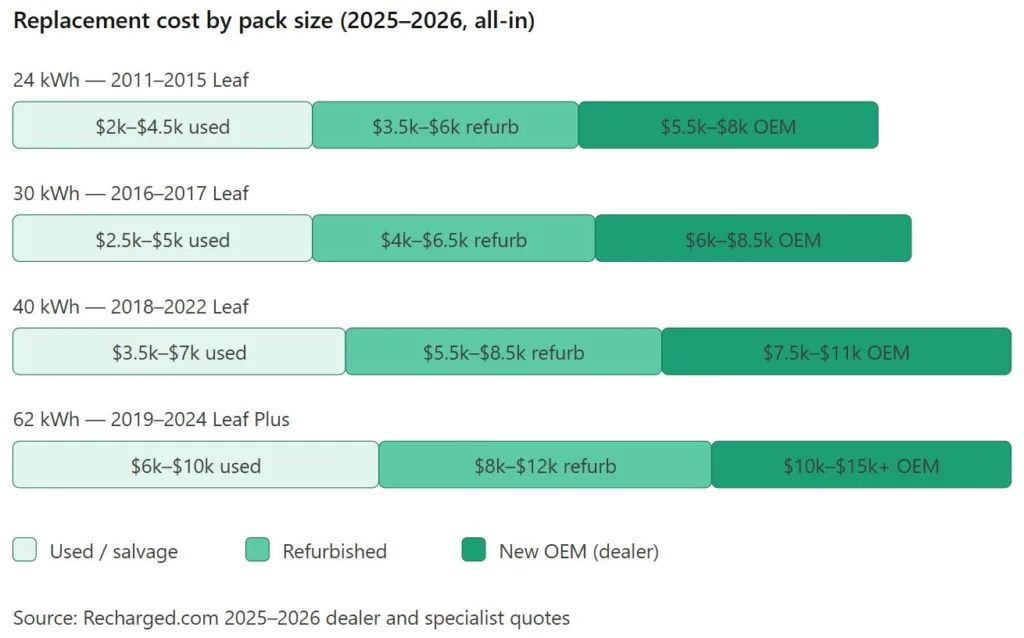
Here are the real-world price ranges owners are seeing in 2025–2026, based on data from dealer quotes, independent EV shops, and specialist sources. These are all-in figures including parts and labor.
| Pack Size | New/OEM (Dealer) | Refurbished (Specialist) | Used/Salvage |
|---|---|---|---|
| 24 kWh (2011–2015) | $5,500–$8,000 | $3,500–$6,000 | $2,000–$4,500 |
| 30 kWh (2016–2017) | $6,000–$8,500 | $4,000–$6,500 | $2,500–$5,000 |
| 40 kWh (2018–2022) | $7,500–$11,000 | $5,500–$8,500 | $3,500–$7,000 |
| 62 kWh (2019–2024 Plus) | $10,000–$15,000+ | $8,000–$12,000 | $6,000–$10,000 |
Sources: Recharged.com (2025–2026 dealer and specialist quotes); Recurrent Auto EV Battery Replacement Research
Labor costs alone: Removing and replacing a Leaf’s high-voltage pack typically adds $500–$1,500 to the bill. The job requires specialist equipment and EV-certified technicians this is not a DIY repair.
What Drives the Price Difference?
Three factors move the needle most on final cost:
1. New OEM vs refurbished vs used
A brand-new OEM pack from a Nissan dealer costs the most but offers predictable, like-new performance. Refurbished packs, sourced by specialist EV shops from salvaged Leafs and reconditioned, can save you $2,000–$5,000 and many come with 2–3 year warranties from the installer. Used salvage packs are cheapest but carry the most risk: the pack’s actual health is unknown unless tested with tools like LeafSpy Pro before purchase.
2. Who does the work
Independent EV specialists consistently undercut dealer pricing by thousands. In competitive metro markets, you may find multiple specialists quoting the same job use that competition to your advantage. Always ask what warranty the installer puts on the replacement pack, not just the labor.
3. Upgrading vs replacing like-for-like
Owners of older 24 kWh or 30 kWh Leafs sometimes choose to upgrade to a 40 kWh pack rather than replace like-for-like. More range, better resale value, longer-lasting chemistry. The catch: upgrades on older Leafs can require additional hardware changes and software modifications, adding $1,000 or more on top of the battery itself. Always get a written quote that spells out exactly what’s included.
The Nissan Leaf Battery Warranty: What It Actually Covers
This is where most Leaf owners discover important things they didn’t know when they bought the car.
Coverage period: 8 years or 100,000 miles, whichever comes first.
What’s covered:
- Defects in materials or workmanship
- Excessive capacity loss this is the key clause
The capacity bar threshold:
The Leaf’s dashboard shows battery capacity as a row of bars 12 bars when new, representing full original capacity. Nissan’s warranty covers capacity loss if the battery drops below 9 bars within the warranty period. At 9 bars, the battery has lost roughly 30% of its original capacity equivalent to around 70% State of Health (SoH).
If your battery drops to 8 bars or fewer while still within 8 years/100,000 miles, you’re entitled to a free repair or replacement at a Nissan dealership.
Important detail: The warranty clock starts from the original in-service date when the car was first sold or leased, not the model year. A 2019 Leaf sold as a demo in early 2020 could have battery coverage running until 2028. If you bought your Leaf used, check the original sale date, not the model year, to know exactly where you stand.
For 2011–2012 Leafs specifically: Nissan extended an additional capacity warranty covering these early models against dropping below 9 bars for 60 months or 60,000 miles a response to the well-documented fast degradation of first-generation 24 kWh packs.
What the warranty does NOT cover:
- Normal gradual capacity loss that stays above 9 bars
- Misuse, flooding, or accident damage
- Modifications to the battery system
The Leaf’s Biggest Battery Challenge: No Active Thermal Management
This is the single most important thing to understand about Nissan Leaf battery longevity and it’s the reason older Leafs have a worse degradation reputation than most other EVs.
Most EVs use active liquid cooling to keep the battery in its optimal temperature range. The Nissan Leaf, through its 2017 model year, uses a passive air-cooled system. There’s no liquid loop actively managing battery temperature. When it’s hot outside and you are fast charging or driving hard, the battery runs hot and heat is the primary accelerator of battery degradation. Read our blog on Is Fast Charging Bad for EV Battery?
What this means in practice:
According to degradation data from Recharged.com and owner forum research, early 24 kWh Leaf packs lost an average of 2.5–3.5% capacity per year roughly double the rate of liquid-cooled EVs in the same period. In hot climates like Arizona, Texas, and Florida, that rate was often higher.
The 2018+ 40 kWh and 62 kWh packs use improved battery chemistry and fare better typically losing 1–2% capacity per year in moderate climates with sensible charging habits.
This is why location matters so much for used Leaf buyers. A 2015 Leaf with 50,000 miles from Seattle may be in dramatically better battery condition than an identical car from Phoenix with the same mileage.
Signs Your Nissan Leaf Battery May Need Replacing
Watch for these warning signs, regardless of your mileage:
- Range noticeably lower than when the car was new not just cold weather reduction, but consistent shorter trips on a full charge
- Battery bars dropping if you’re down to 9 bars or fewer, check your warranty immediately
- Charging stopping early won’t charge past a certain point even when set to 100%
- Sudden range drops mid-drive the car estimates 60 miles of range then drops to 20 miles unexpectedly
- Battery warning light on dashboard
- Any of these warrant a battery health check first, using LeafSpy Pro (the standard tool Leaf owners use) paired with a Bluetooth OBD2 adapter. This gives you an exact SoH reading before you spend anything.
If you’re seeing capacity issues and still within the warranty window, do not pay for a replacement file a warranty claim first.
Is Replacing the Nissan Leaf Battery Worth It?
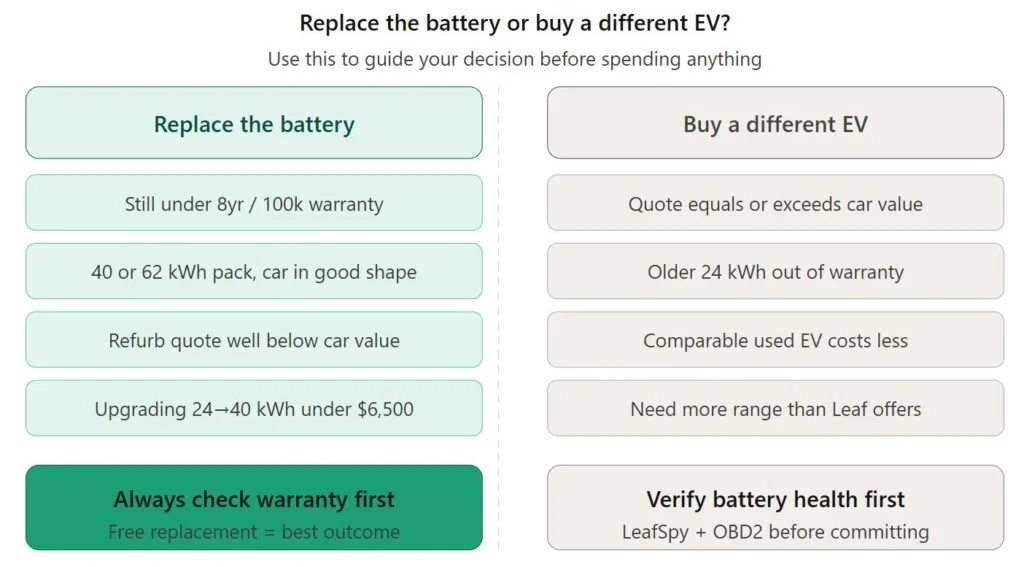
This is the honest, uncomfortable question and the answer depends entirely on the car’s value versus the replacement cost.
When replacement makes sense:
- The car is under warranty and the replacement is free or heavily subsidized
- You have a 40 kWh or 62 kWh Leaf in otherwise good condition, and the replacement cost is meaningfully less than buying a comparable used EV
- You’re upgrading from a 24 kWh to a 40 kWh pack and the total installed cost is under $6,000–$7,000
When it probably doesn’t:
- The all-in replacement quote equals or exceeds the car’s current market value
- You have a 2011–2015 24 kWh Leaf these often sell for $3,000–$6,000, making a $5,000–$8,000 battery replacement economically difficult to justify
- A comparable used EV with strong battery health is available for less than the repair total
Real-world example from Recharged.com: A 2017 Leaf purchased used in 2025 still had warranty coverage and was down to 7 bars. The dealer replaced it with a 40 kWh pack under warranty in under two weeks effective all-in cost to the owner was around $5,000 for the car purchase itself. Battery replacement under warranty is by far the most cost-effective outcome.
The rule of thumb: Always compare the battery replacement quote against the cost of stepping into a different used EV with a verified, healthy battery before signing a repair order.
Ways to Reduce Nissan Leaf Battery Replacement Cost
If you’re out of warranty and need to replace, here’s how to keep costs down:
- Get at least 3 quotes dealers, independent EV specialists, and salvage-based specialists. Prices vary by thousands for the same job.
- Consider a refurbished pack many specialist shops offer 2–3 year warranties on refurbished packs, which is often better than the 12-month warranty on OEM dealer packs.
- Check your warranty one more time verify the original in-service date, not just model year. Many owners discover they have more coverage remaining than they thought.
- Check for open recalls in 2024–2025, Nissan recalled certain 2019–2022 Leafs for a battery overheating issue during DC fast charging. The remedy is a free software update. Check nhtsa.gov/recalls with your VIN.
- Use LeafSpy to verify condition before any work a $15 app and a $25 OBD2 adapter can confirm exactly what your battery’s SoH is before you commit to any repair path.
For daily habits that slow degradation and extend your battery’s useful life, read our blog on how to extend EV battery life.
Quick Reference: Nissan Leaf Battery Costs at a Glance
| Situation | Estimated Cost |
|---|---|
| Under warranty dealer repair | Free (if battery drops below 9 bars) |
| 40 kWh replacement, refurbished | $5,500–$8,500 installed |
| 40 kWh replacement, OEM dealer | $7,500–$11,000 installed |
| 62 kWh replacement, refurbished | $8,000–$12,000 installed |
| 24 kWh replacement (older Leafs) | $3,500–$8,000 installed |
| Labor only (dealer/specialist) | $500–$1,500 |
Final Thoughts
The Nissan Leaf battery replacement decision is really two decisions: first, whether your warranty still covers you (check before spending anything), and second, whether a replacement makes economic sense given the car’s current value.
For Leaf owners still under warranty with degraded batteries, the outcome can be excellent Nissan’s 8-year/100,000-mile coverage with the 9-bar capacity clause is a meaningful safety net. For out-of-warranty owners with older 24 kWh packs, the math often points toward a different used EV rather than a replacement.
Either way, knowing your battery’s actual SoH before making any decision is essential. A 10-minute check with LeafSpy Pro can save you thousands.
Frequently Asked Questions
Q. How much does it cost to replace a Nissan Leaf battery?
A. In 2025–2026, the all-in cost ranges from around $2,000 for a used 24 kWh pack on older Leafs, up to $15,000+ for a new OEM 62 kWh pack installed at a dealer. The most common scenario for 40 kWh Leaf owners is $6,000–$10,000 at an independent EV specialist.
Q. Does Nissan cover battery replacement under warranty?
A. Yes. Nissan’s battery warranty covers the Leaf for 8 years or 100,000 miles against defects and excessive capacity loss. If your battery drops below 9 of 12 capacity bars within that period, Nissan is required to repair or replace it at no cost to you.
Q. How long does a Nissan Leaf battery last?
A. In moderate climates with sensible charging habits, 40 kWh and 62 kWh packs typically last the full warranty period and beyond, losing around 1–2% capacity per year. Older 24 kWh packs, especially in hot climates, degraded faster often 2.5–3.5% per year.
Q. Can I replace a Nissan Leaf battery myself?
A. Not practically. The traction battery pack weighs over 600 pounds and operates at high voltage. Removal requires specialist equipment and EV-certified technicians. Attempting a DIY replacement also voids any remaining warranty.
Q. Is it worth replacing a Nissan Leaf battery?
A. It depends on the cost versus the car’s value. If you’re under warranty, almost always yes. If out of warranty, compare the replacement quote against the cost of a comparable used EV with a healthy battery before committing.

Jamie Carter is an EV enthusiast and independent researcher who has been following electric vehicle technology since 2019. After buying her first EV and spending years digging through manufacturer data, owner forums, and industry reports to answer her own questions, she started sharing what she learned. At EV Battery Central, Jamie writes research-backed guides on battery health, charging habits, and EV ownership & more.