Your EV battery is the most expensive component in the car. It can represent 30 to 40% of the vehicle’s total value. So before you sign anything, understanding what the battery warranty actually covers is one of the smartest things you can do.
The good news is most major brands now offer solid battery coverage. The bad news is not all warranties are built the same, and the differences are in the details that most buyers never read. This guide cuts through the fine print so you know exactly what you are getting, brand by brand.
What Every EV Battery Warranty Has (and What to Watch For)
Every EV battery warranty in the US has three core components. Understanding all three is important because brands use them differently.
- Coverage period: How many years the warranty runs from the original in-service date.
- Mileage limit: The maximum mileage allowed. The warranty expires at whichever comes first, years or miles.
- Capacity guarantee: The percentage of original battery capacity the manufacturer promises to maintain. If your battery drops below this threshold within the warranty period, the manufacturer must repair or replace it.
Most people only look at years and miles. The capacity guarantee is where the real differences show up.
By federal law in the US, all EV batteries must be covered for at least 8 years or 100,000 miles. California extends this to 10 years or 150,000 miles for 2026 model year vehicles, with an 80% capacity floor. Other CARB-aligned states are expected to follow.
EV Battery Warranty Comparison: Brand by Brand
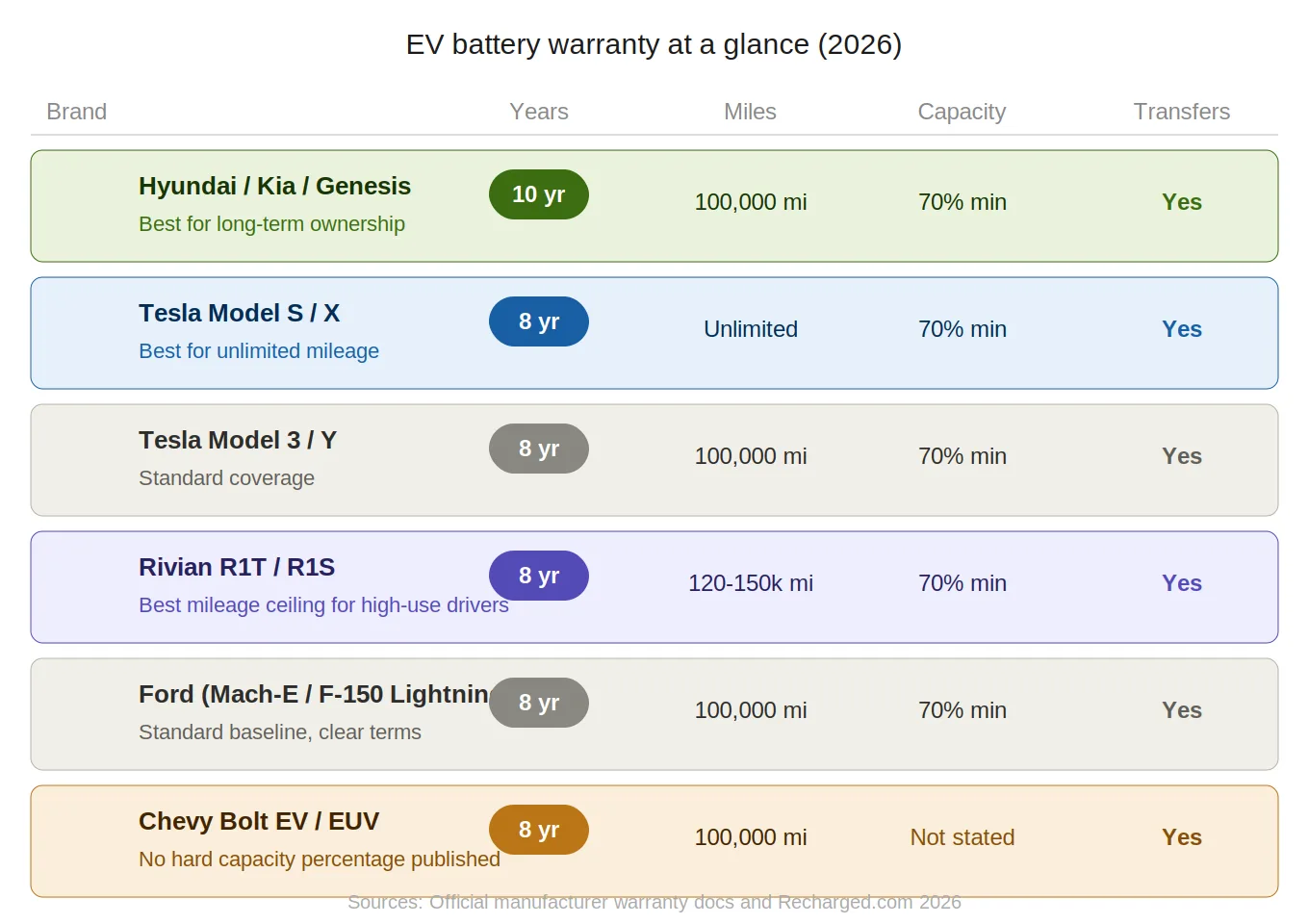
Hyundai, Kia and Genesis – Best in Class for Coverage Length
Coverage: 10 years or 100,000 miles
Capacity guarantee: 70% minimum
Transferable to second owner: Yes
Hyundai, Kia and Genesis offer the longest standard battery warranty of any mainstream brand in the US. Ten years of coverage means a 2026 Ioniq 5 or EV6 is protected until 2036 under normal use. Hyundai states clearly in its official warranty documentation: the battery will not degrade below 70% of original capacity during the warranty period.
This is the straightforward, no-fine-print promise that makes Hyundai and Kia stand out. If you plan to keep your EV for a long time, these brands are hard to beat on paper coverage alone.
Tesla – Strongest Mileage Terms
Coverage Model 3/Y: 8 years or 100,000 miles, 70% capacity
Coverage Model S/X: 8 years or unlimited miles, 70% capacity
Transferable to second owner: Yes
Tesla splits warranty terms by model. The Model S and Model X have the standout clause: 8 years with no mileage cap at all. That is exceptional for high-mileage drivers. The Model 3 and Model Y sit at the standard 8 years or 100,000 miles with a 70% capacity floor.
One important note: Tesla does not cover gradual capacity loss that stays above the 70% threshold. Loss of battery energy over time due to normal usage is explicitly excluded. The warranty covers defects and failures, not slow degradation.
Starting with 2026 model year vehicles, Tesla also introduced a separate 7-year warranty on high-priced propulsion-related parts, adding another layer of protection on top of the standard battery coverage.
Ford (Mustang Mach-E and F-150 Lightning) – Solid Baseline
Coverage: 8 years or 100,000 miles
Capacity guarantee: 70% minimum
Transferable to second owner: Yes
Ford’s EV battery warranty is clean and straightforward. Both the Mustang Mach-E and F-150 Lightning carry the same terms: 8 years or 100,000 miles with an explicit promise that the battery will retain at least 70% of its original capacity. Ford’s official EV care page confirms this coverage for both models.
The coverage is fully transferable, which matters a lot if you are buying a used Mach-E or Lightning. The warranty follows the vehicle, not the first owner.
Chevrolet Bolt EV and EUV – Coverage Without a Hard Capacity Number
Coverage: 8 years or 100,000 miles
Capacity guarantee: No specific percentage published
Transferable to second owner: Yes
The Chevy Bolt meets the federal 8-year or 100,000-mile requirement. However, unlike Tesla, Ford, Hyundai and most other brands, GM does not publish a hard capacity percentage guarantee for the Bolt. The warranty covers defects in materials and workmanship, not a specific minimum capacity level.
In practice, GM investigates sudden or severe range loss as a potential defect. Gradual degradation that stays within what GM considers normal wear is not covered. The line between normal and warrantable degradation is less clearly defined here than with other brands.
This does not mean the Bolt is a bad choice. It has a strong real-world reliability record. But if a clear capacity floor matters to you, other brands spell it out more precisely.
VW, BMW, Mercedes-Benz, Nissan and Others – The 8-Year Baseline
Coverage: 8 years or 100,000 miles
Capacity guarantee: 70% minimum (most models)
Transferable: Varies by brand
The majority of remaining mainstream brands cluster at the same baseline: 8 years, 100,000 miles, 70% capacity. This includes Volkswagen ID.4, BMW iX and i4, Mercedes EQ series, Nissan Ariya, Volvo XC40 Recharge and Polestar 2.
Nissan deserves a specific mention. The Leaf uses a 12-bar capacity display rather than a percentage, with warranty coverage triggering if the battery drops below 9 bars within the 8-year or 100,000-mile period. This is equivalent to roughly 70% SoH. For a full breakdown of how this works, see our Nissan Leaf battery replacement cost guide.
What Does 70% Capacity Actually Mean for Your Range?
This is the question most warranty articles skip. A 70% capacity guarantee sounds reassuring, but what does it mean on the road?
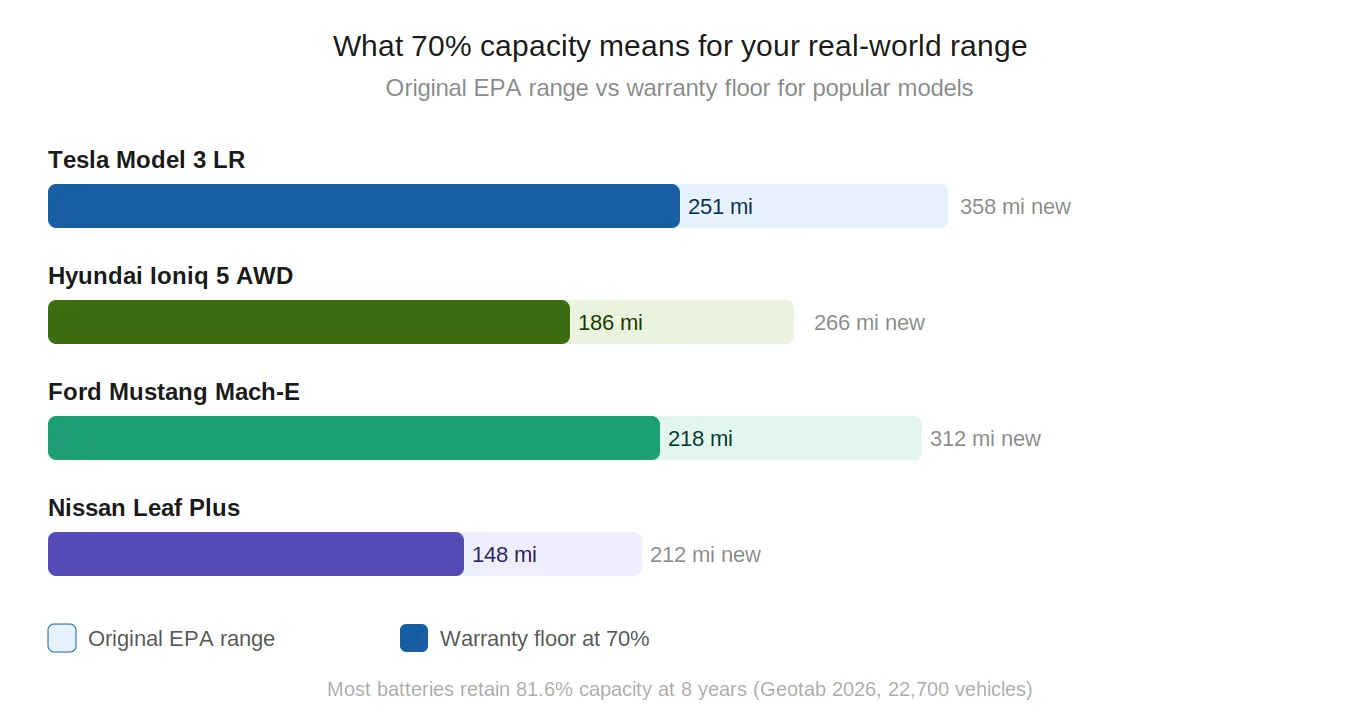
Here is a simple way to think about it. Take your EV’s original range when new, and multiply by 0.70. That is the minimum range your battery is guaranteed to deliver before the warranty triggers a replacement.
Examples using EPA-rated range when new:
- Tesla Model 3 Long Range (358 miles new): warranty floor is approximately 251 miles
- Hyundai Ioniq 5 AWD (266 miles new): warranty floor is approximately 186 miles
- Ford Mustang Mach-E (312 miles new): warranty floor is approximately 218 miles
- Nissan Leaf Plus (212 miles new): warranty floor is approximately 148 miles
In practice, most EV batteries degrade far slower than this. Geotab’s 2026 study of over 22,700 real-world EVs found the average battery retains around 81.6% of original capacity after 8 years of typical use. The 70% threshold exists as a safety net, not an expectation.
Does the Warranty Transfer When You Buy Used?
Yes, for most mainstream brands. Tesla, Ford, GM, Hyundai, Kia, Nissan and Rivian all transfer the remaining battery warranty to subsequent owners for the remaining time and mileage.
What this means in practice: if you buy a 2022 Hyundai Ioniq 5 in 2026 with 40,000 miles on it, you have up to 6 more years and 60,000 more miles of battery coverage remaining. That is a meaningful financial safety net on a used purchase.
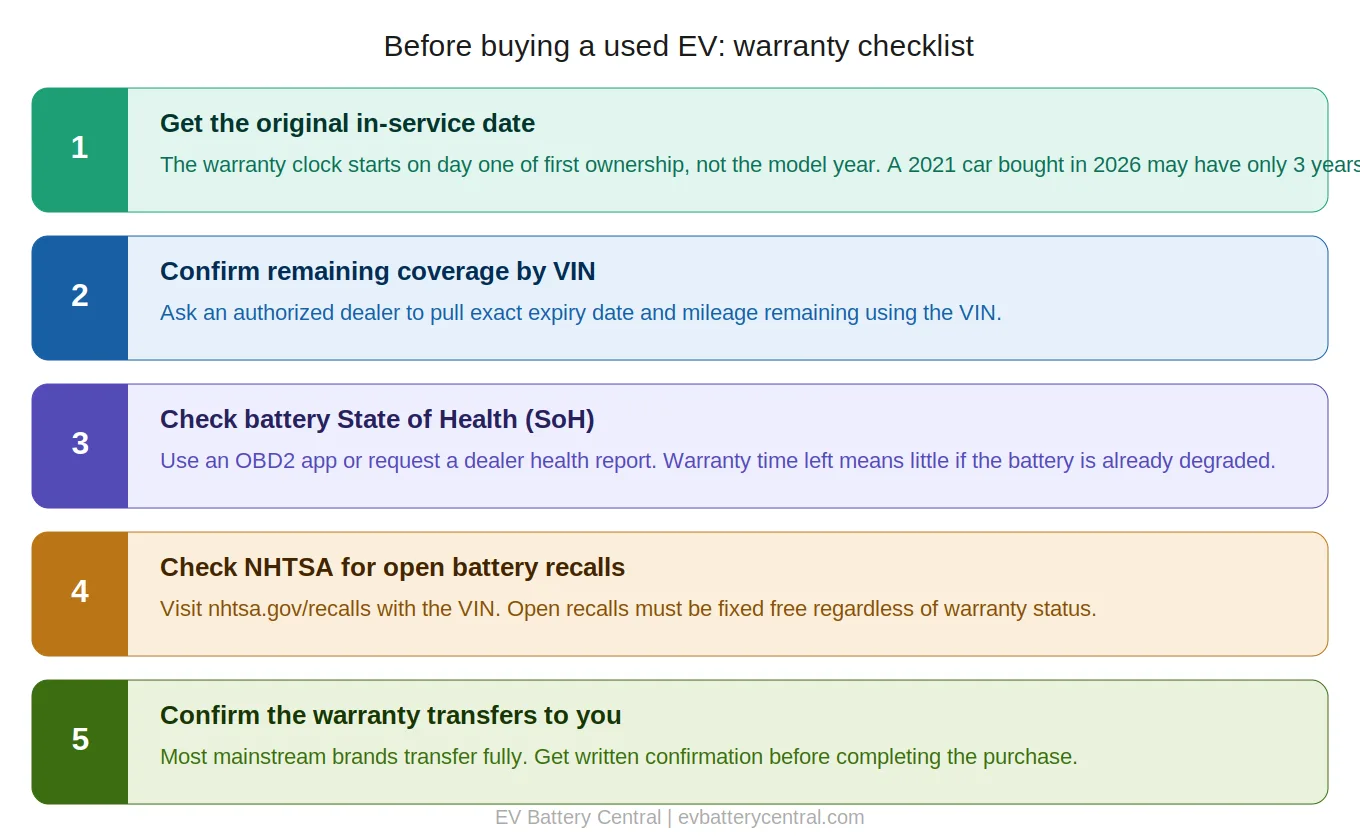
A few things to always check when buying used:
- Ask for the original in-service date, not just the model year
- Have a dealer confirm the warranty start date and remaining coverage by VIN
- Check NHTSA.gov for any open battery recalls before completing the purchase
Which EV Battery Warranty Is Actually Best?
The honest answer depends on how you use your vehicle.
- If you want the longest time coverage: Hyundai, Kia, Genesis. Ten years beats everyone else on the calendar.
- If you drive high mileage: Tesla Model S or X (unlimited miles) or Rivian with a large pack (150,000-mile ceiling) give you the most room.
- If you want a clear, published capacity promise: Most brands are clear at 70%. Chevy is the exception, with no hard percentage published.
- If you are buying used: Check the in-service date, verify remaining coverage by VIN, and use the battery health check guide before committing to any purchase regardless of brand.
The baseline of 8 years and 100,000 miles that most brands offer is genuinely solid protection for the majority of owners. The real gap is not between brands, it is between owners who read the warranty and those who do not.
Frequently Asked Questions
Q. What is the minimum EV battery warranty required by law in the US?
A. By federal law, all plug-in EV batteries must be covered for at least 8 years or 100,000 miles, whichever comes first. California requires 10 years or 150,000 miles for newer model years.
Q. Does EV battery warranty cover normal degradation?
A. No. All manufacturer warranties exclude gradual capacity loss from normal use. The warranty covers defects and excessive or abnormal capacity loss that drops below the published threshold, typically 70%.
Q. Which brand has the best EV battery warranty in 2026?
A. Hyundai, Kia and Genesis lead on coverage length at 10 years or 100,000 miles. Rivian leads on mileage for high-use drivers with up to 150,000-mile coverage on larger pack configurations. Tesla’s Model S and X offer 8 years with no mileage cap.
Q. Does fast charging void my EV battery warranty?
A. No. DC fast charging within manufacturer specifications does not void the battery warranty for any major brand. This is one of the most common misconceptions about EV ownership.
Q. How do I check how much battery warranty I have left on a used EV?
A. Contact an authorized dealer with your VIN. They can confirm the original in-service date and calculate remaining warranty coverage. For Nissan Leaf owners, you can also use LeafSpy Pro to check battery health directly.

Jamie Carter is an EV enthusiast and independent researcher who has been following electric vehicle technology since 2019. After buying her first EV and spending years digging through manufacturer data, owner forums, and industry reports to answer her own questions, she started sharing what she learned. At EV Battery Central, Jamie writes research-backed guides on battery health, charging habits, and EV ownership & more.