Quick Answer: On a used EV, the battery is the most important thing to check before you sign anything. Mileage alone tells you very little. A 60,000-mile EV with a healthy battery can be a far better buy than a 30,000-mile one with a tired pack. This checklist gives you 12 specific things to check, the red flags that mean walk away, and the exact questions to ask every seller.
Used EV prices have dropped 35% to 40% from new in 2026, and over 2.3 million electric vehicles are hitting their 3 to 5 year mark this year alone. For a lot of buyers, a used EV is now genuinely within reach.
But here is the catch that most buyers miss.
On a gas car, the odometer tells you most of what you need to know about wear. On an EV, the odometer tells you very little by itself. A three-year-old EV with 60,000 miles and a healthy battery can be in better shape than the same car with 30,000 miles and a tired one, depending on how and where the car was charged and stored.
The number that matters is battery State of Health. This checklist tells you exactly how to get it, read it, and use it.
Why Used EV Battery Health Is More Important Than Mileage
Based on 2026 market analysis, the best value in the used EV market lies in 3 to 4 year old EVs with 88% to 92% State of Health. You avoid the steep initial depreciation of 40% to 50% in the first three years while still getting 8 to 10 years of usable life before hitting the 70% replacement threshold.
A degraded battery does two things to a used EV deal. It reduces the range you get every day. And it reduces what the car is worth when you sell. Analysis of over 58,000 used EV listings shows that each 1% drop in battery State of Health pulls resale value down by 1.2% to 1.6% for mainstream EVs and up to 2% for premium long-range models.
Energy Solutions Intelligence analysed 847 used EV transactions in 2025 and found that battery health was the number one deal-breaker. Buyers who brought battery health data to negotiations saved an average of $4,200 more than those who did not.
Knowledge is literally money here. Here is the checklist.
Before You Contact the Seller: 3 Things to Do First
Check 1: Look Up the Original EPA Range for the Exact Trim
Do not look up the general model name. Look up the specific year, trim, and battery pack. Range and charging speed vary significantly within the same model name. The original EPA figure is your baseline for every battery health comparison you make during the inspection.
Check 2: Look Up Any Open Recalls for That Model Year
Visit NHTSA.gov and enter the VIN or model year. A vehicle with a salvage, rebuilt, flood, or lemon-law title and any unresolved safety recalls are immediate reasons to pause. Battery-related recalls that have not been completed are a specific concern on some older models.
Check 3: Research the Battery Chemistry for That Model
Find out whether the car uses an LFP or NMC battery. This matters because it tells you what good charging habits looked like for that car. An LFP car that was regularly charged to 100% was being used correctly. An NMC car regularly charged to 100% was accumulating extra wear every single day.
At the Inspection: 9 Battery Health Checks
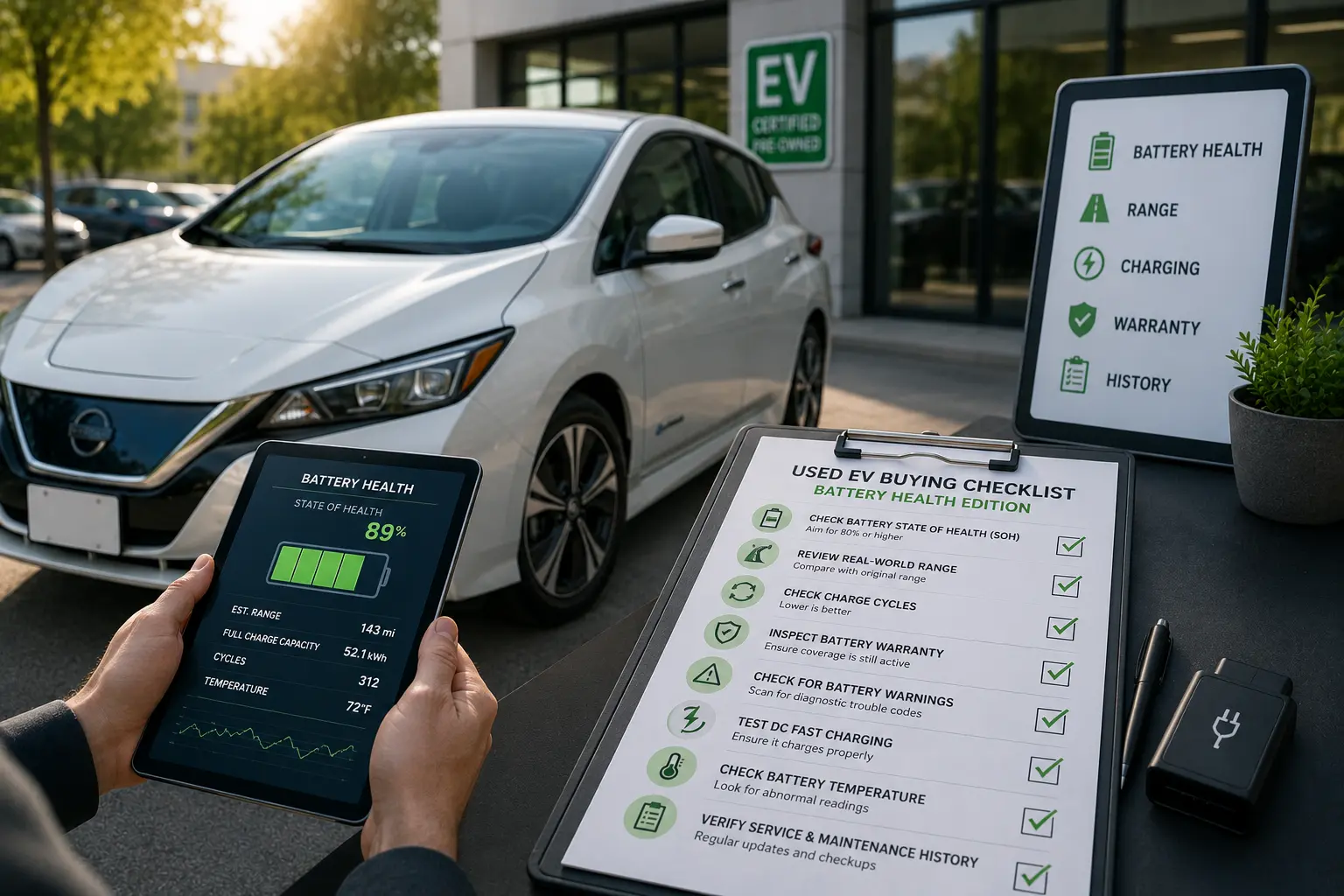
Check 4: Ask for the Battery State of Health Report Upfront
This is the single most important document in any used EV transaction. Ask for a battery health report, state of health estimate, service record, or dashboard range photo at a known state of charge. Verify the remaining battery warranty.
Ask for the SoH as a percentage. A number alone without context means less than understanding what is normal for that model and age.
As a rough guide based on 2026 fleet data:
- Above 90% SoH: Excellent. Battery has been well maintained.
- 85% to 90% SoH: Good. Normal wear for 3 to 5 year old EVs.
- 80% to 85% SoH: Acceptable but factor it into price negotiations.
- Below 80% SoH: Warrants serious investigation before committing.
Clear red flags that should trigger deeper investigation or an immediate walk away include SoH below 80% within the first 120,000 km unless the car has done extreme mileage or relied on fast charging only, large cell imbalance of more than 80 to 100 mV difference between modules at mid state of charge, and repeated thermal limiting events recorded in the log.
Check 5: Open the Manufacturer App and Check the Data
Ask the seller to open the manufacturer’s companion app while you are sitting together. Most major brands including Tesla, Ford, GM, Hyundai, and Kia expose battery health data through their owner apps.
Look for:
- Current full charge range estimate
- Any battery related diagnostic codes or warnings
- Charging history if the app shows it
A car that shows mostly home charging sessions is significantly different from one that shows daily fast charging sessions. The pattern matters as much as the current reading.
Check 6: Do the Dashboard Range Check
Charge the EV to 100% if possible. Look at the projected range shown on the dashboard. Compare it to the original EPA rated range for that trim. The percentage difference gives you a rough State of Health estimate you can verify yourself without any tools.
Example: A car originally rated at 300 miles showing 255 miles at 100% charge is sitting at roughly 85% SoH. That is healthy for a 3 to 4 year old EV. A car rated at 300 miles showing 200 miles is at roughly 67% SoH. That is below most warranty thresholds.
Two important caveats: Cold weather temporarily reduces displayed range without indicating real degradation. And dashboard estimates reflect recent driving conditions. Give yourself a few miles of margin when reading these numbers in less than ideal conditions.
Check 7: Check Charging Speed at a Fast Charger
If possible, plug the car into a DC fast charger during your inspection. Watch how fast the charging rate climbs and whether it holds steady.
Slow or inconsistent charging speed compared to the car’s rated capability can indicate battery management issues, thermal problems, or cell degradation beyond what the SoH reading alone reveals. A healthy battery at a compatible fast charger should charge at or close to its rated maximum up to around 80% charge.
Check 8: Inspect the Charging Port Physically
Look for damage, corrosion, loose connections, or hacked-on adapters around the charging inlet. Confirm you are getting the mobile charger, any Level 2 cable, and adapters promised in the listing.
A damaged charging port is not just a cosmetic issue. Repairs can cost $500 to $1,500 and a port that does not make clean contact can affect charging efficiency and long-term battery health.
Check 9: Look Under the Car for Battery Pack Damage
Look under the car for fresh scrapes, dents in the battery enclosure, missing underbody panels, or homemade shielding. A pack that has been dragged over curbs is a concern.
The battery pack sits under the floor on most EVs. Even minor physical damage to the enclosure can affect thermal management and long-term cell health. This takes 30 seconds and most buyers never do it.
Check 10: Check Climate and Storage History
Hot-climate cars that lived outdoors, especially early EVs, deserve extra scrutiny on State of Health. Ask for climate history and records.
A car from a hot climate with no garage parking has likely degraded faster than the same car from a moderate climate. This is not an automatic deal-breaker but it should be reflected in the price and factored into your SoH expectations.
Check 11: Look for Battery Related Service History
Ask to see the full service history. Specifically look for:
- Any battery module replacements
- Any battery management system software updates
- Any thermal management repairs
- Any history of battery warning lights
One service record for a software update is completely normal. Repeated battery warnings, multiple thermal events, or undocumented battery work are all reasons to get an independent diagnostic before committing.
Check 12: Get an Independent Battery Diagnostic
Independent EV inspection services exist in most major metro areas. For a modest fee, often a few hundred dollars, they can pull a comprehensive battery report using OBD-II diagnostic tools designed for EVs and provide an unbiased assessment of battery health, charging system condition, and high-voltage component status. On a higher-priced used EV purchase, the fee tends to pay for itself in negotiating room or peace of mind.
This step is optional for lower-priced purchases. For anything above $20,000, it is genuinely worth it. A proper independent diagnostic catches cell-level issues that a simple SoH reading from the dashboard or app can miss.
Battery Warranty: Verify Before You Sign
Many used EVs may still have some original battery warranty remaining, especially newer model years or lower-mileage vehicles. Coverage varies by manufacturer and VIN, so always verify the warranty directly before buying.
What to confirm in writing before signing:
- Remaining warranty in both years and miles for that specific VIN
- The capacity threshold covered, usually 70% SoH
- Whether the warranty transfers to you as the second owner
- How to file a claim and where service must be performed
- Whether any prior accident history or modifications affect coverage
Our EV battery warranty comparison guide covers the major brand warranty terms side by side so you know what to expect before you even start negotiating.
Red Flags That Mean Walk Away
Some things are worth negotiating around. These are not.
Battery warnings, reduced-power turtle modes, or repeated thermal alerts are all reasons to walk unless a specialist can document a proper fix.
Walk away without hesitation if you find:
- The seller cannot or will not provide any battery health information
- Active battery fault warning lights on the dashboard
- SoH significantly below what the age and mileage would normally suggest with no explanation
- A salvage, rebuilt, or flood title on any EV regardless of price
- Battery pack physical damage with no documentation of inspection or repair
- Charging port that does not function during the inspection
- Missing charging cables or adapters that were listed in the sale
A used EV does not need to be perfect, but some warning signs should make you slow down, renegotiate, or walk away. If the dashboard range looks unusually low for the battery size and weather, or if no one can verify battery warranty status for the VIN, those are signals worth taking seriously.
The Quick Negotiation Guide Using Battery Health Data
Once you have the SoH reading, use it. Most sellers price used EVs based on mileage and condition without factoring in battery health precisely. That gap is your opportunity.
A 5% difference in battery degradation can alter a vehicle’s value by over $2,000. If the SoH is lower than the price suggests, use the data to negotiate. Show the seller the SoH reading, show what a replacement would cost if the battery continues declining, and ask for the price to reflect the actual battery condition rather than the mileage alone.
Our EV battery replacement cost calculator helps you estimate what a replacement would cost on that specific model, which gives you a concrete number to anchor any negotiation.
The Bottom Line: 30 Minutes of Battery Homework Saves Thousands
A used EV is a different kind of purchase than a used petrol car. The engine equivalent, the battery, is not something you can hear or feel on a quick test drive. It requires specific checks.
The good news is that none of these checks are complicated. Most take five minutes. Together they give you a clear, data-backed picture of what you are actually buying.
The sellers who resist these checks are telling you something. The ones who share the data confidently are telling you something too.
Use this checklist on every used EV you inspect and you will buy with confidence rather than hope.
For more on what healthy battery aging looks like on the car you are considering, our guide on what normal EV battery degradation looks like year by year gives you the benchmarks to compare against.
Frequently Asked Questions About Buying a Used EV Battery
Q. What is a good battery State of Health for a used EV?
A. Above 85% SoH is excellent for a 3 to 5 year old EV. Between 80% and 85% is acceptable if the price reflects it. Below 80% on a car that young warrants independent investigation before purchase.
Q. Does mileage or battery health matter more when buying a used EV?
A. Battery health matters more. Two EVs with identical mileage can have very different SoH depending on charging habits, climate, and fast charging use. Always ask for the SoH reading before focusing on the odometer.
Q. Can I check battery health myself without any special tools?
A. Yes, as a rough check. Charge the car to 100% and compare the dashboard range estimate to the original EPA rating for that trim. The percentage difference approximates SoH. For a more accurate reading, use a model-specific app or an independent diagnostic.
Q. Is it worth paying for an independent battery inspection?
A. For any used EV purchase above $20,000, yes. An independent inspection costing a few hundred dollars typically pays for itself in negotiating power alone. Energy Solutions Intelligence found buyers who came with battery health data saved an average of $4,200 compared to those who did not.
Q. What should I do if the seller refuses to provide battery health data?
A. Treat the refusal as a red flag. Walk away or insist on an independent inspection at your own cost before agreeing to any price. A seller confident in their car’s battery health has every reason to share the data.

Jamie Carter is an EV enthusiast and independent researcher who has been following electric vehicle technology since 2019. After buying her first EV and spending years digging through manufacturer data, owner forums, and industry reports to answer her own questions, she started sharing what she learned. At EV Battery Central, Jamie writes research-backed guides on battery health, charging habits, and EV ownership & more.