Quick Answer: Store your EV at 40% to 60% charge in a cool, shaded location. Most EV batteries will sit safely for weeks without issue. For storage beyond one month, disable unnecessary background features, check on the charge level every few weeks, and keep the 12-volt auxiliary battery from draining completely. Do not store at 100% or near 0%.
Whether you are heading off on a long trip, storing a second car over winter, or simply not driving for a few weeks, EV storage is something a lot of owners worry about.
The good news is that modern EVs handle extended parking far better than most people expect. The bad news is that a few common mistakes, like leaving the car fully charged in a hot spot for months, can cause real damage that adds up over time.
Here is what the manufacturer guidance and real-world data actually say.
The Two Things That Actually Damage a Stored EV Battery
Before getting into the steps, it helps to understand what you are actually protecting against.
Lithium-ion batteries age on two main axes: temperature and state of charge. As Capital One Auto Navigator’s EV storage guide explains, heat negatively impacts EV batteries during storage, and keeping charge between 20% and 80% is essential to avoid shortening the battery’s life.
That is why almost every EV manufacturer’s guidance and independent battery lab test converges on the same two pieces of advice: do not store the car full, and do not leave it empty.
- Storing at 100% charge keeps the battery under constant voltage stress. Even sitting still, a battery at 100% is working harder than one at 50%.
- Storing near 0% risks the battery dropping below its safe minimum voltage threshold over time, which in the worst cases can cause cell damage that is not reversible.
Everything else in this guide flows from these two facts.
What Charge Level Is Safe for Long-Term EV Battery Storage
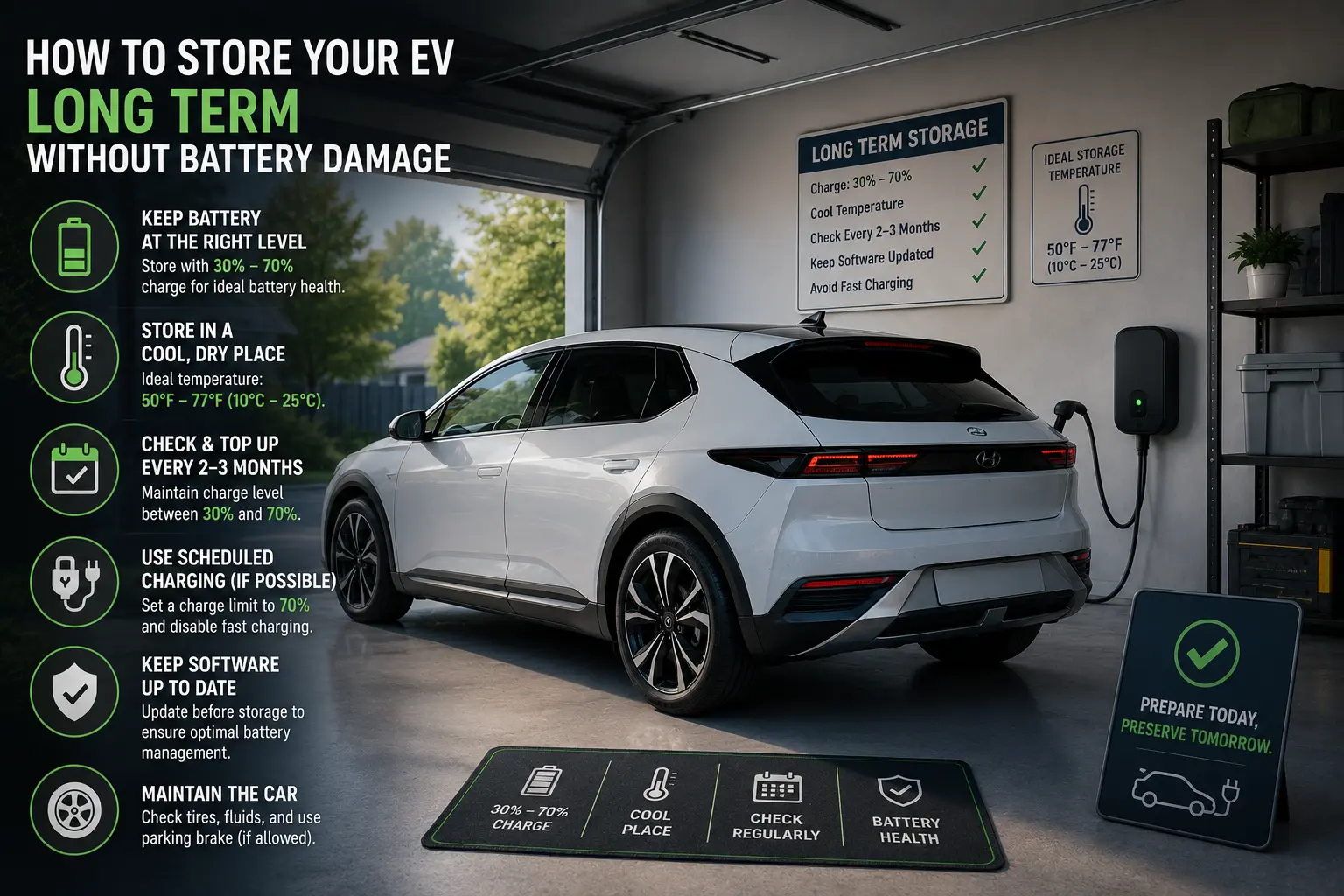
The sweet spot recommended by battery researchers and confirmed by most EV manufacturer manuals is 40% to 60% state of charge for storage of one month or longer.
For shorter periods of 2 to 4 weeks, most EVs will be fine anywhere between 40% and 80%, even parked outdoors, as long as temperatures are not extreme.
For storage of 1 to 3 months, start around 50% to 60%, disable unnecessary background features, and aim for a cool garage or shaded spot.
Inside EVs confirmed that most EV manufacturer manuals suggest maintaining a charge of around 50% for extended storage, with some recommending leaving the vehicle connected to a charger set to a 50% limit if the car supports it.
Should You Keep Your EV Plugged In During Long-Term Storage
This depends on your specific car and how long you are storing it. There is no single right answer for all EVs.
- Plugged in: Best when your EV has a dedicated storage, transport, or long-parking mode that caps the charge level and only wakes systems when needed. Keeping it plugged in lets you set a charge limit so it maintains the right level without dropping or climbing.
- Unplugged: Best when your car is known to have low standby drain and you can start storage at 40% to 60%. The battery will naturally drift downward slowly over time. For storage of up to two to three months starting at the right charge level, this works well for most modern EVs.
Always check your specific model’s owner manual storage section. Manufacturer guidance varies meaningfully between brands. Autovolt Magazine’s guide to manufacturer storage instructions found that some brands recommend recharging every two weeks, while others are comfortable with months of unplugged storage from the right starting charge.
Best Place to Store Your EV to Protect Battery Health
Temperature is the other big factor. Lithium-ion batteries degrade faster in extreme heat or cold. Carnex’s EV storage guide recommends keeping your car in a climate-controlled space with temperatures between 50°F and 70°F (10°C to 21°C) where possible.
If a climate-controlled space is not available:
- A covered garage is significantly better than outdoor parking
- Shaded outdoor parking is better than direct sun exposure
- In hot climates, even a quality car cover reduces heat buildup meaningfully
- In very cold climates, an unheated garage still protects better than open air
The Preflight Airport Parking long-term EV guide notes that if the storage location has access to a charging point, connecting the car at a limited charge level is the most reliable way to maintain battery health over months.
Why Your EV’s 12-Volt Battery Needs Attention During Storage
This is the one most EV owners overlook and it causes real problems.
Your EV has a small 12-volt auxiliary battery separate from the main traction pack. This powers your locks, lights, computers, and infotainment. If it drains completely during storage, you may return to a car that will not turn on or even unlock electronically, even if the main battery is fine.
If the car is not plugged in, the 12-volt battery slowly drains from background systems over time. Capital One Auto Navigator’s storage guide recommends either keeping the car connected to a low-level charger so the 12-volt system stays topped up, or disconnecting the 12-volt battery and placing it on a separate trickle charger indoors.
Most EV owners who have trouble returning to a stored car find it is the 12-volt battery at fault, not the main pack.
EV Storage Checklist: Tyres, Software and Other Battery-Safe Steps
Tires: Inflate to the manufacturer’s recommended pressure or slightly above. Tires lose pressure gradually and flat spots can develop on a car that sits in one spot for months. If storing for more than three months, move the car forward or backward a few feet every 4 to 6 weeks to redistribute weight on the tires.
- Software updates: Run any pending software updates before storing. Some manufacturers push battery management improvements that are worth having installed before a long storage period.
- Clean the car thoroughly: Dirt, bird droppings, and moisture left on the paint and undercarriage for months can cause real damage. A clean car goes into storage in much better condition than a dirty one.
- Check your charge level periodically: Even if you plan to store unplugged, check on the battery level every 3 to 4 weeks. If it has dropped below 20%, plug in briefly to bring it back to the 40% to 50% range.
How Long Are You Storing Your EV? A Battery-Safe Guide by Duration
2 to 4 weeks:
- Charge to 50% to 70%
- Park in shade or covered spot
- Nothing else required for most modern EVs
1 to 3 months:
- Charge to 40% to 60%
- Disable sentry mode, always-on connectivity, and scheduled charging if applicable
- Check charge level every 3 to 4 weeks
- Consider leaving plugged in at a limited charge level if your car supports it
- Check tyre pressure
3 months or more:
- Charge to 50%
- Address the 12-volt battery (trickle charger or disconnect)
- Move the car slightly every 4 to 6 weeks for tyres
- Keep in a cool, shaded, or climate-controlled location
- Check manufacturer storage guidance for your specific model
The Bottom Line on Storing Your EV Without Battery Damage
Storing an EV for weeks or months is not complicated once you understand the two things that actually cause damage: extreme charge levels and extreme temperatures.
Keep the battery at 40% to 60%, park somewhere cool and covered, do not forget the 12-volt battery, and check on the charge level every few weeks for longer storage periods. That is genuinely all most EV owners need to do.
If you want to protect your battery’s health over the long term beyond just storage, our guide on how charging habits affect your EV battery over time covers the daily habits that make the biggest difference.
Frequently Asked Questions About Long-Term EV Battery Storage
Q. What charge level should I store my EV at?
A. 40% to 60% is the recommended range for most lithium-ion EV batteries during long-term storage. This avoids both the high-voltage stress of a full charge and the risk of dropping too low over time.
Q. Can I store my EV outside for months?
A. Yes, though a covered or shaded spot is significantly better than direct sun exposure. Extreme heat accelerates battery degradation. If outdoor storage is unavoidable, a quality car cover helps reduce heat buildup.
Q. Will my EV battery drain to zero if left unplugged?
A. Modern EVs lose only a few percent of charge per month when parked, depending on settings and background systems. Starting at 50% gives you several months of buffer before the charge drops to a concerning level.
Q. Should I leave my EV plugged in during storage?
A. It depends on your model. If your car has a storage or transport mode that caps the charge level, plugged in is ideal. If it does not, unplugged at 40% to 60% is often the better choice to avoid the car topping itself back to 100%. Check your owner’s manual for your specific model’s recommendation.
Q. What happens if I return to a car that will not start after storage?
A. The most likely cause is a depleted 12-volt auxiliary battery, not the main traction pack. This can be jump-started like a regular car battery. If the car still will not respond after jump-starting the 12-volt battery, contact your manufacturer’s service line.

Jamie Carter is an EV enthusiast and independent researcher who has been following electric vehicle technology since 2019. After buying her first EV and spending years digging through manufacturer data, owner forums, and industry reports to answer her own questions, she started sharing what she learned. At EV Battery Central, Jamie writes research-backed guides on battery health, charging habits, and EV ownership & more.