Quick Answer: If your electric car runs out of battery then you need to follow these basic instruction including pull over safely, turn on your hazard lights, and call your manufacturer’s roadside assistance. Do not attempt to tow an EV with its driven wheels on the ground. Most EV makers include roadside assistance free for 3 to 5 years. A flatbed truck is almost always the right recovery method.
Running out of charge in an EV feels scarier than it actually is. You are not stranded forever. You are not doing permanent damage to the car. And you are not the first person this has happened to.
The key is knowing exactly what to do in the right order, because a few common mistakes, like calling the wrong tow truck, can cause real damage that the battery failure itself would not have caused.
Here is Step-by-step Guide During an EV Breakdown:
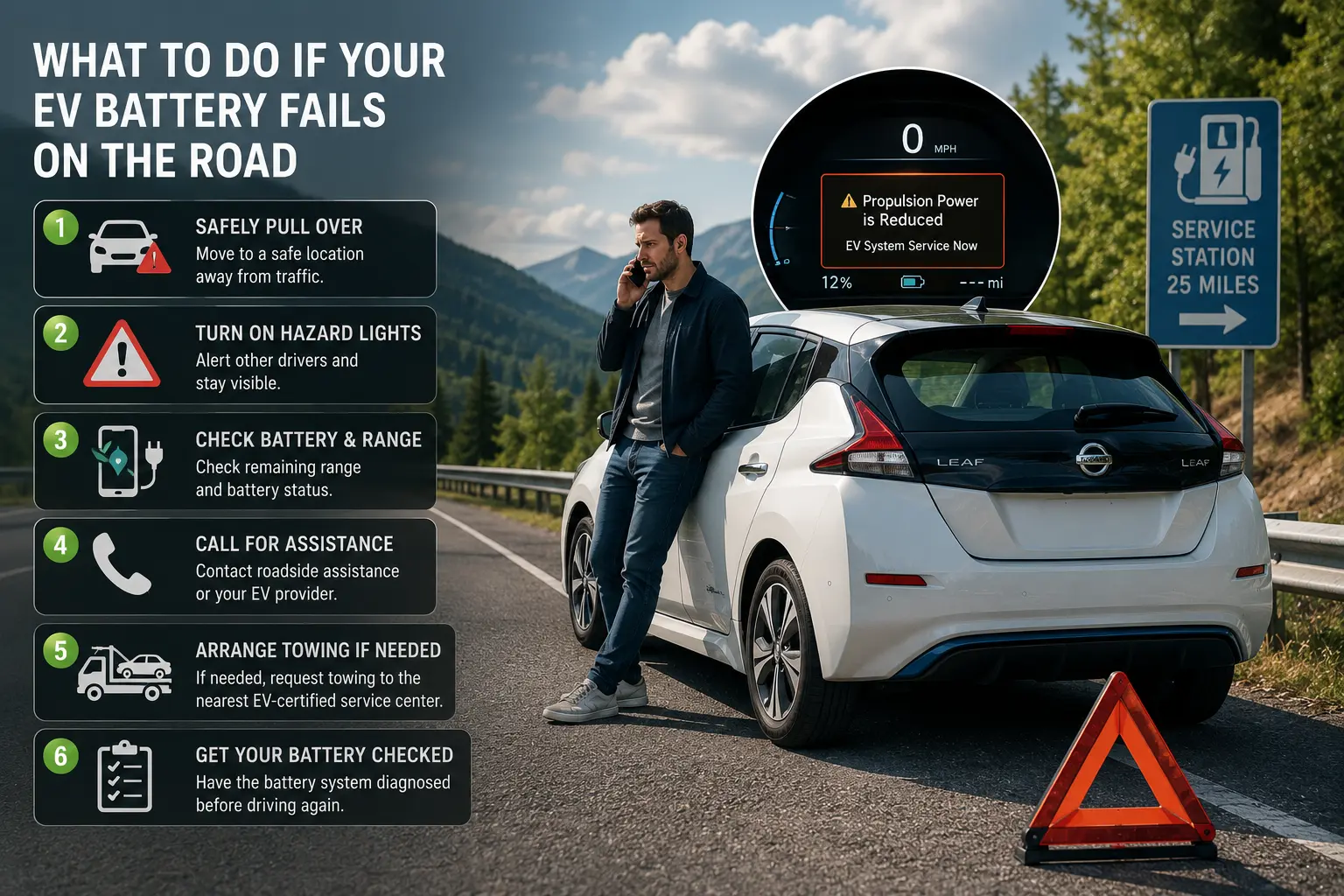
Step 1: Pull Over Safely as Soon as Possible
Modern EVs give you multiple warnings before the battery hits zero. You will see a low battery alert on your dashboard, a range estimate dropping fast, and in many cases an audio warning too. Some EVs enter a low-power mode often called Turtle Mode, which limits speed to around 20 to 30 mph to help you reach safety.
The moment you see these warnings, start looking for a safe place to pull over. A flat spot off the road, a lay-by, or a car park is ideal. Do not wait until the car stops on its own in the middle of traffic.
Once stopped, put the car in park, turn on your hazard lights immediately, and if you have them, place warning triangles or cones behind the vehicle.
Step 2: Know Which Battery Has Actually Failed
This surprises most EV owners that your car has two completely separate batteries.
The large high-voltage traction battery powers the motor and gives you your driving range. The small 12-volt battery, similar to the one in any gas car, powers your lights, locks, infotainment screen, and other.
If your 12-volt battery fails, your car will not start or even unlock electronically, even if your main traction battery is fully charged. This can feel like a total breakdown when it is actually a much simpler fix.
Check your dashboard for messages like ’12V battery low,’ ‘vehicle may not restart,’ or ‘reduced power.’ If your lights, locks, and screen still work, the issue is most likely your main traction battery. If nothing responds at all, the 12-volt battery may be the culprit, and that can be jump-started just like a regular car battery.
Step 3: Call the Right Roadside Assistance
This is the most important step. Do not call a generic tow truck first. Call your manufacturer’s roadside assistance line.
Here is what each major manufacturer covers as of 2026, according to EV Daily’s updated guide:
- Tesla: 4 years or 50,000 miles of roadside assistance included. Can arrange flatbed towing to the nearest Supercharger.
- Ford: 3 years or 36,000 miles with Ford Roadside Assistance. Mobile charging available in select areas.
- GM (Chevrolet, GMC): 5 years or 60,000 miles of roadside assistance included.
If your manufacturer warranty has expired, services like AAA now offer EV-specific roadside assistance in most areas, including mobile charging top-up services that can add enough charge to get you to a nearby station.
Step 4: Do Not Let Them Tow It Wrong
This is the step most people do not know about and it is the one that can turn a minor inconvenience into an expensive repair.
Most EVs must be transported on a flatbed truck with all four wheels off the ground. Flat towing an EV means dragging it with the driven wheels still on the road, that can damage the electric motor and drivetrain even if the car is powered off completely. The spinning wheels can generate electricity and cause the motor to overheat or sustain damage.
When you call for recovery, be specific. Tell them you have an electric vehicle and that it needs a flatbed, not a regular tow. According to common guide on EV emergencies, this is the single most important instruction to give the recovery service.
If the 12-volt system still works, use your owner’s manual to enable the vehicle’s Neutral, Transport, or Tow mode before recovery so the parking brake releases safely.
Step 5: Do Not Touch the High-Voltage Components
If you see smoke, warning lights related to the battery pack, or smell burning, get away from the car and call emergency services immediately. Do not attempt to open any panels, touch orange cables, or investigate high-voltage components yourself. These are for trained technicians only.
In normal range-out situations there is no safety risk at all. But if there is any sign of a physical battery fault rather than just a depleted charge, treat it as an emergency and keep a safe distance.
Step 6: Once Recovered, Charge Before Anything Else
If the car ran down to zero and sat for a period, do not worry about permanent damage in most modern EVs. According to Capital One Auto Navigator’s storage and recovery guide, while allowing charge to drop to 0% is not ideal, it generally will not cause terminal damage in a modern EV.
Plug into a Level 2 charger rather than a fast charger for the first charge after a complete depletion. Give the battery management system time to stabilise before putting it under fast-charge stress.
Check your range and battery health reading after a full charge cycle. If something seems noticeably off compared to your usual readings, get a diagnostic check before your next long trip.
How to Make Sure This Never Happens Again
The good news is that running out of charge is almost entirely avoidable with a few simple habits.
- Use your car’s built-in navigation for long trips: Most modern EVs automatically route you via charging stops when your destination is beyond your current range. Trust it.
- Keep your daily charge above 20%: Running consistently below 20% puts you at risk on any unexpected detour or traffic delay.
- Check range before any unfamiliar journey: Your estimated range on a cold day or at motorway speeds will be lower than the official figure. Plan for 80% of your rated range in real conditions.
- Know where your nearest charger is: Apps like PlugShare, ChargePoint, and your car’s native app show real-time charger availability. A two-minute check before a long drive takes the anxiety out of the whole trip.
The Bottom Line
Running out of charge in EV is an inconvenience, not a disaster. The key steps are simple including pull over early, call your manufacturer’s roadside assistance, and make sure any recovery uses a flatbed with all wheels off the ground.
The one thing that turns a minor incident into an expensive one is the wrong tow method. Get that right and everything else is straightforward. If your battery issues go beyond a simple depletion, our guide on battery issues EV owners report most will help you work out what to check next.
Frequently Asked Questions
Q. Can I jump-start an EV like a gas car?
A. Not for the main traction battery. That is not how it works and attempting it would be dangerous. However if your 12-volt auxiliary battery has died, that can be jump-started the same way as any regular car battery.
Q. Will my EV be damaged if the battery hits zero?
A. In most modern EVs, no permanent damage occurs from a single complete depletion. The battery management system protects the cells even at low charge. However making a habit of running to zero regularly will accelerate degradation over time.
Q. Can I push my EV if it runs out of charge?
A. Generally no. Most EVs will not release the parking brake without power. Even if they do, pushing can be dangerous on a road. The right move is always to call roadside assistance.
Q. How long does it take for roadside assistance to arrive for an EV?
A. This depends on your location and provider. Most manufacturer roadside assistance services aim for 30 to 60 minutes in urban areas. In rural areas it can be longer, which is another reason to plan charging stops ahead of time on long journeys.
Q. Can a mobile charger give me enough range to drive to a station?
A. Yes in many areas. Mobile EV charging vans are becoming more common and can typically add 10 to 20 miles of range in around 20 to 30 minutes, enough to reach the nearest public charger. Availability varies by region and provider.

Jamie Carter is an EV enthusiast and independent researcher who has been following electric vehicle technology since 2019. After buying her first EV and spending years digging through manufacturer data, owner forums, and industry reports to answer her own questions, she started sharing what she learned. At EV Battery Central, Jamie writes research-backed guides on battery health, charging habits, and EV ownership & more.