Quick Answer: The right Tesla charging habit depends entirely on which battery your car has. If you have an LFP battery, charge to 100% regularly. If you have an NMC or NCA battery, keep daily charging at 80% for now, though Tesla’s new nickel cell technology announced in September 2025 will raise that recommendation to 90% for vehicles equipped with the updated cells. Use Superchargers for road trips, not daily charging. Never let the battery sit below 10% or above your set limit for extended periods.
Walk into any Tesla forum or Reddit thread and you will find the same debate running on repeat. Should I charge to 80% or 100%? Does Supercharging really damage my battery? Should I let it drain before charging?
Most of the advice out there is either outdated, wrong for your specific model, or applies to a battery chemistry you do not even have.
This Tesla battery charging guide cuts through all of it. Everything here is specific to Tesla, sourced from Tesla’s own guidance, and updated to reflect what changed in 2025 and 2026.
Step One: Find Out Which Battery Your Tesla Actually Has
Before any charging habit makes sense, you need to know which battery type is in your car. Tesla uses two main chemistries and the right daily charging level is different for each one.
How to check on your Tesla touchscreen:
Go to Controls, then Software, then Additional Vehicle Information. If it shows “High Voltage Battery type: Lithium Iron Phosphate,” you have an LFP battery. If the charging screen shows a sliding scale with a recommended daily limit around 80%, you have a nickel-based NMC or NCA battery.
Which models use which chemistry:
LFP batteries are used in many standard range Model 3 and Model Y variants, particularly those built at Tesla’s Shanghai factory. Most Long Range and Performance variants use nickel-based chemistry, either NMC or NCA. The Cybertruck uses Tesla’s in-house 4680 cells, which are nickel-based. Tesla has stopped selling LFP vehicles in the US due to sourcing and tariff constraints, so most US buyers in 2025 and 2026 have nickel-based cars.
This single piece of information changes every charging decision that follows. Do not skip it.
Tesla Battery Charging Best Practices by Battery Type
If Your Tesla Has an LFP Battery
- Charge to 100% regularly: This is not general advice, it is Tesla’s specific recommendation for LFP cars. LFP chemistry is far more tolerant of high charge levels than nickel-based cells. Charging to 100% regularly helps calibrate the battery management system and keeps your range estimates accurate.Tesla recommends LFP owners charge to 100% at least once a week. For most daily drivers, charging to 100% every night is completely fine.
- Do not regularly drop below 20%: LFP batteries can experience reduced accuracy in their state of charge readings when frequently depleted to very low levels. Keeping above 20% for daily use preserves both battery health and range estimate accuracy.
- Do not worry about Supercharging affecting your LFP battery the same way it affects NMC: LFP chemistry handles fast charging better. That said, using home Level 2 charging as your primary method is still recommended for both cost and convenience reasons.
If Your Tesla Has an NMC or NCA Battery (Most US Models)
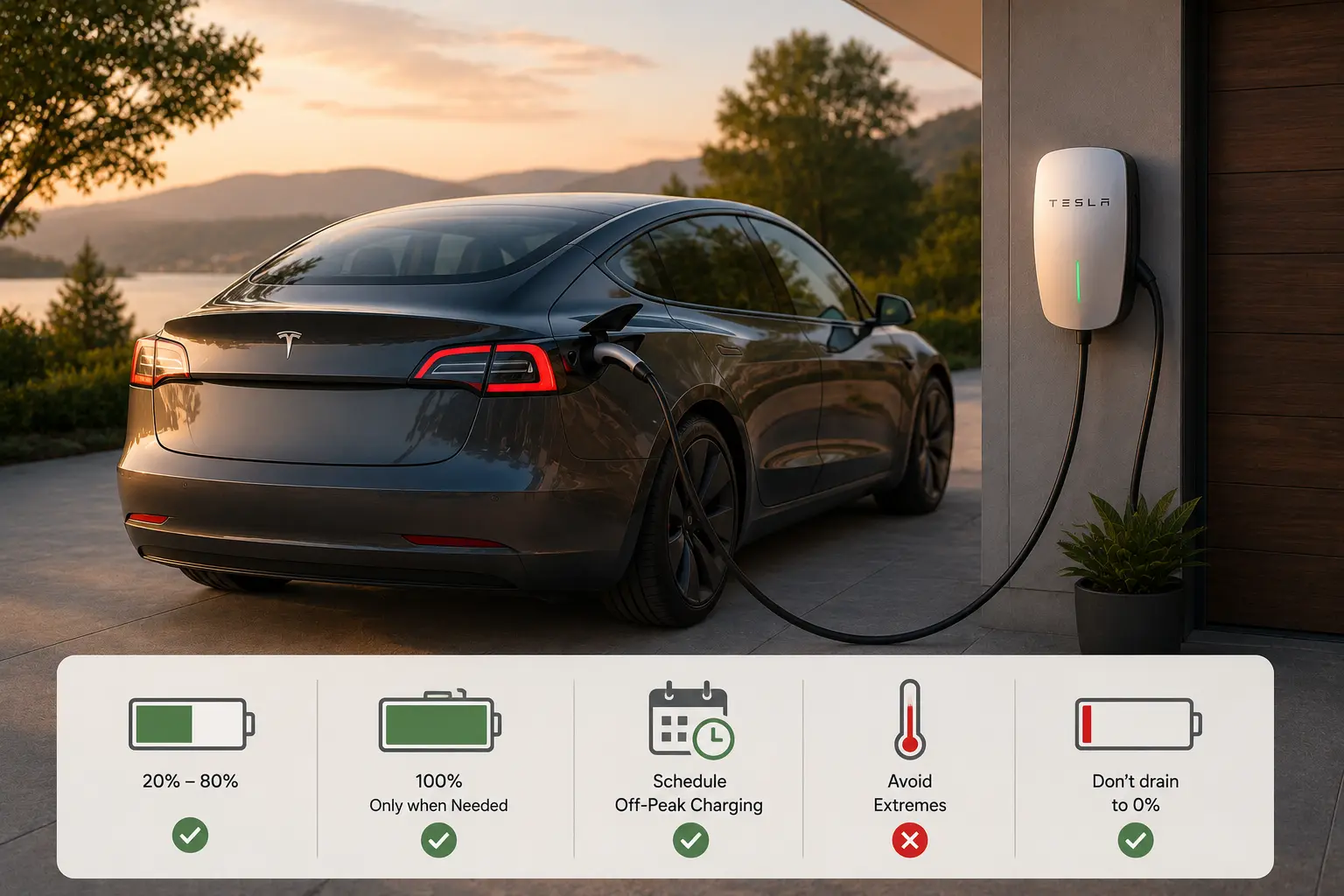
- Set your daily charge limit to 80%: This is Tesla’s current recommendation for nickel-based batteries. Keeping the battery regularly at high voltage accelerates the chemical reactions that reduce long-term capacity.
Setting the charge limit in your Tesla is simple. Go to Charging on the touchscreen and drag the charge limit slider to 80%. The car will stop charging automatically at that level every time. - Save 100% charges for road trips: Charging to 100% the night before a long trip is fine. Just try to drive soon after the car reaches full charge rather than leaving it sitting at 100% for a day or two before you leave.
- Keep the battery above 10% for daily driving: Regularly running the battery down to very low levels adds stress on the cells. For everyday driving, the 20% to 80% window is the sweet spot.
The 2026 Update: Tesla’s New 90% Rule for Future Nickel Batteries
This is the most significant change to Tesla charging guidance in years and most owners do not know about it yet.
In September 2025, Tesla’s VP of Vehicle Engineering, Lars Moravy, announced that the company has developed a new generation of nickel-based battery cells that can be charged to 90% daily without meaningful long-term degradation. Moravy described it as closing the gap to LFP chemistry by half.
The science behind it involves a process called cathode doping. As Not a Tesla App reported, Tesla’s updated cathode material reduces long-term capacity loss from around 20% with older cells to less than 5% with the new doped cathode. That improvement is what makes the 90% daily charge level viable without the degradation trade-off that made 80% the rule for so long.
This matters for two reasons. First, owners of future Teslas with the new cells will get meaningfully more usable daily range without any additional battery wear. Second, it signals that the 80% rule, while still correct for current nickel-based cars, is not a permanent feature of EV ownership but a chemistry constraint that technology is actively solving.
If your Tesla was bought before the new cells roll out, the 80% recommendation still applies. If you are buying a new Tesla in late 2026 or beyond, check whether your model is equipped with the updated cells and follow the guidance Tesla provides for that specific car.
Supercharging Best Practices for Tesla Owners
Supercharging is one of Tesla’s biggest selling points. It is also one of the most misunderstood aspects of Tesla battery care.
The honest rule: Supercharge for road trips. Home charge for daily driving.
Geotab data tracking over 22,700 EVs found that vehicles relying heavily on DC fast charging degraded at around 3.0% per year. Those using mostly home Level 2 charging stayed closer to 1.5% per year. Tesla issued updated guidance in March 2026 explicitly cautioning against using Supercharging as a primary daily charging method.
That does not mean Supercharging is dangerous. It means the frequency matters. Using a Supercharger a few times a month for road trips has minimal long-term impact. Stopping at one every morning on your way to work because it is convenient is where the wear builds up over years.
- Always use Tesla navigation to route to a Supercharger: When you navigate to a Supercharger through your Tesla’s built-in map, the car automatically preconditions the battery to optimal charging temperature before you arrive. This meaningfully speeds up charging and reduces cell stress. Showing up at a Supercharger in cold weather without preconditioning is slower and harder on the battery.
- Stop at 80% when Supercharging on road trips if time allows: Charging speed slows significantly above 80% as the battery management system protects the cells. If you have enough range to reach your next destination or the next charger, stopping at 80% and moving on is faster and gentler on the battery than waiting for a full charge.
- Do not leave the car plugged in at a Supercharger after it has reached your set limit: This is less about battery health and more about courtesy to other Tesla owners, but it also avoids any risk of the car sitting at a high charge level in warm weather.
For a full step-by-step breakdown of how Tesla preconditioning works and when to use it, our guide on how to precondition your EV battery before a fast charge session covers the process in detail.
Tesla Home Charging Best Practices
Home charging is where you will do the vast majority of your charging, and it is where your battery health is most directly in your hands.
- Set a scheduled departure time rather than a scheduled charge time: Tesla’s app lets you set a departure time so the car finishes charging as close to when you leave as possible. This means the battery is not sitting at 80% for eight hours overnight. It finishes at 80% at 7am because you leave at 7:15. The result is less time at high charge and a warmer, more efficient battery when you start driving.
- Charge every night rather than running the battery low and doing large top-ups: Frequent small charges are generally better for long-term cell health than infrequent large charges from low levels. Plugging in nightly keeps the battery in a comfortable mid-range most of the time.
- Use a Level 2 home charger where possible: A standard household outlet adds around 3 to 5 miles of range per hour. A Level 2 home charger adds 25 to 35 miles per hour, which is enough to fully charge most Teslas overnight in 8 to 12 hours. Level 2 charging is also significantly gentler on the battery than DC fast charging. For daily charging, it is the clear best option for both battery health and cost.
- Keep the car plugged in when parked at home, even if it has already reached its charge limit: Modern Tesla vehicles are designed to handle being plugged in. The BMS manages top-up charging intelligently. Leaving the car unplugged at a mid-level charge for days is generally worse than keeping it plugged in at its set limit.
For a full breakdown of how charging habits affect battery degradation over time across all EV brands, our guide on how charging habits affect your EV battery long term has the detailed data.
Tesla Charging Myths Debunked
Here are the most common ones with honest answers:
Myth 1: I should let my Tesla drain to 0% once a month to calibrate the battery
This is carryover advice from old nickel-metal hydride batteries in laptops and phones. Lithium-ion batteries, including Tesla’s, do not benefit from full discharges. Draining to 0% regularly is actually harmful to LFP batteries and stressful for NMC cells. Tesla’s BMS calibrates itself without needing a full discharge. Do not do this.
Myth 2: Supercharging voids my Tesla warranty
False. Using Tesla’s own Supercharger network never voids your warranty. Tesla’s warranty does note that excessive DC fast charging can contribute to degradation, but using Superchargers as designed for road trips is completely within normal use. No warranty has ever been voided simply for using a Supercharger.
Myth 3: Charging to 80% means I am wasting 20% of my battery
Not quite. Think of it more like a recommended operating range. Your battery’s full physical capacity is still there. You are simply keeping it in the range where it experiences the least chemical stress day to day. Occasional 100% charges for road trips use that full capacity when you actually need it.
Myth 4: All Tesla’s should follow the same 80% charging rule
This is perhaps the most widespread myth. As covered above, LFP battery owners should charge to 100% regularly. The 80% rule applies specifically to nickel-based NMC and NCA batteries. Following the wrong rule for your battery type means either unnecessarily limiting your range every day or missing a weekly calibration charge your battery actually needs.
Myth 5: Cold weather permanently damages my Tesla battery
Cold weather reduces your available range temporarily, but it does not cause permanent damage in normal driving. The one scenario to be careful about is fast charging a deeply cold battery without preconditioning. Tesla’s BMS handles this automatically, but helping it along by preconditioning before a Supercharger session in very cold conditions reduces cell stress further. For a full picture of how cold weather affects your Tesla range and what to do about it, our guide on how cold weather affects EV battery performance covers the specifics.
Tesla Charging Best Practices: Quick Reference [Table]
Here is everything in one simple table you can bookmark.
| Situation | LFP Battery | NMC/NCA Battery |
| Daily charge limit | 100% | 80% (90% with new cells) |
| Road trip charge | 100% | 100%, drive soon after |
| Minimum daily level | Stay above 20% | Stay above 10% to 20% |
| Supercharger for daily use | Not recommended | Not recommended |
| Supercharger for road trips | Fine | Fine |
| Plugged in overnight | Yes | Yes |
| Scheduled departure | Recommended | Recommended |
| Cold weather precondition | Yes, before fast charging | Yes, before fast charging |
| Long-term storage | 40% to 60% | 40% to 60% |
The Bottom Line on Tesla Battery Charging Best Practices
Tesla charging is not one-size-fits-all. The single most important thing you can do is find out which battery your car has and follow the right habit for that chemistry.
For LFP owners, that means charging to 100% regularly without guilt. For NMC and NCA owners, it means setting an 80% daily limit today and watching for when Tesla’s new 90% cells roll out for your model. For everyone, it means saving Superchargers for road trips and letting home charging do the daily work.
None of this requires expensive accessories, special habits, or constant monitoring. Just a few simple settings set correctly from day one and your Tesla battery will look after itself for years.
Frequently Asked Questions About Tesla Battery Charging
Q. Should I charge my Tesla to 80% or 100% every day?
A. It depends on your battery type. If your Tesla has an LFP battery, charge to 100% regularly as Tesla recommends. If it has an NMC or NCA battery, set your daily limit to 80%. Check Controls, Software, Additional Vehicle Information on your touchscreen to find out which chemistry you have.
Q. What is the new Tesla 90% charging rule?
A. In September 2025, Tesla’s VP of Vehicle Engineering Lars Moravy announced that Tesla’s next generation of nickel-based battery cells will support a 90% daily charge limit without significant degradation, up from the current 80% recommendation. This applies to future vehicles equipped with the new cells, not to existing nickel-based Teslas. Check Tesla’s guidance for your specific model year.
Q. Does Supercharging really damage my Tesla battery?
A. Occasional Supercharging for road trips does not cause meaningful long-term damage. Using Superchargers as your primary daily charging method over years does accelerate degradation compared to home charging. Tesla itself updated its guidance in March 2026 to explicitly caution against regular Supercharging as a daily habit. Reserve Superchargers for trips, use home charging for daily needs.
Q. Is it bad to leave my Tesla plugged in all the time?
A. No. Tesla’s battery management system handles charging intelligently. Leaving the car plugged in at its set charge limit is generally better than unplugging at a mid-level charge and letting it sit for days. The car only tops up when needed.
Q. How do I find out which battery my Tesla has?
A. Go to Controls, then Software, then Additional Vehicle Information on your Tesla touchscreen. If it shows Lithium Iron Phosphate, you have an LFP battery. If it shows a charging screen with an 80% recommended daily limit, you have a nickel-based pack.
Q. What charge level should I store my Tesla at if not driving for weeks?
A. For storage of a few weeks to a few months, aim for 40% to 60% state of charge. This avoids both the voltage stress of a full charge and the risk of the battery drifting too low through natural self-discharge. If possible, keep the car plugged in at a limited charge level rather than leaving it unplugged.
Q. Can I charge my Tesla in cold weather?
A. Yes. Use your Tesla app to precondition the car before a Supercharger session in cold weather. This warms the battery to optimal charging temperature before you arrive, which speeds up charging and reduces cell stress. Home Level 2 charging in cold weather is fine without any extra steps.

Jamie Carter is an EV enthusiast and independent researcher who has been following electric vehicle technology since 2019. After buying her first EV and spending years digging through manufacturer data, owner forums, and industry reports to answer her own questions, she started sharing what she learned. At EV Battery Central, Jamie writes research-backed guides on battery health, charging habits, and EV ownership & more.