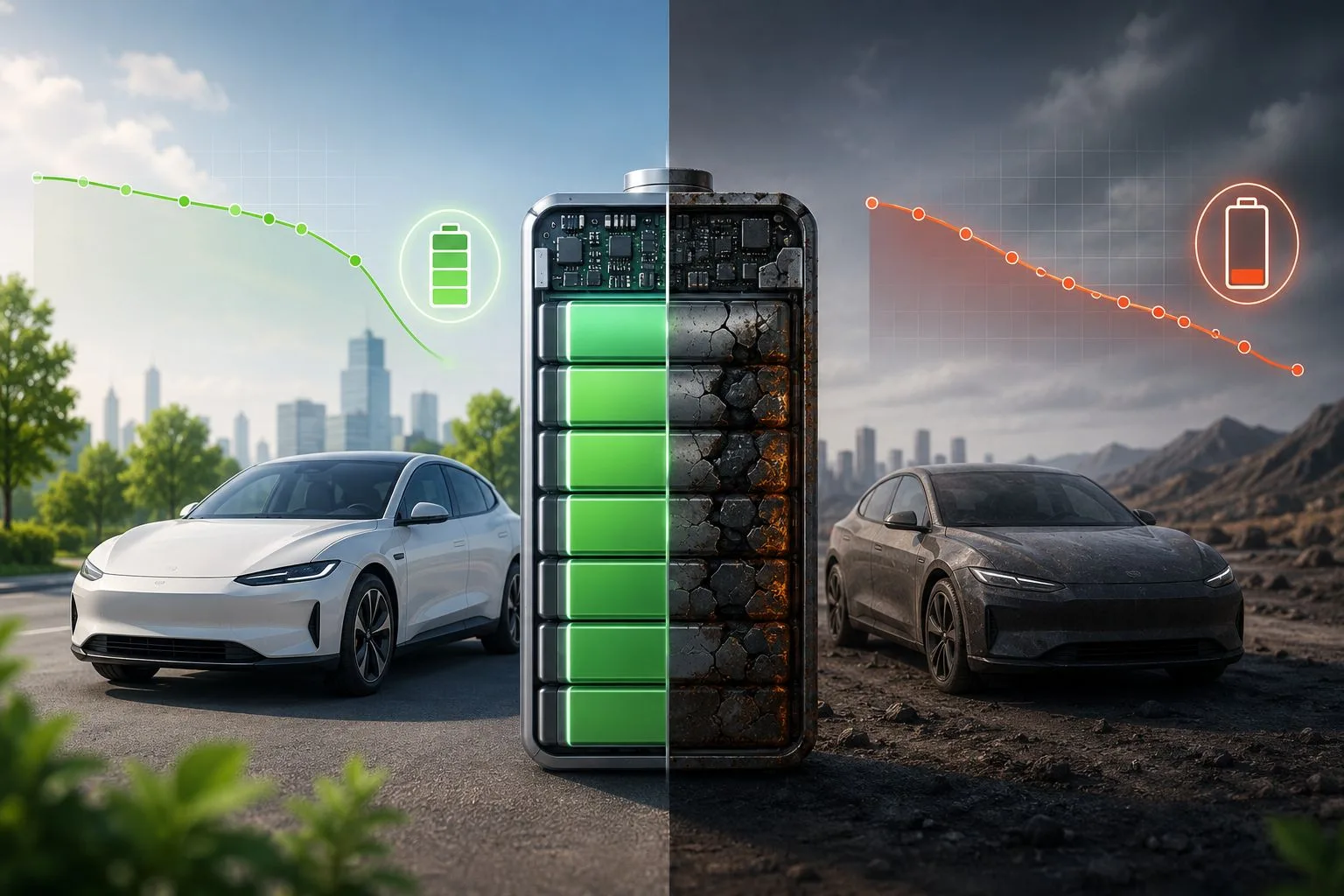
Quick Answer: Most EV batteries lose about 2% to 2.5% of their capacity each year. After 8 years, the average EV battery still holds around 81% of its original capacity. A little range loss over time is completely normal. A sudden sharp drop is not.
If your range feels a little lower than when you first got your EV, take a breath. This happens to almost every EV owner. It is normal, and the real-world data backs that up. The question is not is my battery losing range? It is how much loss is too much. This guide uses verified 2026 data to answer that clearly, so you know exactly where you stand.
What Real 2026 EV Battery Degradation Data Actually Shows
A large study by Geotab tracked over 22,700 real EVs on the road. The average battery degradation rate came out to just 2.3% per year.
Let’s put that in simple terms. At that rate, your battery still holds around 81.6% of its original capacity after 8 years. That is well above the 70% minimum that federal law requires manufacturers to guarantee.
A separate UK study tested over 8,000 used EVs across 36 different brands. The average battery health across the whole group came out to 95.15%. Even cars between 4 and 5 years old still showed a median battery health of 93.53%.
In plain words, most EV batteries are aging much slower than people expect.
A Simple Real-World Example
Say your EV has a 75 kWh battery and 300 miles of range when new.
Losing 2.3% capacity per year, after 8 years it still holds about 81% of its original capacity. That works out to roughly 243 miles of range on a full charge. Still more than enough for daily use, work trips, and most weekend drives.
Your numbers will vary depending on your car, your climate, and your charging habits. But this gives you a realistic picture instead of a worst-case guess.
What Counts as Normal EV Battery Degradation Year by Year
Most real-world studies and manufacturer data point to a similar pattern:
- Year 1: 1% to 3% capacity loss. A slightly faster initial drop is common and not a red flag.
- Years 2 to 5: Around 1% to 2% loss per year.
- By year 5: Total degradation of around 10% to 12% is healthy.
- By year 8: 15% to 19% total loss is still within normal range for most EVs.
Federal law requires automakers to warrant EV batteries for at least 8 years or 100,000 miles. California goes further, requiring batteries to retain at least 70% of their range for 10 years or 150,000 miles starting with 2026 models. If your degradation roughly matches the year-by-year numbers above, you are completely fine.
What Actually Speeds Up EV Battery Degradation
Not every EV owner sees the same wear rate. A few habits make a big difference. Frequent fast charging. This is the single biggest factor. EVs that relied heavily on fast charging above 100 kW showed degradation rates up to 3.0% per year. EVs that mostly used home charging stayed closer to 1.5% per year. Same car, double the wear, just from different charging habits.
Want to build better charging habits from the start? Our guide on EV battery charging best practices covers this in detail.
Hot weather: EVs in hot climates degrade about 0.4% faster per year compared to those in milder regions. Not dramatic on its own, but it adds up steadily over years.
Sitting at very high or very low charge levels: Degradation speeds up most when a car regularly sits above 90% or below 10%. Daily habits matter far more than occasional use.
The good news is that all three of these are within your control.
Simple Habits That Slow Down Battery Degradation
You do not need special tools or extra spending. A few small adjustments go a long way.
- Charge to around 80% for daily use. Save 100% charges for longer trips.
- Use DC fast chargers when you need them, but avoid relying on them daily.
- Park in shade or a garage when possible, especially during hot months.
- Avoid leaving the car sitting near empty for extended periods.
- If you’re parking for a few weeks, aim to leave the battery around 50%.
One habit many owners overlook is battery preconditioning. It warms or cools your battery before charging, which meaningfully improves efficiency and reduces wear over time. Here is how to do it: how to precondition your EV battery.
Warning Signs That Go Beyond Normal EV Battery Degradation
Gradual range loss over years is expected. Here is what is not normal and worth getting checked right away.
- A sudden sharp drop in range over days or weeks, not a slow multi-year fade
- Battery warning messages or error codes on your dashboard
- Charging speed that feels noticeably slower than when the car was new
- Range estimates that jump around wildly between similar drives
These are not signs of normal aging. If you spot any of them, check out our guide on common EV battery problems and what causes them before heading to a service center.
How EV Battery Degradation Affects Your Resale Value
Battery health does not just affect your daily range. It directly affects what your car is worth when you sell.
Recent analysis of used EV sales found that each 1% drop in battery health pulls resale value down by roughly 1.2% to 1.6% for most mainstream EVs, and up to 2% for premium long-range models.
Keeping your battery healthy is not just about today’s range. It is protecting real money down the road.
The Bottom Line on EV Battery Degradation
A little range loss over the years is simply part of owning an EV. It does not mean something is wrong. With real 2026 data showing most batteries holding 80% or more capacity even after 8 years, the picture is honestly more reassuring than most people expect.
A few simple habits keep you on the better end of that range. And if you ever notice a sudden change rather than a slow fade, that is your signal to get it checked, not to worry about normal aging.
Frequently Asked Questions About EV Battery Degradation
Q. Is 2% to 3% battery degradation per year normal?
A. Yes. Real-world data from over 22,000 EVs tracked by Geotab shows the average is 2.3% per year. Most manufacturers consider this well within healthy range.
Q. How much battery capacity will my EV have after 10 years?
A. Based on current data, most EVs retain somewhere between 75% and 88% of their original capacity after 8 to 10 years of normal use.
Q. Does fast charging really damage my EV battery?
A. Frequent fast charging roughly doubles the degradation rate compared to regular home charging. Using it occasionally for road trips is fine. Using it as your daily charger is where the wear adds up.
Q. Will my warranty cover battery degradation?
A. Normal gradual degradation is not covered by warranty. What is covered is if your battery drops below the manufacturer’s stated capacity threshold, usually 70%, before the warranty period ends.
Q. How do I check my EV battery’s health?
A. Most EVs show a battery health or state-of-health reading in the infotainment menu or companion app. You can also compare your current max range against the original EPA-rated range to get a rough percentage.

Jamie Carter is an EV enthusiast and independent researcher who has been following electric vehicle technology since 2019. After buying her first EV and spending years digging through manufacturer data, owner forums, and industry reports to answer her own questions, she started sharing what she learned. At EV Battery Central, Jamie writes research-backed guides on battery health, charging habits, and EV ownership & more.