With the rise in popularity of electric vehicles, manufacturers are racing to increase EV production without compromising quality. According to Gartner, around 85 million EVs are expected to be on the road globally by the end of 2025, including passenger and commercial EVs. This increase in EVs affects EV battery production as it is the heart of any electric vehicle.
Table of Contents
ToggleWhat Are Electric Car Batteries Made Of?
Want a quick, visual breakdown of how are electric car batteries made? Watch this 2-minute quick video to see the entire EV battery manufacturing process. For a more detailed explanation, continue reading below!
Electric car batteries are made of various materials including critical battery metals such as lithium, nickel, cobalt, and manganese, which need to be carefully handled and integrated. In simpler terms, EV batteries store chemical energy and convert it into electricity, which then powers the motor to move the vehicle.
Key Components of Electric Vehicle Batteries
Electric car batteries are made up of several individual cells. These cells can be cylindrical, prismatic or pouch-type, depending on the vehicle’s design, power requirement and range.
Before understanding the electric vehicle battery manufacturing process, it is important to learn the battery composition, as it will give you a better grasp of how EVs work.
The key components of the EV battery are:
- Anode– This is the negative electrode, typically made of graphite, which stores lithium ions during charging.
- Cathode– This acts as the positive electrode and is composed of Manganese, Nickel, Cobalt and lithium.
- Separator– A micro permeable membrane separator is required to prevent any physical contact between the anode and cathode and to ensure proper ionic reactions between the anode and cathode.
- Electrolyte– A lithium-based solution which enables the movement of ions between the anode and cathode during charging and discharging.
- Cell Casings– Typically made of nickel-plated steels to avoid electrolytic reactions, is the enclosure for the cell.
How EV Batteries Are Made: Step-by-Step Process
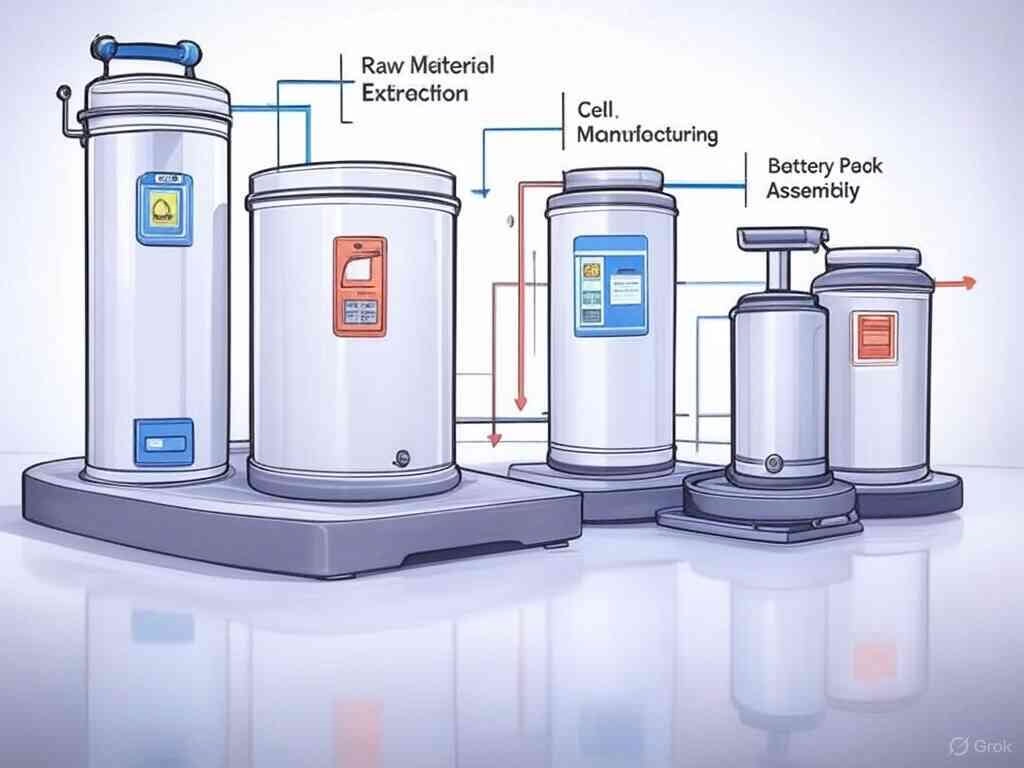
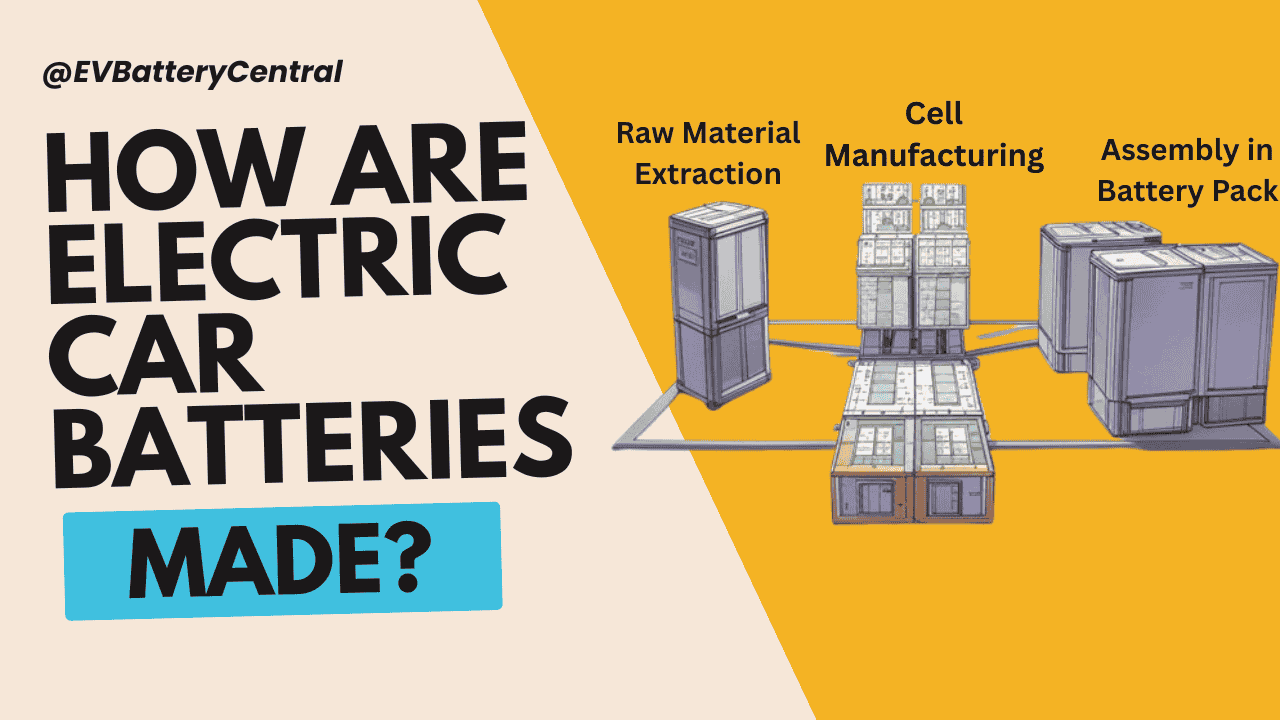
Electric vehicle batteries build on the same lithium-ion technology as smartphone batteries but are engineered for greater energy capacity and range. Now, let’s understand how are batteries made for electric cars, this is a long process that involves Extraction, Processing and Construction.
- Extraction– Materials like lithium, nickel and cobalt are mined using various methods depending on the geographical location of the resources. These resources are found worldwide but are primarily mined in Australia (lithium), Africa (cobalt), and Latin America (lithium brine reserves).
- Processing– The extracted materials are then processed in plants and refineries, converting them to anodes and cathodes. These act as positive and negative charges of the cell facilitating the chemical reaction
- Construction– The batteries are composed of modules, the modules consisting of cells, after processing are sent for construction, where the battery pack is assembled by packing multiple cells together. This is a highly critical stage and acts as the final quality-control checkpoint, where defects such as leaks or faulty cells are identified, and hence this field is integrating automation and robotic technology to avoid human error.
The finished battery packs are then sent to the electric vehicle manufacturer, who in turn install them in their cars. The size of the battery depends on the type of the vehicle and power required for the drive.
Challenges in EV Battery Manufacturing
EV battery manufacturing comes with its fair share of complications, which need to be solved as the future demands a rise in production. Lets look at the key challenges that are to be tackled:
- Safe processing practices– electric car batteries are made up of cells, which need to be maintained in an optimum temperature range, any drastic fluctuations can increase the risk of thermal runaway or fire. To help the integrity of the battery packs, sometimes lateral braces are used, and the spot welding done for the same can cause splatter or overheating which will affect the sensitive cells.
- Operator safety– These are highly flammable and toxic materials, which could combust and start fires if not handled properly. Hence ensuring operator safety is one of the main challenges of the EV battery manufacturing process.
- Ethical sourcing– The Democratic Republic of Congo is one of the leading suppliers of cobalt required for EV batteries. However, studies show that there are unethical practices including child labor and subhuman working conditions. Mining natural resources also poses other threats such as pollution and contamination of groundwater sources.
- Quality checks– Quality is of utmost importance in this industry, as the integral component for an electric vehicle, any faulty battery could lead to dangerous situations and expensive recall procedures. Hence the quality check is a long and exhausting procedure which requires a lot of manpower.
- Cost– With all the extra precautions and standards, EV battery manufacturing is a costly affair. With the increase in the market players are calling for cheaper versions of the vehicle without compromising the quality. This is pushing the developers to innovate and optimize the current facilities to reduce the number of rejections and wastage.
Although the challenges are daunting, it is not impossible to find solutions for this. With the advancements in technology and automotive giants investing billions in alternative solutions, these challenges will soon be a thing of the past.
Future Trends in EV Battery Manufacturing
According to the International Energy Agency (IEA), electric vehicles are projected to exceed 40% of global car sales by 2030, supported by improving affordability and expanding adoption across global markets.
- Range– Companies are looking towards increasing the range while reducing the battery size, lightweight batteries are currently under development.
- Charging capacity– With the upcoming modifications, EV manufacturers are aiming at increasing the charging capacity while reducing the damage to the battery caused by DC fast charging.
- Solid state batteries– The environmental concern regarding the sourcing of the natural resources required for the Lithium-ion battery is creating waves in the industry, and solid-state batteries are a next-generation technology under development offering higher energy density, improved safety, and faster charging compared to conventional lithium-ion batteries..
Must read on Solid State Battery vs Lithium-Ion to learn the difference.
Conclusion
The EV battery manufacturing process is one of the most quality-driven processes out there due to the nature of the application. The batteries are made with longevity and durability in mind and hence held to the highest standard. Used EV batteries can be recycled, allowing valuable materials such as lithium, nickel, and cobalt to be recovered and reused in new batteries or other industries.
With the surge in demand, the facilities and manufacturers are adopting sustainable practices with long-term guarantees ensuring a golden future for the EV industry.

Jamie Carter is an EV enthusiast and independent researcher who has been following electric vehicle technology since 2019. After buying her first EV and spending years digging through manufacturer data, owner forums, and industry reports to answer her own questions, she started sharing what she learned. At EV Battery Central, Jamie writes research-backed guides on battery health, charging habits, and EV ownership & more.